



[Leu31,Pro34]-Neuropeptide Y (human,rat,mouse)
Based on 2 publication(s) in Google Scholar
[Leu31,Pro34]-Neuropeptide Y(human,rat) is a specific neuropeptide Y Y1 receptor agonist. [Leu31,Pro34]-Neuropeptide Y(human,rat) slao activates Y4, Y5. [Leu31,Pro34]-Neuropeptide Y(human,rat) can increase blood pressure in anesthetized rats and increases food intake.
For research use only. We do not sell to patients.
- CAS No.: 132699-73-1
- Formula: C189H284N54O56S
- Molecular Weight:4240.73
-
Storage:
Please store the product under the recommended conditions in the Certificate of Analysis.
![[Leu31,Pro34]-Neuropeptide Y (human,rat,mouse) Chemical Structure](https://file.medchemexpress.com/product_pic/hy-p1323.gif "Click to View [Leu31,Pro34]-Neuropeptide Y (human,rat,mouse) Chemical Structure")

To place orders, for customer services and technical support, please contact: MedChemExpress USA
Tel: 609-228-6898 E-mail: [email protected] [email protected]


-
 Biological Activity
-
Chemical Information
-
Solvent & Solubility
- Purity & Documentation
- References
-
 Help & FAQs


-

HY-P0198
Neuropeptide Y (human,rat,mouse) -

HY-P0086
Corticotropin-releasing factor (human) -
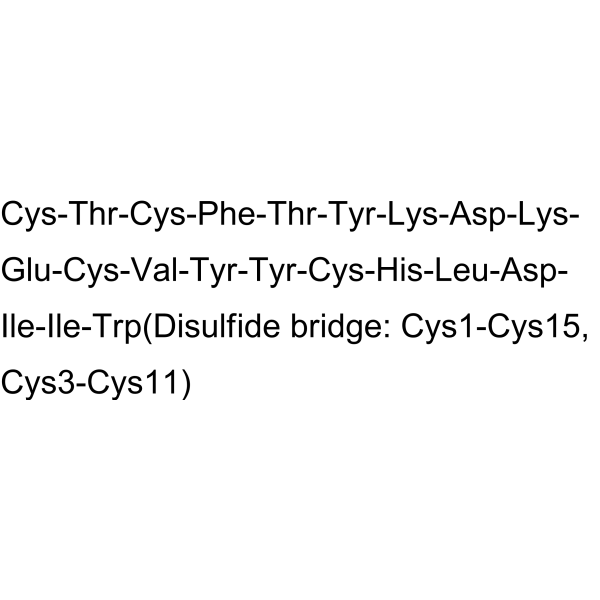
HY-P0204
Endothelin-3, human, mouse, rabbit, rat -
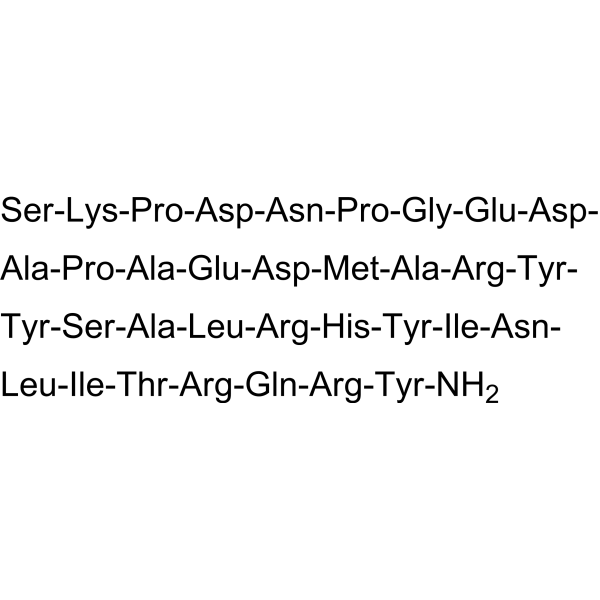
HY-P2543
Neuropeptide Y (3-36) (human, rat) -
![[cPP1-7,NPY19-23,Ala31,Aib32,Gln34]-hPancreatic Polypeptide](https://file.medchemexpress.com/product_pic/hy-p1324.gif)
HY-P1324
[cPP1-7,NPY19-23,Ala31,Aib32,Gln34]-hPancreatic Polypeptide -
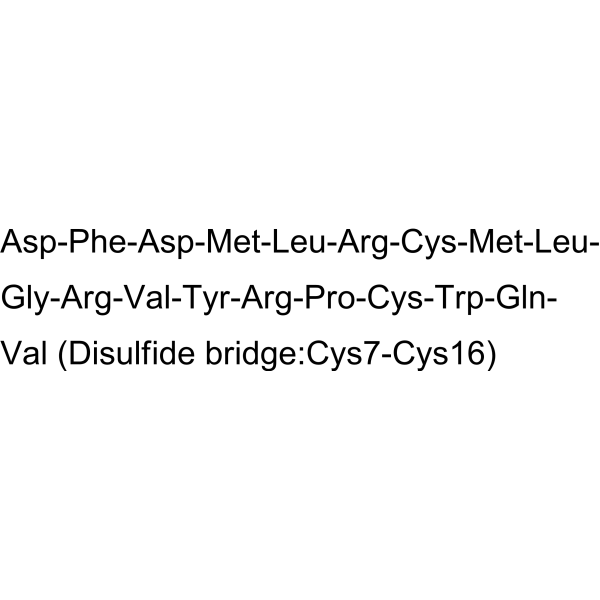
HY-P1205
MCH(human, mouse, rat) -
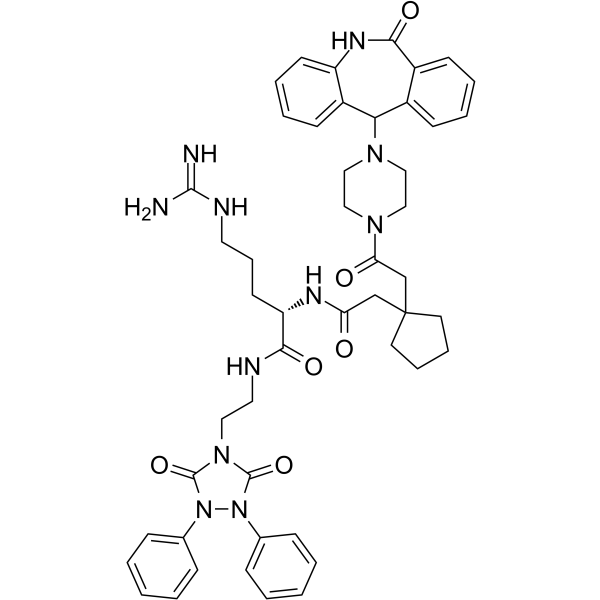
HY-101986
BIIE-0246 -
HY-107725
BIBO3304 -
![[Leu31,Pro34]-Neuropeptide Y (porcine)](https://file.medchemexpress.com/product_pic/hy-p0208.gif)
HY-P0208
[Leu31,Pro34]-Neuropeptide Y (porcine) -

HY-P1514
Peptide YY (PYY), human -
HY-107726
BIBP3226 TFA -

HY-P0199
Pancreatic Polypeptide, human
Publications Citing Use of MedChemExpress (MCE) [Leu31,Pro34]-Neuropeptide Y (human,rat,mouse)
MoreAll Neuropeptide Y Receptor Isoforms
More

Biological Activity
Description
|
NPY Y1 receptor |
NPY Y4 receptor |
NPY Y5 receptor |
In Vitro
[Leu31,Pro34]-Neuropeptide Y(human,rat) has Ki values of 0.39 nM, 0.499 nM, 0.31 nM for Y1, Y4, Y5 in HEK cell lines. [Leu31,Pro34]-Neuropeptide Y(human,rat) has a Ki of >1000 for Y2 in HEK cell lines[2].
MedChemExpress (MCE) has not independently confirmed the accuracy of these methods. They are for reference only.
In Vivo
MedChemExpress (MCE) has not independently confirmed the accuracy of these methods. They are for reference only.


Chemical Information
-
CAS No. 132699-73-1
-
Molecular Weight 4240.73
-
Formula C189H284N54O56S
-
Sequence
Tyr-Pro-Ser-Lys-Pro-Asp-Asn-Pro-Gly-Glu-Asp-Ala-Pro-Ala-Glu-Asp-Met-Ala-Arg-Tyr-Tyr-Ser-Ala-Leu-Arg-His-Tyr-Ile-Asn-Leu-Leu-Thr-Arg-Pro-Arg-Tyr-NH2
-
Sequence Shortening
YPSKPDNPGEDAPAEDMARYYSALRHYINLLTRPRY-NH2
-
Shipping
Room temperature in continental US; may vary elsewhere.
-
Storage
Please store the product under the recommended conditions in the Certificate of Analysis.


Publications (2)
-
Journal Impact Factor
-
Most Recent
-
Nat Commun
Neuropeptide Y neurons mediate opioid-induced itch by disinhibiting GRP-GRPR microcircuits in the spinal cord. [Abstract]2025 Aug 1;16(1):7074. PMID: 40750771 -
J Headache Pain
Neuropeptide Y in the medial habenula alleviates migraine-like behaviors through the Y1 receptor. [Abstract]2023 May 25;24(1):61. PMID: 37231359


Solvent & Solubility
In Vitro
H2O
Peptide Solubility and Storage Guidelines:
1. Calculate the length of the peptide.
2. Calculate the overall charge of the entire peptide according to the following table:
| Contents | Assign value | |
|---|---|---|
| Acidic amino acid | Asp (D), Glu (E), and the C-terminal -COOH. | -1 |
| Basic amino acid | Arg (R), Lys (K), His (H), and the N-terminal -NH2 | +1 |
| Neutral amino acid | Gly (G), Ala (A), Leu (L), Ile (I), Val (V), Cys (C), Met (M), Thr (T), Ser (S), Phe (F), Tyr (Y), Trp (W), Pro (P), Asn (N), Gln (Q) | 0 |
3. Recommended solution:
| Overall charge of peptide | Details |
|---|---|
| Negative (<0) |
1. Try to dissolve the peptide in water first. 2. If water fails, add NH4OH (<50 μL). 3. If the peptide still does not dissolve, add DMSO (50-100 μL) to solubilize the peptide. |
| Positive (>0) |
1. Try to dissolve the peptide in water first. 2. If water fails, try dissolving the peptide in a 10%-30% acetic acid solution. 3. If the peptide still does not dissolve, try dissolving the peptide in a small amount of DMSO. |
| Zero (=0) |
1. Try to dissolve the peptide in organic solvent (acetonitrile, methanol, etc.) first. 2. For very hydrophobic peptides, try dissolving the peptide in a small amount of DMSO, and then dilute the solution with water to the desired concentration. |


Purity & Documentation
References
[1]. J Fuhlendorff, et al. [Leu31, Pro34]neuropeptide Y: a specific Y1 receptor agonist. Proc Natl Acad Sci U S A. 1990 Jan;87(1):182-6. [Content Brief]
[2]. K McCrea, et al. 2-36[K4,RYYSA(19-23)]PP a novel Y5-receptor preferring ligand with strong stimulatory effect on food intake. Regul Pept. 2000 Feb 8;87(1-3):47-58. [Content Brief]
[3]. A Kask, et al. Evidence for involvement of neuropeptide Y receptors in the regulation of food intake: studies with Y1-selective antagonist BIBP3226. Br J Pharmacol. 1998 Aug;124(7):1507-15. [Content Brief]

Calculators
Concentration (start) × Volume (start) = Concentration (final) × Volume (final)


[Leu31,Pro34]-Neuropeptide Y (human,rat,mouse) Related Classifications
HY-P1323 Related Classifications
 Powered by Bioz