



Magnesium hydroxide, 99%(KT)

Based on 1 Customer Validation
Magnesium hydroxide (Magnesium dihydroxide), 99%(KT) is an orally effective antacid. Magnesium hydroxide, 99%(KT) can form a local strongly alkaline microenvironment, reduce ATP production by consuming H+, and hydrolyze cellular phospholipids to disrupt the cellular integrity of microorganisms, thus exhibiting antibacterial activity. Magnesium hydroxide, 99%(KT) downregulates the generation of inflammatory macrophages to alleviate inflammatory responses. Magnesium hydroxide, 99%(KT) can be used in research related to acid peptic diseases and chronic wound infections.
For research use only. We do not sell to patients.
- CAS No.: 1309-42-8
- Formula: Mg(OH)2
- Molecular Weight:58.32
-
Storage:
Store at room temperature 3 years.
In solvent -80°C, 2 years , -20°C, 1 year


To place orders, for customer services and technical support, please contact: MedChemExpress USA
Tel: 609-228-6898 E-mail: [email protected] [email protected]


-
 Biological Activity
-
Chemical Information
- Protocols
- Purity & Documentation
- References
-
 Help & FAQs


-
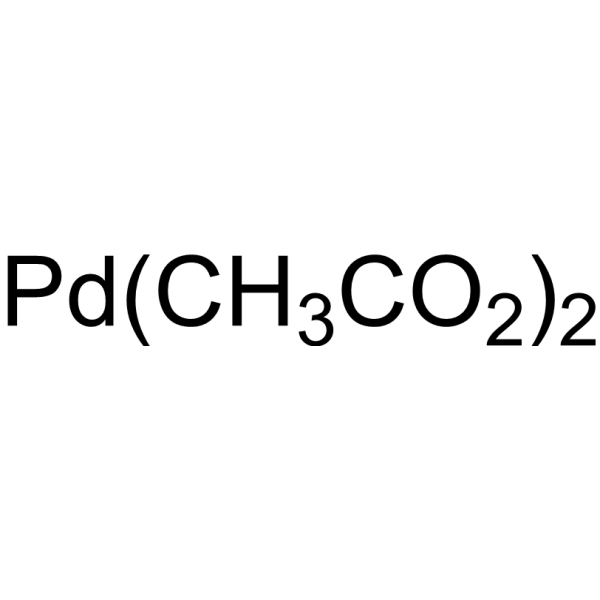
HY-W002072
Palladium (II) acetateCatalyst -

HY-B0658A
Zinc acetate dihydrate, ACS, 98%Biochemical Assay Reagents -

HY-W243408C
Calcium carbonate, 99%Calcium Carbonate Salt -

HY-Y0286
Ammonium carbonate, 99%Buffer -

HY-Y0286A
Diammonium carbonate, 99.999% trace metals basisBuffer Reagents -

HY-W111403
Calcium oxideHeterogeneous Base Catalyst -

HY-W243408D
Calcium carbonate, for cell cultureAcidity Regulator -

HY-B2217D
Calcium hydroxide, ACS, 95%Bactericidal Drug -

HY-W093399
Ammonium bicarbonate,AR,99%Biochemical Assay Reagent -

HY-Y0756
Sodium bicarbonateInorganic Salt


Biological Activity
Description
In Vitro
Magnesium hydroxide, 99%(KT) is used to synthesize a unique fluorescent magnesium hydroxide nanosheet, which is integrated into electrospun fibers to prepare a multifunctional antibacterial wound dressing[1].
Magnesium hydroxide, 99%(KT), a common component of antacids, unexpectedly increases the risk of gastric mucosal injury when used in combination with non-steroidal anti-inflammatory agents[2].
MedChemExpress (MCE) has not independently confirmed the accuracy of these methods. They are for reference only. Further protocols information, click here.


Chemical Information
-
CAS No. 1309-42-8
-
Appearance Solid
-
Molecular Weight 58.32
-
Formula Mg(OH)2
-
Color White to off-white
-
SMILES
O[Mg]O
-
Synonyms
Magnesium dihydroxide, 99%(KT)
-
Shipping
Room temperature in continental US; may vary elsewhere.
-
Storage
Store at room temperature 3 years
In solvent -80°C 2 years -20°C 1 year

Protocols
-
Research Protocol for Infectious Diseases
Infectious-disease experiments test how pathogens interact with host barriers, innate immune receptors, inflammatory signaling, pathogen replication, and tissue injury; pattern-recognition receptors such as TLRs, RIG-I-like receptors, NOD-like receptors, and inflammasomes detect microbial molecules and activate NF-κB, interferon, and cytokine responses. The central hypothesis is that infection severity reflects the balance between pathogen burden and host response: protective inflammation restricts pathogen growth, whereas excessive or mislocalized inflammation contributes to tissue damage and disease phenotype. Unresolved questions include which host pathways are protective versus pathogenic, why some infection models fail to translate to human disease, and which combined readouts best predict clinically relevant infection outcomes.
-
Bacterial live/dead nucleic-acid viability staining
The LIVE/DEAD bacterial viability staining method is based on differential permeability of nucleic-acid-binding fluorescent dyes, most commonly SYTO 9 and propidium iodide (PI), which enables discrimination of bacterial populations with intact versus compromised cytoplasmic membranes. SYTO 9 penetrates both intact and damaged bacterial membranes and binds nucleic acids to produce green fluorescence, whereas propidium iodide penetrates only cells with compromised membranes and fluoresces red while also reducing SYTO 9 signal through competitive binding and fluorescence interactions. The resulting fluorescence pattern is interpreted as a proxy for membrane integrity, which is widely used as an indicator of bacterial viability in microscopy, flow cytometry, and spectroscopic platforms. However, mechanistic studies show that SYTO 9 and PI interactions involve displacement and fluorescence resonance energy transfer effects, which can influence signal interpretation depending on dye ratios a


Purity & Documentation
-
Data Sheet (270 KB)
-
SDS (251 KB)
- English - EN (251 KB)
- Français - FR (251 KB)
- Deutsch - DE (251 KB)
- Norwegian - NO (251 KB)
- Español - ES (251 KB)
- Swedish - SV (251 KB)
- Italian - IT (251 KB)
- Korean - KR (251 KB)
- Portuguese - PT (251 KB)
-
Handling Instructions (2659 KB)
References
[1]. Truskewycz A, et al. Fluorescent Magnesium Hydroxide Nanosheet Bandages with Tailored Properties for Biocompatible Antimicrobial Wound Dressings and pH Monitoring. ACS Appl Mater Interfaces. 2021;13(24):27904-27919. [Content Brief]
[2]. Mäenpää J, et al. Magnesium hydroxide in ibuprofen tablet reduces the gastric mucosal tolerability of ibuprofen. J Clin Gastroenterol. 2004;38(1):41-45. [Content Brief]

Calculators
Concentration (start) × Volume (start) = Concentration (final) × Volume (final)


Magnesium hydroxide, 99%(KT) Related Classifications
HY-B2218D Related Classifications
 Powered by Bioz