



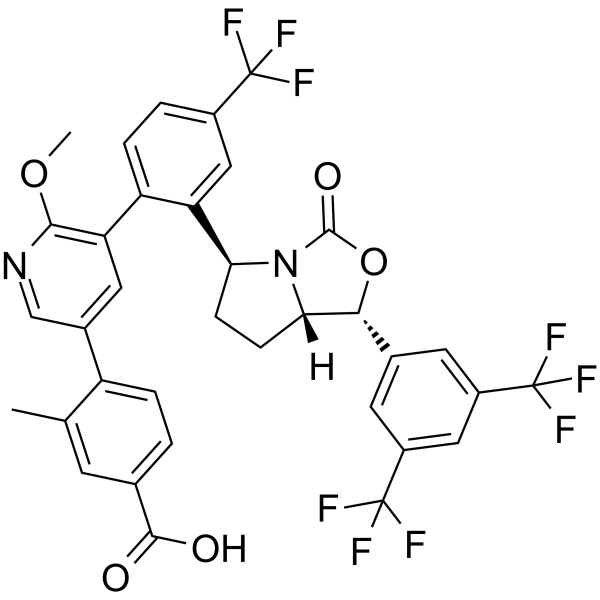
MK-8262
MK-8262 is an orally active and potent cholesteryl ester transfer protein (CETP) inhibitor with an IC50 of 53 nM and a log D of 5.3. MK-8262, a bistrifluoromethyl analogue, has the potential for coronary heart disease (CHD) correlated high-density lipoprotein (HDL) and low-density lipoprotein (LDL) research.
For research use only. We do not sell to patients.
- CAS No.: 1432054-03-9
- Formula: C35H25F9N2O5
- Molecular Weight:724.57
-
Storage:
Please store the product under the recommended conditions in the Certificate of Analysis.

To place orders, for customer services and technical support, please contact: MedChemExpress USA
Tel: 609-228-6898 E-mail: [email protected] [email protected]


-
 Biological Activity
-
Chemical Information
- Protocols
- Purity & Documentation
- References
-
 Help & FAQs




Biological Activity
Description
IC50 & Target
IC50: 53 nM (CETP)[1]
In Vitro
MK-8262 (Compound 87) reduces cell viability in a dose-dependent manner beginning at ∼10 μM in all 8 cell lines regardless of human CYP expression or glutathione depletion (HEK293/CYP cell lines expressing human CYP1A2, CYP2E1, CYP2D6, CYP2C8, CYP2B6, CYP3A4, CYP2C19, or CYP2C9)[1].
MK-8262 has no effect on human CYP protein concentration or Nrf2 activation in any of the 8 cell lines[1].
MedChemExpress (MCE) has not independently confirmed the accuracy of these methods. They are for reference only.
In Vivo
MK-8262 (1 mg/kg; iv) has a T1/2 MRT of 6 hours, a CL of 2.6 mL/min•kg, and a Vss of 0.95 L/kg for mouse[1].
MK-8262 (2 mg/kg; po) has a Cmax of 0.43 μM and an AUC of 7.9 μM•h for mouse[1].
MK-8262 (1 mg/kg; iv) has a T1/2 MRT of 13 hours, a CL of 3.1 mL/min•kg, and a Vss of 2.4 L/kg for mouse[1].
MK-8262 (2 mg/kg; po) has a Cmax of 0.4 μM and an AUC of 9.7 μM•h for mouse[1].
MedChemExpress (MCE) has not independently confirmed the accuracy of these methods. They are for reference only.


Chemical Information
-
CAS No. 1432054-03-9
-
Molecular Weight 724.57
-
Formula C35H25F9N2O5
-
SMILES
O=C(O)C1=CC=C(C2=CC(C3=CC=C(C(F)(F)F)C=C3[C@@H]4CC[C@]5([H])N4C(O[C@@H]5C6=CC(C(F)(F)F)=CC(C(F)(F)F)=C6)=O)=C(OC)N=C2)C(C)=C1
-
Shipping
Room temperature in continental US; may vary elsewhere.
-
Storage
Please store the product under the recommended conditions in the Certificate of Analysis.


Purity & Documentation
References

Calculators
Concentration (start) × Volume (start) = Concentration (final) × Volume (final)


MK-8262 Related Classifications
HY-132303 Related Classifications
 Powered by Bioz