



MSU38225

Based on 1 Customer Validation
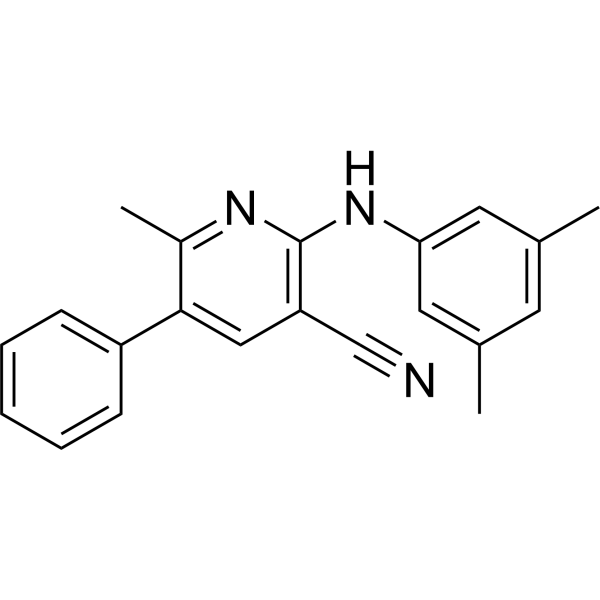
MSU38225 is a selective Nrf2 inhibitor. MSU38225 increases ROS levels by inhibiting antioxidant production. MSU38225 arrests cells at the G2/M phase, enhances cellular sensitivity to chemotherapeutic agents, and exerts synergistic effects with Carboplatin (HY-17393) and 5-fluorouracil (HY-90006). MSU38225 exhibits anticancer activity against lung cancer. MSU38225 can be used in research related to non-small cell lung cancer.
For research use only. We do not sell to patients.
- Purity : 99.94%
- CAS No.: 1629160-83-3
- Formula: C21H19N3
- Molecular Weight:313.40
-
Storage:Powder -20°C, 3 years ; In solvent -80°C, 6 months , -20°C, 1 month

To place orders, for customer services and technical support, please contact: MedChemExpress USA
Tel: 609-228-6898 E-mail: [email protected] [email protected]


-
 Biological Activity
-
Chemical Information
-
Solvent & Solubility
- Protocols
- Purity & Documentation
- References
-
 Help & FAQs




Biological Activity
Description
In Vitro
MSU38225 (24 h) inhibits tBHQ-induced Nrf2 transcriptional activity in MCF-7 NRF2/ARE reporter cells without cytotoxicity[1].
MSU38225 (24 h) suppresses the expression of Nrf2 downstream target genes and proteins in KEAP1-mutant A549 lung cancer cells without altering NFE2L2 mRNA levels[1].
MSU38225 (24 h) increases ROS production in tBHP-stimulated KEAP1-mutant A549 lung cancer cells in a dose-dependent manner via an Nrf2-dependent mechanism[1].
MSU38225 (72 h) inhibits the proliferation of cancer cells; it exerts stronger potency in Nrf2-dependent KEAP1-mutant A549 and H460 lung cancer cells via an Nrf2-dependent mechanism[1].
MSU38225 (7 days) exerts a dose-dependent and significant inhibitory effect on the 3D colony formation of A549, H460 and A427 lung cancer cells in soft agar[1].
MSU38225 (72 h) synergistically enhances the antiproliferative effects of Carboplatin (HY-17393) and 5-fluorouracil (HY-90006) in KEAP1G12C-mutant A549 lung cancer cells[1].
MSU38225 (10 μM; 24 h) reduces NRF2 protein levels in KEAP1-mutant non-small cell lung cancer cells A549 and H460, and significantly downregulates the mRNA expression of NRF2 target genes NQO1, GCLC, AKR1C2 and GCLM in A549 cells[2].
MSU38225 (10 μM; 24 h) arrests KEAP1-mutant non-small cell lung cancer cells A549 and H460 at the G2/M phase following 12 h of low-serum synchronization[2].
MedChemExpress (MCE) has not independently confirmed the accuracy of these methods. They are for reference only. Further protocols information, click here.
-
Cell Line:A549 human lung cancer cells
-
Concentration:5 μM
-
Incubation Time:72 h
-
Result:Inhibited cell proliferation by 9.8% relative to the vehicle control.
-
Cell Line:A549 and H460 KEAP1-mutant non-small cell lung cancer cells
-
Concentration:10 μM
-
Incubation Time:24 h
-
Result:Decreased NRF2 protein levels in A549 and H460 cells.
Significantly reduced mRNA levels of NRF2 target genes NQO1, GCLC, AKR1C2, and GCLM in A549 cells relative to vehicle control.
-
Cell Line:A549 human lung cancer cells
-
Concentration:10 μM
-
Incubation Time:24 h
-
Result:Significantly reduced (p < 0.0001) cell migration by 65% relative to vehicle control.
In Vivo
MedChemExpress (MCE) has not independently confirmed the accuracy of these methods. They are for reference only.
-
Animal Model:athymic nude mice (male, 6 weeks-old)[1]
-
Dosage:50 mg/kg
-
Administration:i.p.; twice daily; 4 weeks
-
Result:Slowed tumor growth, though the change was not statistically significant.
Significantly slowed tumor growth when combined with carboplatin compared to vehicle control (p<0.01) and carboplatin alone (p<0.05).
Decreased Nrf2 protein expression in tumors compared to vehicle control.
Showed good tolerability with no changes in mouse body weight over time.


Chemical Information
-
CAS No. 1629160-83-3
-
Appearance Solid
-
Molecular Weight 313.40
-
Formula C21H19N3
-
Color Off-white to light yellow
-
SMILES
N#CC1=C(NC2=CC(C)=CC(C)=C2)N=C(C)C(C3=CC=CC=C3)=C1
-
Shipping
Room temperature in continental US; may vary elsewhere.
-
Storage
Powder -20°C 3 years In solvent -80°C 6 months -20°C 1 month


Solvent & Solubility
In Vitro:
DMSO : 100 mg/mL (319.08 mM; Need ultrasonic; Hygroscopic DMSO has a significant impact on the solubility of product, please use newly opened DMSO)
Please refer to the solubility information to select the appropriate solvent. Once prepared, please aliquot and store the solution to prevent product inactivation from repeated freeze-thaw cycles.
Storage method and period of stock solution: -80°C, 6 months; -20°C, 1 month. When stored at -80°C, please use it within 6 months. When stored at -20°C, please use it within 1 month.
Please refer to the solubility information to select the appropriate solvent. Once prepared, please aliquot and store the solution to prevent product inactivation from repeated freeze-thaw cycles.
Storage method and period of stock solution: -80°C, 6 months; -20°C, 1 month. When stored at -80°C, please use it within 6 months. When stored at -20°C, please use it within 1 month.
Concentration (start) × Volume (start) = Concentration (final) × Volume (final)

Protocols
-
Flow cytometric DNA-content cell-cycle staining
Flow cytometric DNA-content cell-cycle staining measures the fluorescence intensity of DNA-bound fluorochromes in single cells or nuclei to estimate DNA content distributions, allowing assignment of populations to G0/G1, S, and G2/M phases by DNA histogram deconvolution. Propidium iodide (PI) intercalates into DNA, and PI fluorescence is proportional to cellular DNA content when staining is performed under conditions that make DNA accessible and minimize non-DNA signal. Cells with G2/M DNA content are expected to show approximately twice the fluorescence intensity of G0/G1 cells, while S-phase cells occupy intermediate fluorescence values. PI-based DNA-content analysis can also detect cells with fractional DNA content, often reported as sub-G1, when DNA fragmentation and extraction during staining reduce retained DNA signal in apoptotic cells. DAPI is an alternative DNA fluorochrome for univariate DNA-content analysis, while bivariate approaches combining DNA content with proliferation
-
ROS/oxidative-stress fluorescent staining
ROS/oxidative-stress fluorescent staining uses cell-permeant fluorogenic probes that become fluorescent after oxidation inside cells or tissues; commonly used examples include DCFH-DA/DCFDA for broad cellular oxidant detection, DHE for superoxide-related signal detection, MitoSOX for mitochondrial superoxide-related signal detection, and CellROX probes for oxidative-stress-associated fluorescence readouts. The assay detects probe oxidation rather than a single ROS species unless the probe and analysis method have been chemically validated for that species. DCFH-DA enters cells, is deacetylated by intracellular esterases to DCFH, and produces fluorescent DCF after oxidation, so the readout is used as an operational measure of total cellular oxidative stress rather than a species-specific ROS measurement. DHE and MitoSOX can report superoxide-related oxidation, but red fluorescence alone can include non-specific ethidium-like oxidation products; HPLC or optimized spectral approaches are
-
Protocol for Cell Cycle
Cell-cycle analysis by flow cytometry measures DNA content in single cells to estimate the fraction of cells in G0/G1, S, and G2/M phases. Propidium iodide intercalates into DNA, and after RNA removal with RNase, fluorescence intensity reflects cellular DNA content: 2N cells are assigned to G0/G1, cells between 2N and 4N to S phase, and 4N cells to G2/M. DNA-content analysis alone cannot reliably separate G0 from G1 or G2 from M. Ki-67 can distinguish quiescent G0 cells from cycling cells, EdU or BrdU incorporation marks active DNA synthesis in S phase, and phospho-histone H3 staining identifies mitotic cells within the 4N population.


Purity & Documentation
-
Data Sheet (287 KB)
-
SDS (252 KB)
- English - EN (252 KB)
- Français - FR (252 KB)
- Deutsch - DE (252 KB)
- Norwegian - NO (252 KB)
- Español - ES (252 KB)
- Swedish - SV (252 KB)
- Italian - IT (252 KB)
- Korean - KR (252 KB)
- Portuguese - PT (252 KB)
-
Handling Instructions (2659 KB)
References
[1]. Zhang D, et al. A Novel Nrf2 Pathway Inhibitor Sensitizes Keap1-Mutant Lung Cancer Cells to Chemotherapy. Molecular cancer therapeutics. 2021 Sep;20(9):1692-1701. [Content Brief]
[2]. Hou Z, et al. Exploring structural effects in a new class of NRF2 inhibitors. RSC Med Chem. 2022 Nov 16;14(1):74-84. [Content Brief]


Complete Stock Solution Preparation Table
Please refer to the solubility information to select the appropriate solvent. Once prepared, please aliquot and store the solution to prevent product inactivation from repeated freeze-thaw cycles.
Storage method and period of stock solution: -80°C, 6 months; -20°C, 1 month. When stored at -80°C, please use it within 6 months. When stored at -20°C, please use it within 1 month.
| Optional Solvent | Concentration Solvent Mass | 1 mg | 5 mg | 10 mg | 25 mg |
|---|---|---|---|---|---|
| DMSO | 1 mM | 3.1908 mL | 15.9541 mL | 31.9081 mL | 79.7703 mL |
| 5 mM | 0.6382 mL | 3.1908 mL | 6.3816 mL | 15.9541 mL | |
| 10 mM | 0.3191 mL | 1.5954 mL | 3.1908 mL | 7.9770 mL | |
| 15 mM | 0.2127 mL | 1.0636 mL | 2.1272 mL | 5.3180 mL | |
| 20 mM | 0.1595 mL | 0.7977 mL | 1.5954 mL | 3.9885 mL | |
| 25 mM | 0.1276 mL | 0.6382 mL | 1.2763 mL | 3.1908 mL | |
| 30 mM | 0.1064 mL | 0.5318 mL | 1.0636 mL | 2.6590 mL | |
| 40 mM | 0.0798 mL | 0.3989 mL | 0.7977 mL | 1.9943 mL | |
| 50 mM | 0.0638 mL | 0.3191 mL | 0.6382 mL | 1.5954 mL | |
| 60 mM | 0.0532 mL | 0.2659 mL | 0.5318 mL | 1.3295 mL | |
| 80 mM | 0.0399 mL | 0.1994 mL | 0.3989 mL | 0.9971 mL | |
| 100 mM | 0.0319 mL | 0.1595 mL | 0.3191 mL | 0.7977 mL |


MSU38225 Related Classifications
HY-153873 Related Classifications
 Powered by Bioz
Keywords