



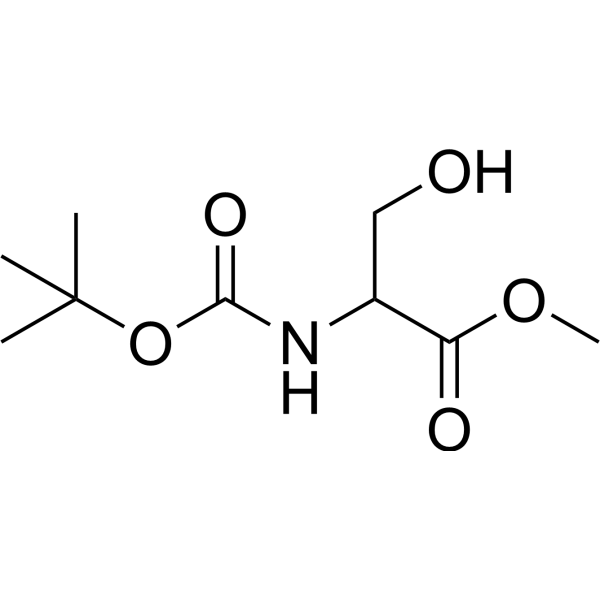
N-BOC-DL-serine methyl ester

Based on 1 Customer Validation
N-BOC-DL-serine methyl ester is a Serine derivative. N-BOC-DL-serine methyl ester is used for the synthesis of α,β-dehydro-α-amino acid. N-BOC-DL-serine methyl ester is also used for the synthesis of anti-cancer agent, such as quinazolinone derivative that inhibits PI3K activity, and tricyclic pyrolopyranopyridines that inhibits protein kinase activity.
For research use only. We do not sell to patients.
- Purity : 98.0%
- CAS No.: 69942-12-7
- Formula: C9H17NO5
- Molecular Weight:219.23
-
Storage:Pure form -20°C, 3 years , 4°C, 2 years ; In solvent -80°C, 6 months , -20°C, 1 month

To place orders, for customer services and technical support, please contact: MedChemExpress USA
Tel: 609-228-6898 E-mail: [email protected] [email protected]


-
 Biological Activity
-
Chemical Information
-
Solvent & Solubility
- Protocols
- Purity & Documentation
- References
-
 Help & FAQs




Biological Activity
Description


Chemical Information
-
CAS No. 69942-12-7
-
Appearance Liquid (Density: 1.148 g/cm3)
-
Molecular Weight 219.23
-
Formula C9H17NO5
-
Color Colorless to light yellow
-
Shipping
Room temperature in continental US; may vary elsewhere.
-
Storage
Pure form -20°C 3 years 4°C 2 years In solvent -80°C 6 months -20°C 1 month


Solvent & Solubility
In Vitro:
DMSO : ≥ 200 mg/mL (912.28 mM; Hygroscopic DMSO has a significant impact on the solubility of product, please use newly opened DMSO)
* "≥" means soluble, but saturation unknown.
Please refer to the solubility information to select the appropriate solvent. Once prepared, please aliquot and store the solution to prevent product inactivation from repeated freeze-thaw cycles.
Storage method and period of stock solution: -80°C, 6 months; -20°C, 1 month. When stored at -80°C, please use it within 6 months. When stored at -20°C, please use it within 1 month.
Please refer to the solubility information to select the appropriate solvent. Once prepared, please aliquot and store the solution to prevent product inactivation from repeated freeze-thaw cycles.
Storage method and period of stock solution: -80°C, 6 months; -20°C, 1 month. When stored at -80°C, please use it within 6 months. When stored at -20°C, please use it within 1 month.
Concentration (start) × Volume (start) = Concentration (final) × Volume (final)

Protocols
-
Kinase activity and phosphorylation assays
Kinase activity assays measure the ability of kinases to transfer phosphate groups from ATP to specific substrates, while phosphorylation assays detect the presence and levels of phosphorylated proteins. Common methods include radiolabeled ATP incorporation (e. g. ,), ADP release detection via bioluminescence (e. g. ,[3]), enzyme-linked immunosorbent assays (ELISA) for phospho-specific epitopes (e. g. ,[6]), and microtiter-based formats for high-throughput screening (e. g. ,[8]). The ADP-Glo assay quantifies kinase activity by measuring ADP produced during phosphorylation using a luciferase-based system. Radiometric assays involve autoradiography or scintillation counting after incorporation of 32P-labeled ATP into substrate proteins. ELISA-based approaches rely on phospho-specific antibodies to detect activated kinases in cell lysates or purified samples.
-
Protocol for Kinase activity and phosphorylation assays
Kinase activity assays measure transfer of phosphate from ATP to a protein or peptide substrate, generating phosphorylated substrate, ADP, or incorporated radiolabeled phosphate as the readout; phosphorylation assays measure site-specific phosphorylation in cells or tissues as a proxy for kinase-pathway activation, inhibition, or substrate regulation. Phosphorylation can be detected by phospho-specific Western blot, immunoprecipitation kinase assay, phospho-immunofluorescence, phospho-flow cytometry, luminescent ADP detection, radiolabeled ATP incorporation, or reporter-based pathway assays, and these readouts can be applied to cancer cells, primary neurons, mouse tumors, organoids, inflammatory macrophages, ferroptosis studies, and mitophagy studies when the kinase target is biologically relevant.


Purity & Documentation
-
Data Sheet (271 KB)
-
SDS (393 KB)
- English - EN (393 KB)
- Français - FR (393 KB)
- Deutsch - DE (393 KB)
- Norwegian - NO (393 KB)
- Español - ES (393 KB)
- Swedish - SV (393 KB)
- Italian - IT (393 KB)
- Korean - KR (393 KB)
- Portuguese - PT (393 KB)
-
Handling Instructions (2659 KB)
References


Complete Stock Solution Preparation Table
Please refer to the solubility information to select the appropriate solvent. Once prepared, please aliquot and store the solution to prevent product inactivation from repeated freeze-thaw cycles.
Storage method and period of stock solution: -80°C, 6 months; -20°C, 1 month. When stored at -80°C, please use it within 6 months. When stored at -20°C, please use it within 1 month.
| Optional Solvent | Concentration Solvent Mass | 1 mg | 5 mg | 10 mg | 25 mg |
|---|---|---|---|---|---|
| DMSO | 1 mM | 4.5614 mL | 22.8071 mL | 45.6142 mL | 114.0355 mL |
| 5 mM | 0.9123 mL | 4.5614 mL | 9.1228 mL | 22.8071 mL | |
| 10 mM | 0.4561 mL | 2.2807 mL | 4.5614 mL | 11.4035 mL | |
| 15 mM | 0.3041 mL | 1.5205 mL | 3.0409 mL | 7.6024 mL | |
| 20 mM | 0.2281 mL | 1.1404 mL | 2.2807 mL | 5.7018 mL | |
| 25 mM | 0.1825 mL | 0.9123 mL | 1.8246 mL | 4.5614 mL | |
| 30 mM | 0.1520 mL | 0.7602 mL | 1.5205 mL | 3.8012 mL | |
| 40 mM | 0.1140 mL | 0.5702 mL | 1.1404 mL | 2.8509 mL | |
| 50 mM | 0.0912 mL | 0.4561 mL | 0.9123 mL | 2.2807 mL | |
| 60 mM | 0.0760 mL | 0.3801 mL | 0.7602 mL | 1.9006 mL | |
| 80 mM | 0.0570 mL | 0.2851 mL | 0.5702 mL | 1.4254 mL | |
| 100 mM | 0.0456 mL | 0.2281 mL | 0.4561 mL | 1.1404 mL |


N-BOC-DL-serine methyl ester Related Classifications
HY-W005308 Related Classifications
 Powered by Bioz