



Neurokinin B TFA

Based on 1 Customer Validation
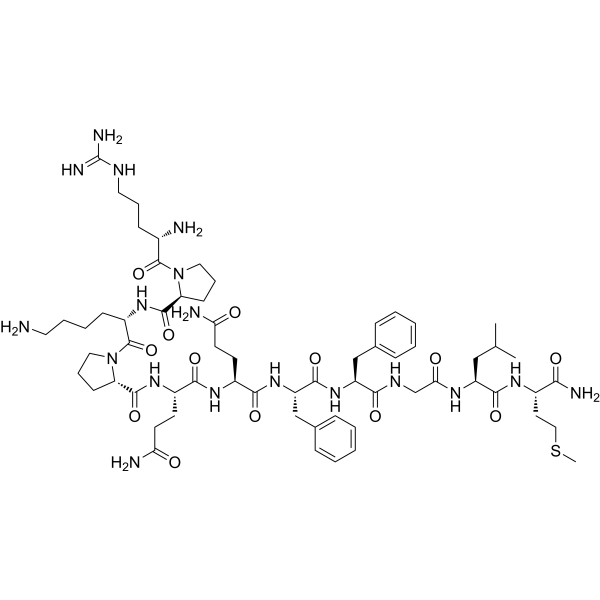
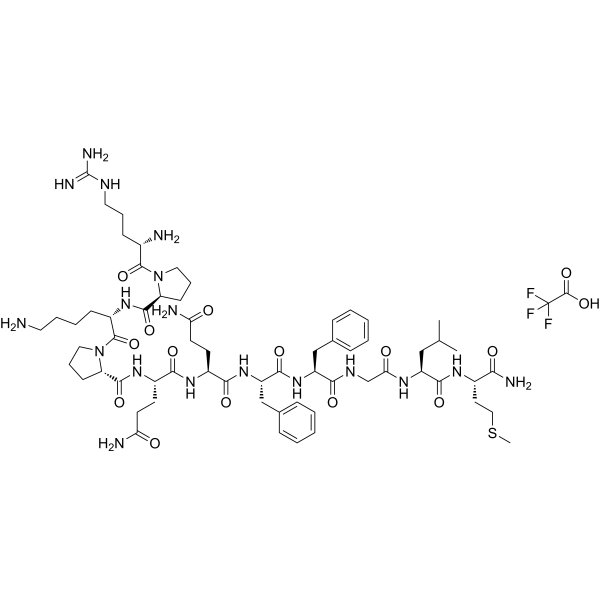
Neurokinin B TFA is a tachykinin family peptide that preferentially binds to and activates NK3R over other tachykinin receptors. Neurokinin B TFA preferentially binds to the substance P receptor (SP-N receptor) and mediates acetylcholine release from cholinergic neurons. Neurokinin B TFA regulates the pulsatile release of Kisspeptin and GnRH, stimulates or inhibits the secretion of luteinizing hormone (HY-P2293), regulates reproductive function via metabolic signals, and drives the onset of puberty. Neurokinin B TFA exerts vasoactive effects and induces contraction of isolated guinea pig ileum. Neurokinin B TFA can be used in studies related to hypogonadotropic hypogonadism.
For research use only. We do not sell to patients.
- Purity : 99.36%
- CAS No.: 101536-55-4
- Formula: C55H79N13O14S2.2C2HF3O2
- Molecular Weight:1438.47
-
Storage:
Sealed storage, away from moisture.
Powder -80°C, 2 years , -20°C, 1 year* In solvent : -80°C, 6 months; -20°C, 1 month (sealed storage, away from moisture)


To place orders, for customer services and technical support, please contact: MedChemExpress USA
Tel: 609-228-6898 E-mail: [email protected] [email protected]


-
 Biological Activity
-
Chemical Information
-
Solvent & Solubility
- Protocols
- Purity & Documentation
- References
-
 Help & FAQs


-
HY-P0201
Substance PNeurotransmitter -
HY-P0201A
Substance P TFANeurotransmitter -
HY-P0197A
Neurokinin A TFAPeptide Neurotransmitter -

HY-P0197
Neurokinin APeptide Neurotransmitter -

HY-P2546
Biotin-Substance PNeurokinin Receptor Modulator -
HY-P1492
Substance P (7-11)Active Compound -
HY-P1485A
Substance P(1-7) TFAActive Compound -
HY-P1494
Substance P (1-9)Neurokinin Receptor -
![[Sar9] Substance P](https://file.medchemexpress.com/product_pic/hy-p1738.gif)
HY-P1738
[Sar9] Substance PNeurokinin Receptor Agonist -

HY-P10746
EB1002NK2R Agonist -
![[Sar9,Met(O2)11]-Substance P TFA](https://file.medchemexpress.com/product_pic/hy-p1012a.gif)
HY-P1012A
[Sar9,Met(O2)11]-Substance P TFATachykinin NK1 Receptor Agonist -

HY-P0250
KassininPeptide


Biological Activity
Description
IC50 & Target
[1]|
NK3R |
In Vivo
Neurokinin B (1 nmol; intracerebroventricular injection; single administration) TFA induces a mild and sustained increase in LH concentration in ovary-intact ewes at any stage of the estrous cycle, with a peak reaching 4-6 ng/mL[3].
MedChemExpress (MCE) has not independently confirmed the accuracy of these methods. They are for reference only.
-
Animal Model:Suffolk breed (adult, ovary-intact, random stages of the estrous cycle)[3]
-
Dosage:1 nmol
-
Administration:i.c.v.; single injection
-
Result:Produced a prolonged increase in LH concentrations lasting 2-3 hours in three of five ewes.
Reached peak LH levels of 4-6 ng/mL, similar to late follicular phase concentrations.


Chemical Information
-
CAS No. 101536-55-4
-
Appearance Solid
-
Molecular Weight 1438.47
-
Formula C55H79N13O14S2.2C2HF3O2
-
Color White to off-white
-
Sequence
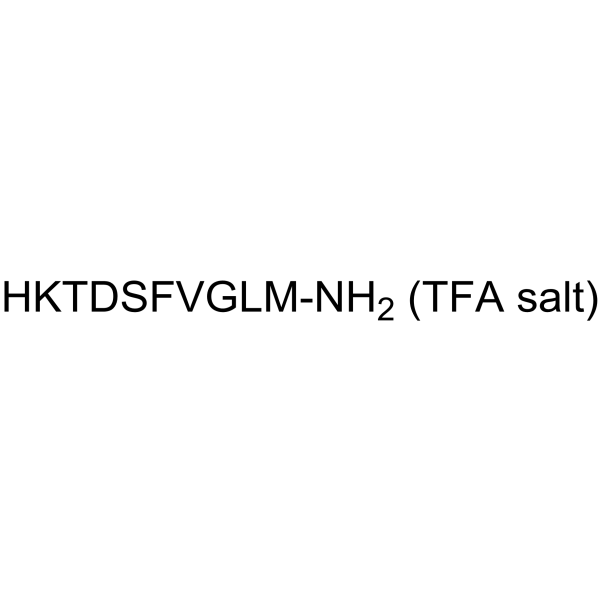
Asp-Met-His-Asp-Phe-Phe-Val-Gly-Leu-Met-NH2
-
Sequence Shortening
DMHDFFVGLM-NH2
-
Shipping
Room temperature in continental US; may vary elsewhere.
-
Storage
Sealed storage, away from moisture
Powder -80°C 2 years -20°C 1 year * In solvent : -80°C, 6 months; -20°C, 1 month (sealed storage, away from moisture)


Solvent & Solubility
In Vitro:
DMSO : ≥ 33.33 mg/mL (23.17 mM; Hygroscopic DMSO has a significant impact on the solubility of product, please use newly opened DMSO)
* "≥" means soluble, but saturation unknown.
Please refer to the solubility information to select the appropriate solvent. Once prepared, please aliquot and store the solution to prevent product inactivation from repeated freeze-thaw cycles.
Storage method and period of stock solution: -80°C, 6 months; -20°C, 1 month (sealed storage, away from moisture). When stored at -80°C, please use it within 6 months. When stored at -20°C, please use it within 1 month.
Please refer to the solubility information to select the appropriate solvent. Once prepared, please aliquot and store the solution to prevent product inactivation from repeated freeze-thaw cycles.
Storage method and period of stock solution: -80°C, 6 months; -20°C, 1 month (sealed storage, away from moisture). When stored at -80°C, please use it within 6 months. When stored at -20°C, please use it within 1 month.
Concentration (start) × Volume (start) = Concentration (final) × Volume (final)
In Vivo:
Select the appropriate dissolution method based on your experimental animal and administration route.
- For the following dissolution methods, please ensure to first prepare a clear stock solution using an In Vitro approach and then sequentially add co-solvents:
- To ensure reliable experimental results, the clarified stock solution can be appropriately stored based on storage conditions. As for the working solution for In Vivo experiments, it is recommended to prepare freshly and use it on the same day.
- The percentages shown for the solvents indicate their volumetric ratio in the final prepared solution. If precipitation or phase separation occurs during preparation, heat and/or sonication can be used to aid dissolution.
Add each solvent one by one: 10% DMSO 40% PEG300 5% Tween-80 45% Saline
Solubility: 2.5 mg/mL (1.74 mM); Suspended solution; Need ultrasonic
This protocol yields a suspended solution of 2.5 mg/mL. Suspended solution can be used for oral and intraperitoneal injection.
Taking 1 mL working solution as an example, add 100 μL DMSO stock solution (25.0 mg/mL) to 400 μL PEG300, and mix evenly; then add 50 μL Tween-80 and mix evenly; then add 450 μL Saline to adjust the volume to 1 mL.
Preparation of Saline: Dissolve 0.9 g sodium chloride in ddH₂O and dilute to 100 mL to obtain a clear Saline solution.
In Vivo Dissolution Calculator
Please enter the basic information of animal experiments:
-
-
-
-
Recommended: Prepare an additional quantity of animals to account for potential losses during experiments.
Please enter your animal formula composition:
-
%DMSO +
Recommended: Keep the proportion of DMSO in working solution below 2% if your animal is weak.
-
%+
-
+%Tween-80 + +
-
%Saline +
The co-solvents required include: DMSO, . All of co-solvents are available by MedChemExpress (MCE). , Tween 80. All of co-solvents are available by MedChemExpress (MCE).
Working solution concentration: 0.22 mg/mL
Method for preparing stock solution: mg drug dissolved in μL DMSO. Stock solution concentration: mg/mL. * In solvent : -80°C, 6 months; -20°C, 1 month (sealed storage, away from moisture)
1. Take μL DMSO stock solution;
2. Add μL .
μL , mix evenly;
3. Then add μL Tween 80, mix evenly;
4. Then add μL
Please ensure that the stock solution in the first step is dissolved to a clear state, and add co-solvents in sequence. You can use ultrasonic heating (ultrasonic cleaner, recommended frequency 20-40 kHz), vortexing, etc. to assist dissolution.

Protocols
-
Research Protocol for Endocrine Diseases
Endocrine diseases often arise from disrupted hormone production, hormone signaling, or target-tissue responsiveness; for diabetes-focused endocrine disease models, insulin signaling regulates glucose uptake, hepatic glucose output, lipid metabolism, and β-cell compensation. Type 2 diabetes develops through interacting defects in insulin resistance, β-cell dysfunction, adipose inflammation, hepatic glucose overproduction, altered incretin signaling, and ectopic lipid metabolism. A major unresolved question is whether endocrine dysfunction is driven primarily by target-tissue insulin resistance, intrinsic β-cell failure, immune/inflammatory stress, or combined multi-organ failure that differs by disease stage.


Purity & Documentation
-
Data Sheet (270 KB)
-
SDS (254 KB)
- English - EN (254 KB)
- Français - FR (254 KB)
- Deutsch - DE (254 KB)
- Norwegian - NO (254 KB)
- Español - ES (254 KB)
- Swedish - SV (254 KB)
- Italian - IT (254 KB)
- Korean - KR (254 KB)
- Portuguese - PT (254 KB)
-
Handling Instructions (2659 KB)
References
[1]. Navarro VM. Interactions between kisspeptins and neurokinin B. Adv Exp Med Biol. 2013;784:325-47. [Content Brief]
[2]. Jayasena CN, et al. Effects of neurokinin B administration on reproductive hormone secretion in healthy men and women. The Journal of clinical endocrinology and metabolism. 2014 Jan;99(1):E19-27. [Content Brief]
[3]. Billings HJ, et al. Neurokinin B acts via the neurokinin-3 receptor in the retrochiasmatic area to stimulate luteinizing hormone secretion in sheep. Endocrinology. 2010 Aug;151(8):3836-46. [Content Brief]
[4]. Laufer R, et al. Neurokinin B is a preferred agonist for a neuronal substance P receptor and its action is antagonized by enkephalin. Proceedings of the National Academy of Sciences of the United States of America. 1985 Nov;82(21):7444-8. [Content Brief]


Complete Stock Solution Preparation Table
Please refer to the solubility information to select the appropriate solvent. Once prepared, please aliquot and store the solution to prevent product inactivation from repeated freeze-thaw cycles.
Storage method and period of stock solution: -80°C, 6 months; -20°C, 1 month (sealed storage, away from moisture). When stored at -80°C, please use it within 6 months. When stored at -20°C, please use it within 1 month.
| Optional Solvent | Concentration Solvent Mass | 1 mg | 5 mg | 10 mg | 25 mg |
|---|---|---|---|---|---|
| DMSO | 1 mM | 0.6952 mL | 3.4759 mL | 6.9518 mL | 17.3796 mL |
| 5 mM | 0.1390 mL | 0.6952 mL | 1.3904 mL | 3.4759 mL | |
| 10 mM | 0.0695 mL | 0.3476 mL | 0.6952 mL | 1.7380 mL | |
| 15 mM | 0.0463 mL | 0.2317 mL | 0.4635 mL | 1.1586 mL | |
| 20 mM | 0.0348 mL | 0.1738 mL | 0.3476 mL | 0.8690 mL |


Neurokinin B TFA Related Classifications
HY-P0242A Related Classifications
 Powered by Bioz