



Obestatin(rat)

Based on 1 Customer Validation
Obestatin(rat), encoded by the Ghrelin gene, is a cpeptide, comprised of 23 amino acids. Obestatin(rat) suppresses food intake, inhibits jejunal contraction, and decreases body-weight gain. Obestatin is an endogenous ligand of G-protein coupled receptor 39 (GPR39). Obestatin(rat) has anti-inflammatory, anti-myocardial infarction and antioxidant activities.
For research use only. We do not sell to patients.
- Purity : 98.73%
- CAS No.: 869705-22-6
- Formula: C114H174N34O31
- Molecular Weight:2516.81
-
Storage:
Sealed storage, away from moisture and light, under nitrogen.
Powder -80°C, 2 years , -20°C, 1 year* In solvent : -80°C, 6 months; -20°C, 1 month (sealed storage, away from moisture and light, under nitrogen)

To place orders, for customer services and technical support, please contact: MedChemExpress USA
Tel: 609-228-6898 E-mail: [email protected] [email protected]


-
 Biological Activity
-
Chemical Information
- Protocols
- Purity & Documentation
- References
-
 Help & FAQs


-
HY-P1035
Neuropeptide W-23 (human)NPBW1/2 Agonist -
HY-P1305
CART(55-102)(rat)Satiety Factor -
HY-P1304
CART(55-102)(human)Satiety Factor -
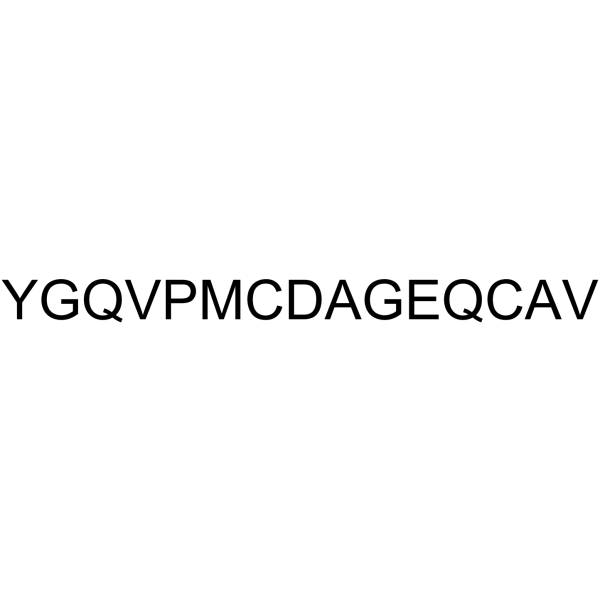
HY-P1303
CART(62-76)(human,rat)Neuropeptide -
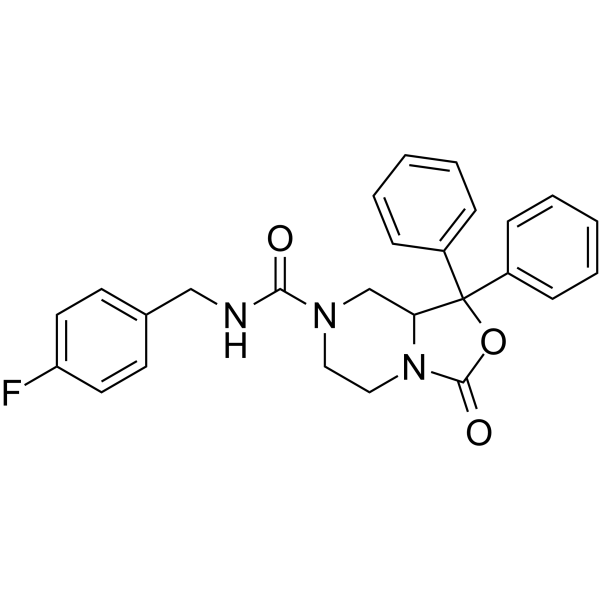
HY-108625
SHA 68Non-peptide NPSR Antagonist -
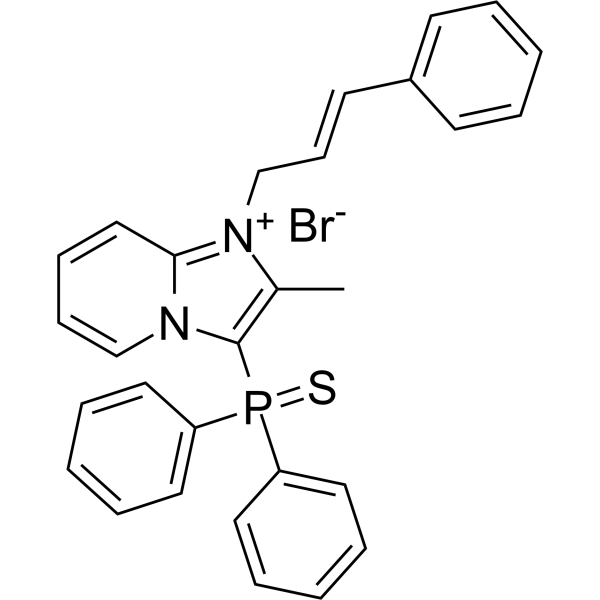
HY-108626
ML154NPSR Antagonist -
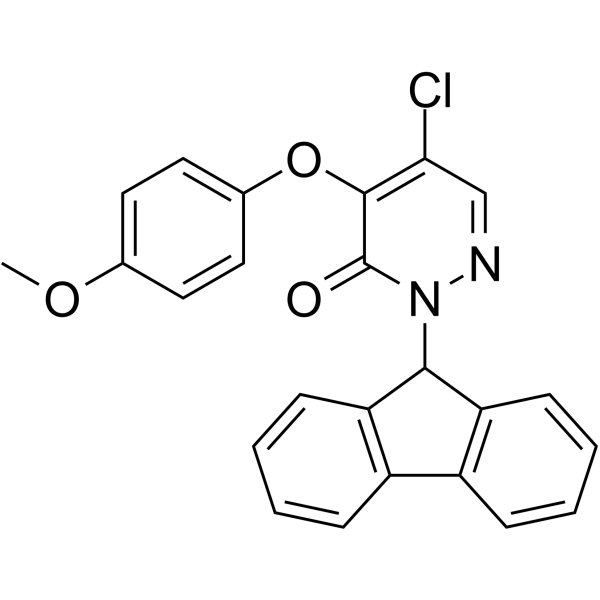
HY-108624
CYM 50769GPR7 Antagonist -

HY-108625R
SHA 68 (Standard)Non-peptide NPSR Antagonist -

HY-108624R
CYM 50769 (Standard)Reference Standard


Biological Activity
Description


Chemical Information
-
CAS No. 869705-22-6
-
Appearance Solid
-
Molecular Weight 2516.81
-
Formula C114H174N34O31
-
Color White to off-white
-
Sequence
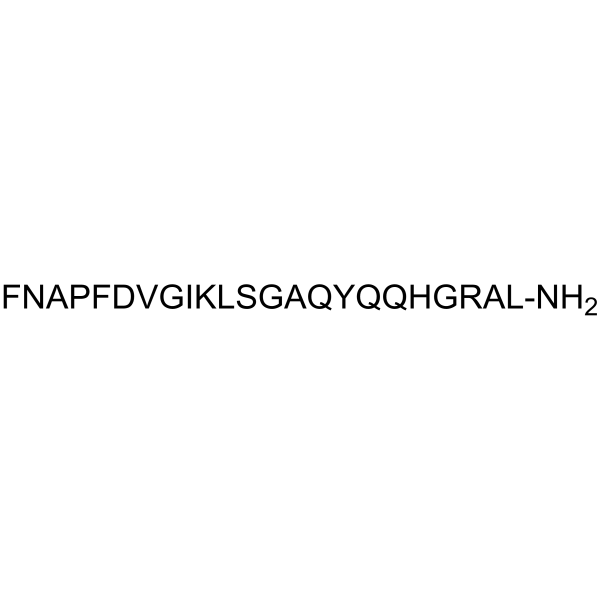
Phe-Asn-Ala-Pro-Phe-Asp-Val-Gly-Ile-Lys-Leu-Ser-Gly-Ala-Gln-Tyr-Gln-Gln-His-Gly-Arg-Ala-Leu-NH2
-
Sequence Shortening
FNAPFDVGIKLSGAQYQQHGRAL-NH2
-
Shipping
Room temperature in continental US; may vary elsewhere.
-
Storage
Sealed storage, away from moisture and light, under nitrogen
Powder -80°C 2 years -20°C 1 year * In solvent : -80°C, 6 months; -20°C, 1 month (sealed storage, away from moisture and light, under nitrogen)

Protocols
-
Research Protocol for Cardiovascular Diseases
Cardiovascular disease can be modeled as maladaptive cardiac remodeling, where ischemic injury or pressure overload activates inflammatory signaling, fibroblast activation, extracellular-matrix deposition, cardiomyocyte hypertrophy, vascular remodeling, and progressive ventricular dysfunction. The TGF-β/SMAD axis is a central profibrotic pathway after myocardial injury and pressure overload, while innate immune and cytokine pathways regulate leukocyte recruitment, scar formation, and adverse remodeling. Key unresolved questions include which inflammatory signals are reparative versus harmful, when fibrosis is protective versus maladaptive, and whether pathway inhibition improves function without weakening necessary infarct healing or compensatory remodeling.
-
Research Protocol for Inflammation-related Diseases
The NLRP3 inflammasome is a cytosolic innate immune signaling platform that integrates priming signals and danger-signal activation to promote caspase-1 activation, maturation of IL-1β and IL-18, and gasdermin D-mediated pyroptotic cell death. The core experimental logic is to determine whether inflammatory disease phenotypes are driven by increased NLRP3 expression, ASC-containing inflammasome assembly, caspase-1 cleavage, GSDMD cleavage, and extracellular release of IL-1β/IL-18 rather than by nonspecific cell injury alone. The pathway is strongly linked to inflammation-related disease phenotypes because monosodium urate crystals activate NALP3/NLRP3 inflammasome signaling in gout-like crystal inflammation, cholesterol crystals activate NLRP3 inflammasomes in atherogenesis models, and DSS-induced intestinal inflammation has been reported to involve NLRP3 inflammasome activity. However, experimental colitis studies also show context-dependent protective effects of NLRP3 inflammasome co


Purity & Documentation
-
Data Sheet (259 KB)
-
SDS (252 KB)
- English - EN (252 KB)
- Français - FR (252 KB)
- Deutsch - DE (252 KB)
- Norwegian - NO (252 KB)
- Español - ES (252 KB)
- Swedish - SV (252 KB)
- Italian - IT (252 KB)
- Korean - KR (252 KB)
- Portuguese - PT (252 KB)
-
Handling Instructions (2659 KB)
References
[1]. Azadeh Toosi, et al. Obestatin Improve Spatial Memory Impairment in a Rat Model of Fetal Alcohol Spectrum Disorders via Inhibiting Apoptosis and Neuroinflammation. Neuropeptides. 2019 Apr;74:88-94. [Content Brief]
[2]. Science. 2005 Nov 11;310(5750):996-9. doi: 10.1126/science.1117255. [Content Brief]

Calculators
Concentration (start) × Volume (start) = Concentration (final) × Volume (final)


Obestatin(rat) Related Classifications
HY-P1306 Related Classifications
 Powered by Bioz