



PA Janelia Fluor® 646, SE
Based on 1 publication(s) in Google Scholar
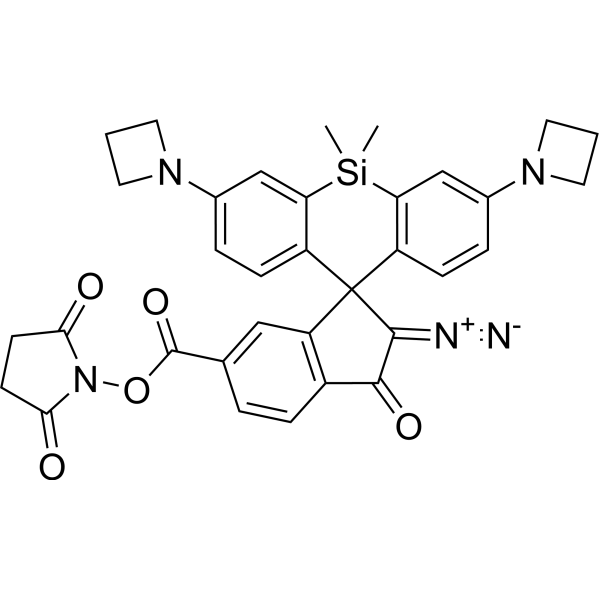
PA Janelia Fluor 646, SE (PA-JF646-NHS) is a photo-activatable fluorescent dye. PA Janelia Fluor 646, SE is a far-red light-excited, 405 nm-activated NHS ester-based dye. Janelia Fluor fluorescent dyes can be chemically conjugated to the specific HaloTag substrate (a chloroalkane ligand) to form a fluorescent ligand, rather than binding directly to the HaloTag protein itself. PA Janelia Fluor 646, SE can achieve extremely low background and single-molecule-level ultra-high-resolution imaging through photo-controlled switching, making it a powerful tool for live cell super-resolution microscopy technology (Ex/Em = 646/664 nm).
For research use only. We do not sell to patients.
- Purity : 99%
- CAS No.: 2093120-32-0
- Formula: C34H31N5O5Si
- Molecular Weight:617.73
-
Storage:
-20°C, protect from light
* In solvent : -80°C, 6 months; -20°C, 1 month (protect from light)

To place orders, for customer services and technical support, please contact: MedChemExpress USA
Tel: 609-228-6898 E-mail: [email protected] [email protected]


-
 Biological Activity
-
Chemical Information
- Purity & Documentation
-
 Help & FAQs


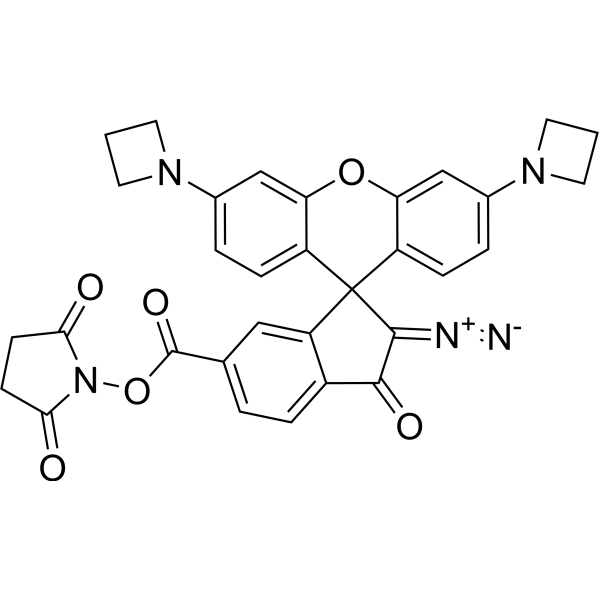
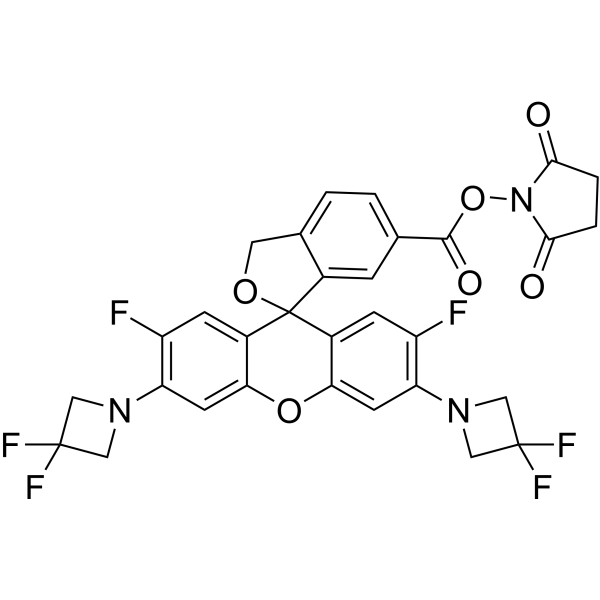
Publications Citing Use of MedChemExpress (MCE) PA Janelia Fluor® 646, SE
More

Biological Activity
Description
In Vitro
Janelia Fluor fluorescent dyes do not inherently possess HaloTag-binding activity; however, reactive groups such as NHS esters serve as reaction sites for covalent coupling-via chemical synthesis-to an amino-functionalized HaloTag chloroalkane ligand scaffold, thereby yielding a fluorescent HaloTag ligand.
Guide (The following is the experimental plan we recommend. This plan serves only as a reference guide. The specific operations should be adjusted according to your actual needs.)
Preparation of stock solution
Solvent: Dissolved in high-quality anhydrous DMSO, with a concentration of 1-10 mM.
Dissolution aid: To ensure complete dissolution, if necessary, the test tube can be heated to 37°C and then agitated in an ultrasonic bath.
2. Coupling Scheme (Amine Reactivity)
2.1 Buffer solution: Prepare the protein/antibody in a buffer solution without primary amines (such as PBS, carbonate buffer solution), with a pH value of 8.3 - 8.5.
2.2 Reaction: Add the PA-JF646-NHS stock solution to the protein solution (usually the dye is present in a 5-10 times molar excess).
2.3 Cultivation: Incubate at room temperature or at 37°C for 1 hour.
2.4 Purification: Use gel filtration (rotating column) or dialysis to separate the coupled protein from the free dye.
3. Cell Labeling and Imaging
3.1 Application: Suitable for both living cells and fixed cells with PALM (Photo-Activated Localization Microscopy).
3.2 Activation: Activated by 365 nm light.
3.3 Imaging: The maximum excitation wavelength is approximately 650 nm; the maximum emission wavelength is approximately 664 nm.
3.4 Washing: If necessary, wash the cells with 1x PBS and 2% BSA three times before imaging.
3.5 Wash-Free Option: This dye is fluorescently active, enabling "wash-free" imaging because the unbound ligands remain in the dark state until they bind.
MedChemExpress (MCE) has not independently confirmed the accuracy of these methods. They are for reference only. .


Chemical Information
-
CAS No. 2093120-32-0
-
Appearance Solid
-
Molecular Weight 617.73
-
Formula C34H31N5O5Si
-
Color White to off-white
-
SMILES
O=C(C1=CC(C2(C3=CC=C(N4CCC4)C=C3[Si](C)(C)C5=C2C=CC(N6CCC6)=C5)C7=[N+]=[N-])=C(C=C1)C7=O)ON8C(CCC8=O)=O
-
Synonyms
PA-JF646-NHS
-
Shipping
Room temperature in continental US; may vary elsewhere.
-
Storage
-20°C, protect from light
* In solvent : -80°C, 6 months; -20°C, 1 month (protect from light)


Publications (1)
-
Journal Impact Factor
-
Most Recent


Purity & Documentation
-
Data Sheet (254 KB)
-
SDS (252 KB)
- English - EN (252 KB)
- Français - FR (252 KB)
- Deutsch - DE (252 KB)
- Norwegian - NO (252 KB)
- Español - ES (252 KB)
- Swedish - SV (252 KB)
- Italian - IT (252 KB)
- Korean - KR (252 KB)
- Portuguese - PT (252 KB)
-
Handling Instructions (2659 KB)

Calculators
Concentration (start) × Volume (start) = Concentration (final) × Volume (final)


PA Janelia Fluor® 646, SE Related Classifications
HY-133535 Related Classifications
 Powered by Bioz