



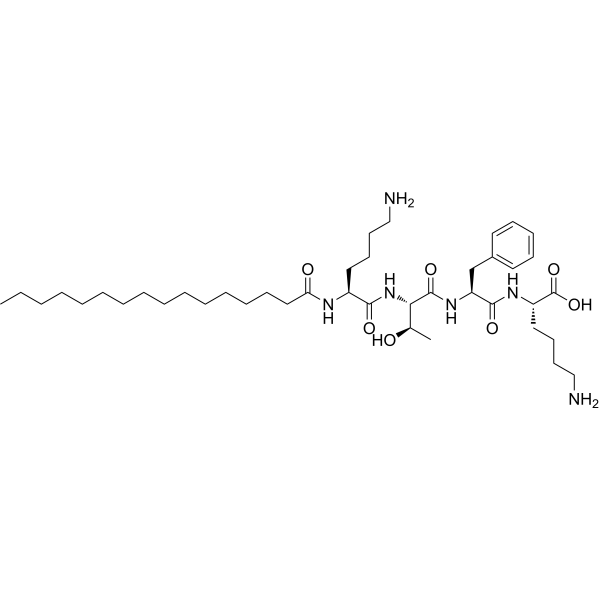
Palmitoyl tetrapeptide-10

Based on 1 Customer Validation
Palmitoyl tetrapeptide-10 is a bioactive peptide. Palmitoyl tetrapeptide-10 works synergistically with other active ingredients to increase the expression of corneodesmosin (a marker of keratinocyte adhesion) and filaggrin (a marker of keratinocyte terminal differentiation), thereby reducing skin permeability and improving skin barrier function. Palmitoyl tetrapeptide-10 can be used in the research of sensitive skin syndrome and skin pigmentation.
For research use only. We do not sell to patients.
- Purity : 99.43%
- CAS No.: 887140-79-6
- Formula: C41H72N6O7
- Molecular Weight:761.05
-
Storage:
Sealed storage, away from moisture.
Powder -80°C, 2 years , -20°C, 1 year* In solvent : -80°C, 6 months; -20°C, 1 month (sealed storage, away from moisture)

To place orders, for customer services and technical support, please contact: MedChemExpress USA
Tel: 609-228-6898 E-mail: [email protected] [email protected]


-
 Biological Activity
-
Chemical Information
-
Solvent & Solubility
- Purity & Documentation
- References
-
 Help & FAQs




Biological Activity
Description


Chemical Information
-
CAS No. 887140-79-6
-
Appearance Solid
-
Molecular Weight 761.05
-
Formula C41H72N6O7
-
Color White to off-white
-
Sequence
{Palmitoyl-Lys}-Thr-Phe-Lys
-
Sequence Shortening
{Palmitoyl-Lys}-TFK
-
Shipping
Room temperature in continental US; may vary elsewhere.
-
Storage
Sealed storage, away from moisture
Powder -80°C 2 years -20°C 1 year * In solvent : -80°C, 6 months; -20°C, 1 month (sealed storage, away from moisture)


Solvent & Solubility
In Vitro:
H2O : ≥ 100 mg/mL (131.40 mM)
* "≥" means soluble, but saturation unknown.
Please refer to the solubility information to select the appropriate solvent. Once prepared, please aliquot and store the solution to prevent product inactivation from repeated freeze-thaw cycles.
Storage method and period of stock solution: -80°C, 6 months; -20°C, 1 month (sealed storage, away from moisture). When stored at -80°C, please use it within 6 months. When stored at -20°C, please use it within 1 month.
* Note: If you choose water as the stock solution, please dilute it to the working solution, then filter and sterilize it with a 0.22 μm filter before use.
Please refer to the solubility information to select the appropriate solvent. Once prepared, please aliquot and store the solution to prevent product inactivation from repeated freeze-thaw cycles.
Storage method and period of stock solution: -80°C, 6 months; -20°C, 1 month (sealed storage, away from moisture). When stored at -80°C, please use it within 6 months. When stored at -20°C, please use it within 1 month.
* Note: If you choose water as the stock solution, please dilute it to the working solution, then filter and sterilize it with a 0.22 μm filter before use.
Concentration (start) × Volume (start) = Concentration (final) × Volume (final)


Purity & Documentation
-
Data Sheet (268 KB)
-
SDS (252 KB)
- English - EN (252 KB)
- Français - FR (252 KB)
- Deutsch - DE (252 KB)
- Norwegian - NO (252 KB)
- Español - ES (252 KB)
- Swedish - SV (252 KB)
- Italian - IT (252 KB)
- Korean - KR (252 KB)
- Portuguese - PT (252 KB)
-
Handling Instructions (2659 KB)
References
[1]. Wenner K, et al. An Open-Label Study Assessing the Efficacy and Tolerability of a Skincare Regimen in Subjects of Different Ethnicities with Moderate-to-Severe Hyperpigmentation. J Cosmet Dermatol. 2022;21(6):2497-2507. [Content Brief]
[2]. Polena H, et al. Evaluation of the sensitive skin syndrome and the effect of a dermo-cosmetic treatment in Thai and Polish subjects. Int J Cosmet Sci. 2025 Aug 19. [Content Brief]


Complete Stock Solution Preparation Table
Please refer to the solubility information to select the appropriate solvent. Once prepared, please aliquot and store the solution to prevent product inactivation from repeated freeze-thaw cycles.
Storage method and period of stock solution: -80°C, 6 months; -20°C, 1 month (sealed storage, away from moisture). When stored at -80°C, please use it within 6 months. When stored at -20°C, please use it within 1 month.
| Optional Solvent | Concentration Solvent Mass | 1 mg | 5 mg | 10 mg | 25 mg |
|---|---|---|---|---|---|
| H2O | 1 mM | 1.3140 mL | 6.5699 mL | 13.1397 mL | 32.8494 mL |
| 5 mM | 0.2628 mL | 1.3140 mL | 2.6279 mL | 6.5699 mL | |
| 10 mM | 0.1314 mL | 0.6570 mL | 1.3140 mL | 3.2849 mL | |
| 15 mM | 0.0876 mL | 0.4380 mL | 0.8760 mL | 2.1900 mL | |
| 20 mM | 0.0657 mL | 0.3285 mL | 0.6570 mL | 1.6425 mL | |
| 25 mM | 0.0526 mL | 0.2628 mL | 0.5256 mL | 1.3140 mL | |
| 30 mM | 0.0438 mL | 0.2190 mL | 0.4380 mL | 1.0950 mL | |
| 40 mM | 0.0328 mL | 0.1642 mL | 0.3285 mL | 0.8212 mL | |
| 50 mM | 0.0263 mL | 0.1314 mL | 0.2628 mL | 0.6570 mL | |
| 60 mM | 0.0219 mL | 0.1095 mL | 0.2190 mL | 0.5475 mL | |
| 80 mM | 0.0164 mL | 0.0821 mL | 0.1642 mL | 0.4106 mL | |
| 100 mM | 0.0131 mL | 0.0657 mL | 0.1314 mL | 0.3285 mL |
* Note: If you choose water as the stock solution, please dilute it to the working solution, then filter and sterilize it with a 0.22 μm filter before use.


Palmitoyl tetrapeptide-10 Related Classifications
HY-P5269 Related Classifications
 Powered by Bioz