



Patisiran sodium
Based on 1 publication(s) in Google Scholar
Patisiran sodium is a double-stranded small interfering RNA that targets a sequence within the transthyretin (TTR) messenger RNA. Patisiran sodium specifically inhibits hepatic synthesis of mutant and wild-type TTR. Patisiran sodium can be used for the research of hereditary TTR amyloidosis.
For research use only. We do not sell to patients.
- Purity : 99.09%
- CAS No.: 1386913-72-9
- Molecular Weight:13424 (free acid)
-
Storage:
-20°C, stored under nitrogen, away from moisture
* In solvent : -80°C, 6 months; -20°C, 1 month (stored under nitrogen, away from moisture)


To place orders, for customer services and technical support, please contact: MedChemExpress USA
Tel: 609-228-6898 E-mail: [email protected] [email protected]


-
 Biological Activity
-
Chemical Information
-
Solvent & Solubility
- Protocols
- Purity & Documentation
- References
-
 Help & FAQs


-

HY-132588
LumasiranGlycolate Oxidase Inhibitor -
HY-132613
Lumasiran sodiumGlycolate Oxidase Inhibitor -

HY-132610
GivosiranALAS1 Inhibitor -

HY-132610A
Givosiran sodiumALAS1 Inhibitor -
HY-132606A
Nedosiran sodiumRNA Interference Agent -
HY-132591A
Inclisiran sodiumPCSK9 Inhibitor -

HY-108764
Mipomersen sodiumapoB Inhibitor -
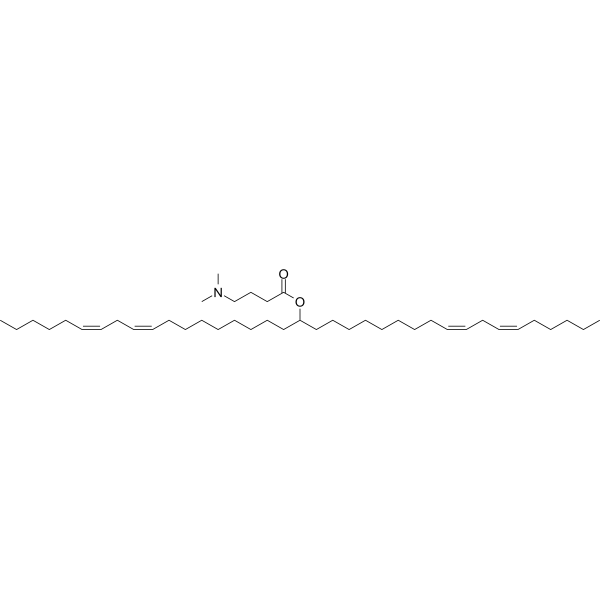
HY-112251
D-Lin-MC3-DMAsiRNA Delivery Vehicle -
HY-109528
Fomivirsen sodiumCMV Inhibitor -

HY-132589
VutrisiransiRNA Agent -

HY-P0035
Insulin (human)Recombinant Human Insulin -
HY-16658B
Z-VAD-FMKPan-Caspase Inhibitor
Publications Citing Use of MedChemExpress (MCE) Patisiran sodium
More

Biological Activity
Description
In Vitro
Patisiran sodium causes TTR degradation (via RNA interference) and subsequently a reduction in serum TTR protein levels and tissue TTR protein deposits by specifically binding to a genetically conserved sequence in the 3' untranslated region of mutant and wild-type transthyretin (TTR) messenger RNA[2].
MedChemExpress (MCE) has not independently confirmed the accuracy of these methods. They are for reference only. Further protocols information, click here.


Chemical Information
-
CAS No. 1386913-72-9
-
Appearance Solid
-
Molecular Weight 13424 (free acid)
-
Color White to light yellow
-
SMILES
[Patisiran (sodium)]
-
Sequence
RNA, (A-U-G-G-A-A-Um-A-C-U-C-U-U-G-G-U-Um-A-C-dT-dT), complex with RNA (G-Um-A-ACm-Cm-A-A-G-A-G-Um-A-Um-Um-Cm-Cm-A-Um-dT-dT) (1:1) sodium salt
-
Shipping
Room temperature in continental US; may vary elsewhere.
-
Storage
-20°C, stored under nitrogen, away from moisture
* In solvent : -80°C, 6 months; -20°C, 1 month (stored under nitrogen, away from moisture)


Publications (1)
-
Journal Impact Factor
-
Most Recent
-
J Control Release
Impact of ionizable lipid source on quality and stability of siRNA-loaded lipid nanoparticles. [Abstract]2026 Mar 14:114825. PMID: 41839265


Solvent & Solubility
In Vitro:
H2O : 33.33 mg/mL (Need ultrasonic)

Protocols
-
Amyloid: Congo Red Amyloid Staining
Congo red amyloid staining is a histochemical method used to detect extracellular amyloid deposits in tissue sections based on the affinity of Congo red dye for β-pleated sheet-rich protein aggregates. When bound to amyloid, Congo red produces characteristic apple-green birefringence under polarized light microscopy, which is widely regarded as a diagnostic feature of amyloid deposition in histopathology. The diagnostic principle relies on the combination of dye binding (congophilia) and optical anisotropy under polarized illumination, which distinguishes amyloid from most non-amyloid eosinophilic extracellular deposits in routine histological evaluation. Amyloid identification by Congo red staining remains a cornerstone in diagnostic pathology despite the availability of adjunct methods such as immunohistochemistry and mass spectrometry, particularly because of its ability to localize deposits directly within tissue architecture. The specificity of Congo red-positive deposits is incre


Purity & Documentation
-
Data Sheet (270 KB)
-
SDS (251 KB)
- English - EN (251 KB)
- Français - FR (251 KB)
- Deutsch - DE (251 KB)
- Norwegian - NO (251 KB)
- Español - ES (251 KB)
- Swedish - SV (251 KB)
- Italian - IT (251 KB)
- Korean - KR (251 KB)
- Portuguese - PT (251 KB)
-
Handling Instructions (2242 KB)
References
[1]. Adams D, et, al. Patisiran, an RNAi Therapeutic, for Hereditary Transthyretin Amyloidosis. N Engl J Med. 2018 Jul 5;379(1):11-21. [Content Brief]
[2]. Hoy SM. Patisiran: First Global Approval. Drugs. 2018 Oct;78(15):1625-1631. [Content Brief]
[3]. Kristen AV, et, al. Patisiran, an RNAi therapeutic for the treatment of hereditary transthyretin-mediated amyloidosis. Neurodegener Dis Manag. 2019 Feb;9(1):5-23. [Content Brief]

Calculators
Concentration (start) × Volume (start) = Concentration (final) × Volume (final)


Patisiran sodium Related Classifications
HY-132609 Related Classifications
 Powered by Bioz