



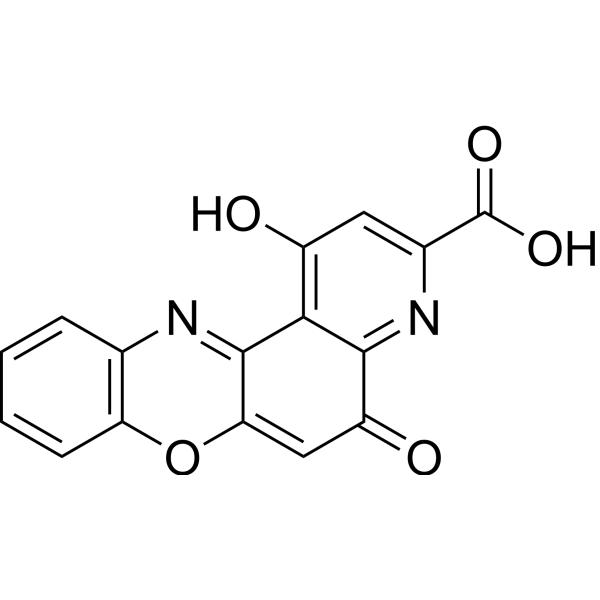
Pirenoxine

Based on 1 Customer Validation
Pirenoxine (Catalin K) is an antioxidant with lens-protective activity. Pirenoxine inhibits lens sclerosis, prevents lipid peroxidation and suppresses lens protein opacification. Pirenoxine blocks benzoquinone acetic acid-induced cataract progression. Pirenoxine can be used in research related to presbyopia and cataracts.
Nos produits utilisent uniquement pour la recherche. Nous ne vendons pas aux patients.
- Pureté : 95.0%
- CAS No.: 1043-21-6
- Formule: C16H8N2O5
- Masse moléculaire:308.25
-
Stockage:Powder -20°C, 3 years ; In solvent -80°C, 6 months , -20°C, 1 month

To place orders, for customer services and technical support, please contact: MedChemExpress USA
Tel: 609-228-6898 E-mail: [email protected] [email protected]


-
 Activité biologique
-
Chemical Information
-
Solvant et solubilité
- Protocole
- Pureté et documentation
- Références
-
 Help & FAQs




Activité biologique
Description
In Vitro
Pirenoxine inhibits lens protein opacification induced by UVC, selenite and Ca2+[1][2].
Pirenoxine (PRX) (0.016-0.1 μM; 0-4 days) delays selenite-induced early lens opacification and reduces the degradation of insoluble lens proteins in lens homogenates of SD rat pups[2].
Pirenoxine reduces UVC-induced lens opacity and γ-crystallin degradation in porcine lens homogenates; it delays the onset and reduces the opacity of glucose/galactose-induced diabetic cataracts in intact goat lenses[2].
Pirenoxine (10-4 M) elevates the levels of glutathione (GSH), water-soluble proteins and sulfur-containing amino acids in lenses of galactose-induced diabetic SD rats, while it only produces partial effects at 10-5 M[2].
Pirenoxine inhibits oxidative damage in intact rat lenses induced by macrophages stimulated with Fe3+/ascorbic acid, hemoglobin or fMLP; it also inhibits lipid peroxidation in intact rat lenses treated with ROS induced by xanthine/xanthine oxidase[2].
Pirenoxine (60 μM; 48 h) reduces sorbitol content in bovine lenses[2].
MedChemExpress (MCE) has not independently confirmed the accuracy of these methods. They are for reference only.
In Vivo
Pirenoxine (0.005% concentration; topical administration; 4 times daily; for 120 consecutive days) delays the progression of age-related cataracts in senescence-accelerated mice[2].
Pirenoxine (2.5-5 mg/kg; subcutaneous injection; single administration) prevents early gross lens opacification in selenite-induced cataract SD young rats only at the dose of 5 mg/kg[2].
Pirenoxine (PRX) (0.8 mg/15 mL; topical administration; three times daily for 7 consecutive days) increases the activities of antioxidant enzymes and the level of GSH, while reduces the levels of oxidative damage markers in Wistar rats with selenite-induced cataracts[2].
Pirenoxine (concentration 0.005-2%; topical administration; 2 drops, three times daily; for 30 consecutive days) reduces the incidence of cataracts in galactose-induced diabetic cataract SD rats and tryptophan deficiency-induced congenital cataract colored rabbits, and improves the antioxidant/protein-related indicators of their lenses[2].
Pirenoxine (concentration 0.0053%; topical administration; three times daily; for 60 consecutive days) slows disease progression and reverses lens opacification in Wistar rats with established galactose-induced diabetic cataracts[2].
MedChemExpress (MCE) has not independently confirmed the accuracy of these methods. They are for reference only.
-
Animal Model:Sprague-Dawley (6-week-old male, tobacco smoke-induced presbyopia model)[1]
-
Dosage:0.005%
-
Administration:eye drops; 4 times daily; 12 days
-
Result:Reduced lens elasticity ratio significantly compared to PBS-treated smoke-exposed rats.
-
Animal Model:Wistar rat[2]
-
Dosage:0.8 mg/15 mL concentration
-
Administration:topical; 3 times daily; 7 days
-
Result:Increased superoxide dismutase (SOD) activity in serum compared to untreated controls.
Increased catalase (CAT) activity in serum compared to untreated controls.
Decreased malondialdehyde (MDA) levels in serum compared to untreated controls.
Increased SOD activity in lens tissue compared to untreated controls.
Increased CAT activity in lens tissue compared to untreated controls.
Increased reduced glutathione (GSH) levels in lens tissue compared to untreated controls.
-
Animal Model:
-
Dosage:0.005% concentration; 0.01% concentration; 2% concentration
-
Administration:topical; 2 drops 3 times daily; 30 days
-
Result:Reduced cataract incidence by 40%.
Increased lens GSH levels.
Increased lens water-soluble protein levels.
Increased lens sulfur-containing amino acid levels.
-
Animal Model:Wistar rat[2]
-
Dosage:0.0053% concentration
-
Administration:topical; 3 times daily; 60 days
-
Result:Reduced lens opacity between days 10 and 90 of galactose exposure.
Reduced progression of lens opacity between days 10 and 90 of galactose exposure.


Chemical Information
-
CAS No. 1043-21-6
-
Appearance Solid
-
Masse moléculaire 308.25
-
Formule C16H8N2O5
-
Color Light brown to brown
-
SMILES
O=C(C1=CC(O)=C2C(C(C=C3OC4=C(N=C32)C=CC=C4)=O)=N1)O
-
Synonyms
Catalin K
-
Livraison
Room temperature in continental US; may vary elsewhere.
-
Stockage
Powder -20°C 3 years In solvent -80°C 6 months -20°C 1 month


Solvant et solubilité
In Vitro:
H2O : < 0.1 mg/mL (insoluble)


Pureté et documentation
-
Fiche technique (290 KB)
-
SDS (393 KB)
- English - EN (393 KB)
- Français - FR (393 KB)
- Deutsch - DE (393 KB)
- Norwegian - NO (393 KB)
- Español - ES (393 KB)
- Swedish - SV (393 KB)
- Italian - IT (393 KB)
- Korean - KR (393 KB)
- Portuguese - PT (393 KB)
-
Instruction de manipulation (2659 KB)
Références
[1]. Tsuneyoshi Y, et al. Suppression of presbyopia progression with pirenoxine eye drops: experiments on rats and non-blinded, randomized clinical trial of efficacy. Scientific reports. 2017 Jul 28;7(1):6819. [Content Brief]
[2]. Upaphong P, et al. The Possible Positive Mechanisms of Pirenoxine in Cataract Formation. International journal of molecular sciences. 2022 Aug 21;23(16):9431. [Content Brief]

Calculators
Concentration (start) × Volume (start) = Concentration (final) × Volume (final)


Pirenoxine Related Classifications
HY-108296 Related Classifications
 Powered by Bioz