



PLGA-PEG-MAL (20kDA-5.0kDA, LA:GA ratio 50:50)
Based on 1 publication(s) in Google Scholar
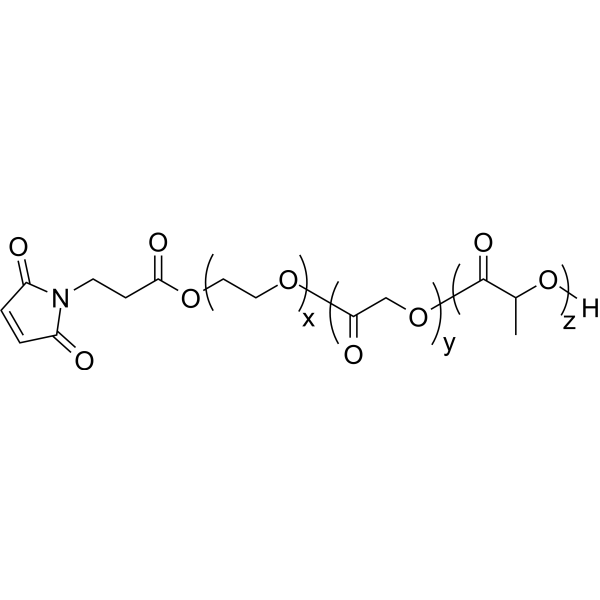
PLGA-PEG-MAL (20kDA-5.0kDA, LA:GA ratio 50:50) is a degradable amphiphilic polymer nanocarrier of poly (lactic acid-co-glycolic acid)-block-poly (ethylene glycol) (PLGA-PEG-Mal) that allows covalent modification of functional molecules. PLGA-PEG-MAL (20kDA-5.0kDA, LA:GA ratio 50:50) serves as a core polymer for nanoparticle synthesis, and also acts as a nanoparticle component for site-specific antibody conjugation to construct artificial antigen-presenting cells. PLGA-PEG-MAL (20kDA-5.0kDA, LA:GA ratio 50:50) is applicable for drug delivery-related research.
For research use only. We do not sell to patients.
-
Storage:Pure form -20°C, 3 years , 4°C, 2 years ; In solvent -80°C, 6 months , -20°C, 1 month

To place orders, for customer services and technical support, please contact: MedChemExpress USA
Tel: 609-228-6898 E-mail: [email protected] [email protected]


-
 Biological Activity
-
Chemical Information
- Purity & Documentation
- References
-
 Help & FAQs


Publications Citing Use of MedChemExpress (MCE) PLGA-PEG-MAL (20kDA-5.0kDA, LA:GA ratio 50:50)
More

Biological Activity
Description
In Vitro
PLGA-PEG-MAL (20 kDa-5.0 kDa, LA:GA ratio 50:50) nanoparticles conjugated with MECA79 and anti-CD3 antibodies exhibit a stable spherical morphology, sustain the in vitro release of anti-CD3 monoclonal antibodies for up to one week, and possess long-term stability in NOD mouse plasma[1].
PLGA-PEG-MAL (20 kDa-5.0 kDa, LA:GA ratio 50:50)-modified artificial antigen-presenting cells (NP-Mal low and NP-Mal high) induce weaker calcium influx in human CD8+ T cells compared with azide-functionalized nanoparticles and boost granzyme B secretion[2].
PLGA-PEG-MAL (20kDA-5.0kDA, LA:GA ratio 50:50)-based aAPCs (NP-Mal low and NP-Mal high) modulate CD8+ T cell phenotype at a concentration of 200 μg/mL, with NP-Mal high promoting a more differentiated, central memory phenotype and NP-Mal low promoting a more effector memory phenotype[2].
MedChemExpress (MCE) has not independently confirmed the accuracy of these methods. They are for reference only. .
In Vivo
MedChemExpress (MCE) has not independently confirmed the accuracy of these methods. They are for reference only.


Chemical Information
-
Appearance Oil
-
Color White to off-white
-
SMILES
O=C(C=CC1=O)N1CCC(OCCOCC(COCC(C(O[H])C)=O)=O)=O.[x].[y]
-
Shipping
Room temperature in continental US; may vary elsewhere.
-
Storage
Pure form -20°C 3 years 4°C 2 years In solvent -80°C 6 months -20°C 1 month


Publications (1)
-
Journal Impact Factor
-
Most Recent
-
Adv Sci (Weinh)
Targeting the SOX9/TIMP1 Axis with iRGD-Conjugated Nanoplatform Enhances Dendritic Cell Function and Photodynamic Immunotherapy in Gastric Cancer. [Abstract]2025 Nov 21:e10500. PMID: 41270217


Purity & Documentation
-
Data Sheet (271 KB)
-
SDS (252 KB)
- English - EN (252 KB)
- Français - FR (252 KB)
- Deutsch - DE (252 KB)
- Norwegian - NO (252 KB)
- Español - ES (252 KB)
- Swedish - SV (252 KB)
- Italian - IT (252 KB)
- Korean - KR (252 KB)
- Portuguese - PT (252 KB)
-
Handling Instructions (2659 KB)
References

Calculators
Concentration (start) × Volume (start) = Concentration (final) × Volume (final)


PLGA-PEG-MAL (20kDA-5.0kDA, LA:GA ratio 50:50) Related Classifications
HY-148776 Related Classifications
 Powered by Bioz
Keywords
- PLGA-PEG-MAL (20kDA-5.0kDA, LA:GA ratio 50:50)
- Biochemical Assay Reagents
- artificial antigen-presenting cells
- Granzyme B
- PLNs
- poly(d,l-lactic-co-glycolic) acid-polyethylene glycol block copolymer
- clathrin-mediated internalization
- human CD8+ T cells
- nanoparticle synthesis
- type 1 diabetes
- NOD mice
- inflamed pancreata
- Inhibitor
- inhibitor
- inhibit