



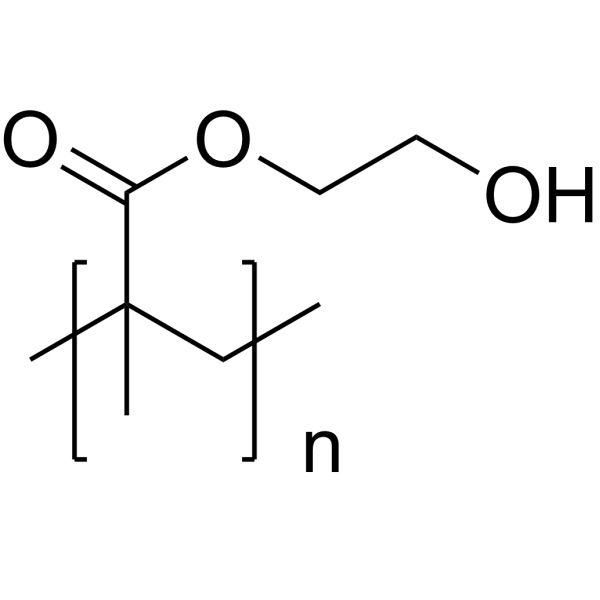
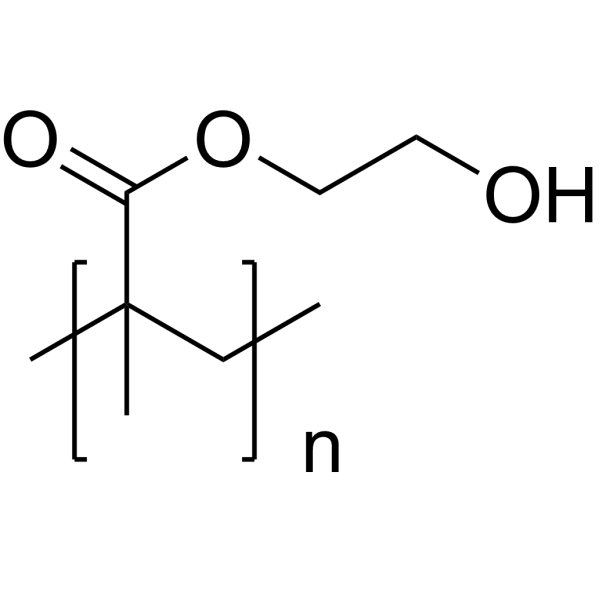
Poly(2-hydroxyethyl methacrylate) (Mv 300000)

Based on 1 Customer Validation
Poly(2-hydroxyethyl methacrylate) (Mv 300000) is a biocompatible, optically transparent, hydrophilic, and non-degradable polymer with excellent cytocompatibility, eliciting a minimal immunological response from host tissue. Poly(2-hydroxyethyl methacrylate) (Mv 300000) can be used for different biomedical applications, such as bone tissue regeneration, wound dressings and drug delivery.
For research use only. We do not sell to patients.
- CAS No.: 25249-16-5
- Molecular Weight:300000(Average)
-
Storage:Powder -20°C, 3 years , 4°C, 2 years ; In solvent -80°C, 6 months , -20°C, 1 month


To place orders, for customer services and technical support, please contact: MedChemExpress USA
Tel: 609-228-6898 E-mail: [email protected] [email protected]


-
 Biological Activity
-
Chemical Information
-
Solvent & Solubility
- Purity & Documentation
- References
-
 Help & FAQs






Biological Activity
Description
In Vitro
Poly(2-hydroxyethyl methacrylate) (Mv 300000) absorbs water or biological fluids via its hydrophilic pendant groups to form a hydrogel, which is utilized in applications, such as soft contact lenses, tissue regeneration, cancer research, ocular drug delivery, artificial skin, artificial cornea, and so on[1].
Poly(2-hydroxyethyl methacrylate) (Mv 300000) can be loaded with Quercetin (QT) (HY-18085) to synthesize QT-pHEMA-GelCryoMem, which exhibits good antimicrobial activity against S. aureus and can be used in various applications, such as wound dressings, scaffolds, or drug delivery[2].
Poly(2-hydroxyethyl methacrylate) (Mv 300000) can be used in the synthesis of spongy materials possessing antimicrobial properties, making them potential candidates for wound and burn dressing applications[3].
MedChemExpress (MCE) has not independently confirmed the accuracy of these methods. They are for reference only. .


Chemical Information
-
CAS No. 25249-16-5
-
Appearance Solid
-
Molecular Weight 300000(Average)
-
Color White to off-white
-
SMILES
OCCOC(C(C)(C)CC)=O.[n]
-
Shipping
Room temperature in continental US; may vary elsewhere.
-
Storage
Powder -20°C 3 years 4°C 2 years In solvent -80°C 6 months -20°C 1 month


Solvent & Solubility
In Vitro:
DMSO : 50 mg/mL (Need ultrasonic; Hygroscopic DMSO has a significant impact on the solubility of product, please use newly opened DMSO)


Purity & Documentation
-
Data Sheet (271 KB)
-
SDS (251 KB)
- English - EN (251 KB)
- Français - FR (251 KB)
- Deutsch - DE (251 KB)
- Norwegian - NO (251 KB)
- Español - ES (251 KB)
- Swedish - SV (251 KB)
- Italian - IT (251 KB)
- Korean - KR (251 KB)
- Portuguese - PT (251 KB)
-
Handling Instructions (2659 KB)
References
[1]. Tuna B, et al. Advancing wound healing: controlled release of tannic acid via epitope imprinted antimicrobial spongy cover material. World J Microbiol Biotechnol. 2025 Feb 4;41(2):59. [Content Brief]
[2]. Zare M, et al. pHEMA: An Overview for Biomedical Applications. Int J Mol Sci. 2021 Jun 15;22(12):6376. [Content Brief]

Calculators
Concentration (start) × Volume (start) = Concentration (final) × Volume (final)


Poly(2-hydroxyethyl methacrylate) (Mv 300000) Related Classifications
HY-112531B Related Classifications
 Powered by Bioz