



Polycaprolactone diol (MW 2000)

Based on 1 Customer Validation
Polycaprolactone diol (MW 2000) (PCL-diol (MW 2000)) can be used as a precursor of biodegradable and bioabsorbable polycaprolactone.
연구목적의 판매만을 진행합니다. 환자를 대상으로 한 판매는 하지 않습니다.
- CAS No.: 36890-68-3
- 분자량:2000 (Average)
-
보관:
Store at room temperature, keep dry and cool.
In solvent -80°C, 1 year , -20°C, 6 months


To place orders, for customer services and technical support, please contact: MedChemExpress USA
Tel: 609-228-6898 E-mail: [email protected] [email protected]


-
 Biological Activity
-
Chemical Information
- 순도&문서
- References
-
 Help & FAQs


-

HY-W392100A
Polycaprolactone diol (MW 530)Monomer For Network Elastic Polyesters -
HY-D1005
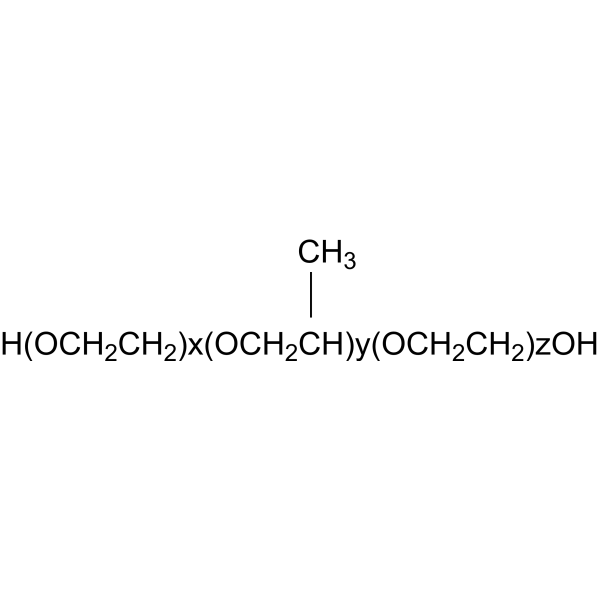
Poloxamer 407 (F127)LPL Receptor Inhibitor -
HY-Y0703
Sodium carboxymethyl cellulose (Viscosity:800-1200 mPa.s)Biochemical Assay Reagent -
HY-D1005A
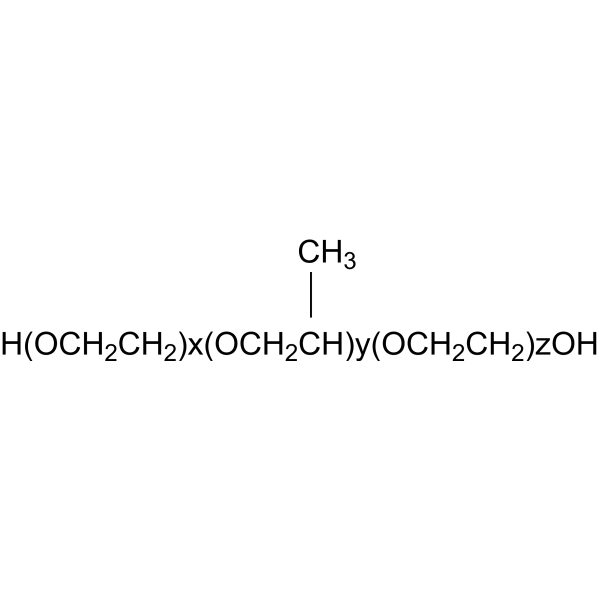
Poloxamer 188Linear Copolymer -
HY-D1005H
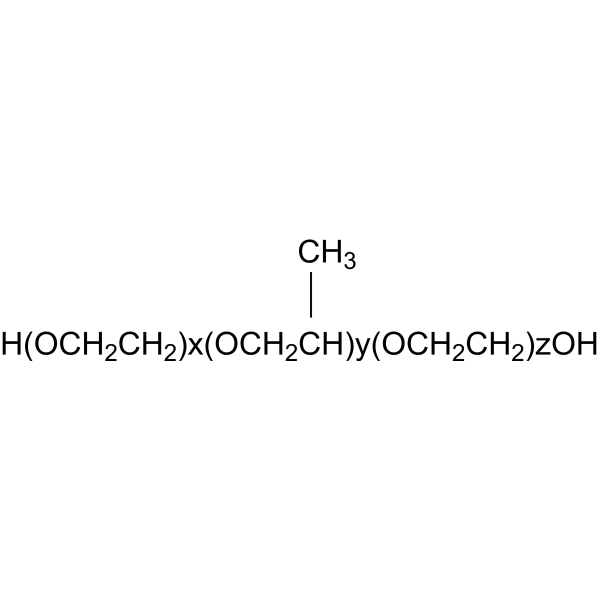
Poloxamer 188 (F68)Nonionic Linear Copolymer -

HY-W392100C
Polycaprolactone diol (MW 10000)Biochemical Assay Reagents -
HY-Y0703C
Sodium carboxymethyl cellulose (Viscosity:300-800mpa.s)Biochemical Assay Reagent -

HY-Y1365
GelatinsNatural Materials -
HY-D1005A6
Poloxamer 124 (L44)Biochemical Assay Agent -
HY-D1005A22
Poloxamer 338 (F108)Biochemical Assay Agent -
HY-Y1889A
Sodium carboxymethyl cellulose (MW 250000)Anti-adhesion agent -
HY-Y0703A
Sodium carboxymethyl cellulose (Viscosity:1200-1400 mPa.s)Biochemical Assay Reagent


Biological Activity
제품 설명
In Vitro
Polycaprolactone diol (MW 2000) holds potential for use in the synthesis of flexible, wear-resistant polyurethanes (TPU, WPU, elastomers, and adhesives), as well as in biodegradable tissue scaffolds, long-acting sustained-release drug carriers, flexible 3D printing materials, and flexible industrial coatings.
MedChemExpress (MCE) has not independently confirmed the accuracy of these methods. They are for reference only. .


Chemical Information
-
CAS No. 36890-68-3
-
Appearance Solid-Liquid Mixture
-
분자량 2000 (Average)
-
Color White to off-white
-
SMILES
[H]OCCCCCC(OCCOCCOC(CCCCCO[H])=O)=O.[n].[n]
-
Synonyms
PCL-diol (MW 2000)
-
선적
Room temperature in continental US; may vary elsewhere.
-
보관
Store at room temperature, keep dry and cool
In solvent -80°C 1 year -20°C 6 months


순도&문서
-
Data Sheet (262 KB)
-
SDS (251 KB)
- English - EN (251 KB)
- Français - FR (251 KB)
- Deutsch - DE (251 KB)
- Norwegian - NO (251 KB)
- Español - ES (251 KB)
- Swedish - SV (251 KB)
- Italian - IT (251 KB)
- Korean - KR (251 KB)
- Portuguese - PT (251 KB)
-
Handling Instructions (2659 KB)
References

Calculators
Concentration (start) × Volume (start) = Concentration (final) × Volume (final)


Polycaprolactone diol (MW 2000) Related Classifications
HY-W392100B Related Classifications
 Powered by Bioz