



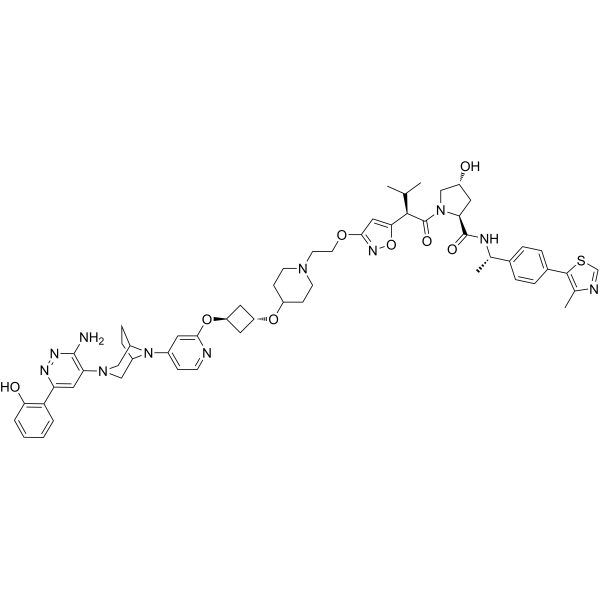
PROTAC BRM degrader-1
PROTAC BRM degrader-1 is a VHL-recruiting PROTAC degrader that exhibits higher selectivity for the degradation of SMARCA2 (BRM) over its highly homologous protein SMARCA4 (BRG1). The KD values of PROTAC BRM degrader-1 for BRM and BRG1 are 72 nM and 108 nM, respectively. PROTAC BRM degrader-1 can be used in studies related to selective SMARCA2 degradation, SWI/SNF function, and SMARCA4-mutant non-small cell lung cancer.
For research use only. We do not sell to patients.
- CAS No.: 2378051-80-8
- Formula: C57H69N11O8S
- Molecular Weight:1068.29
-
Storage:
Please store the product under the recommended conditions in the Certificate of Analysis.

To place orders, for customer services and technical support, please contact: MedChemExpress USA
Tel: 609-228-6898 E-mail: [email protected] [email protected]


-
 Biological Activity
-
Chemical Information
- Purity & Documentation
- References
-
 Help & FAQs




Biological Activity
Description
IC50 & Target
[1]|
BRM 72 nM (Kd) |
BRG1 108 nM (Kd) |
Cellular Effect
|
Cell Line

|
Type | Value | Description | References |
|---|---|---|---|---|
| Calu-6 | GI50 |
24 nM
|
Inhibited Calu-6 cell proliferation.
Inhibited Calu-6 cell proliferation.
|
38180485 |
| NCI-H1944 | GI50 |
0.64 nM
|
Antiproliferative activity against H1944 BRG1-mutant non-small cell lung cancer cells assessed as growth inhibition incubated for 7 days.
Antiproliferative activity against H1944 BRG1-mutant non-small cell lung cancer cells assessed as growth inhibition incubated for 7 days.
|
38180485 |
In Vitro
PROTAC BRM degrader-1 (compound 17) binds to the bromodomain protein fragments of BRM and BRG1 with KD values of 72 and 108 nM, respectively, and binds to VHL with a KD of 3.4 nM[1].
PROTAC BRM degrader-1 forms the VHL-PROTAC-BRM and VHL-PROTAC-BRG1 ternary complexes in SPR assays. When BRM/BRG1 bromodomain fragments are used, the t1/2 values of the complexes are 13.3 and 9.5 s, respectively; when full-length BRM/BRG1 is used, the t1/2 values are 346 and 1174 s, respectively. The lifetime of the ternary complexes does not show a consistent correlation with the 53-fold BRM degradation selectivity[1].
The plasma protein binding rate of PROTAC BRM degrader-1 (compound 17) in mice reaches up to 97.3%[1].
PROTAC BRM degrader-1 (100 nM; 8 h) reduces BRM and BRG1 in whole proteome analysis of SW1573 cells, while significantly affecting PALS1, B4E2N5, and PATJ, and exerts a minor protein abundance-lowering effect on MAPKAPK3, PLAU, and PBRM1[1].
PROTAC BRM degrader-1 has an extraction ratio (ER) of 0.53 in the mouse liver microsomal stability assay[1].
PROTAC BRM degrader-1 (22 h) degrades BRM and BRG1 in a concentration-dependent manner in SW1573 cells, with DC50 values of 0.093 nM and 4.9 nM, respectively. Both proteins exhibit a Dmax of >85%, and the BRG1/BRM DC50 ratio is 53[1].
PROTAC BRM degrader-1 (concentration gradient; 7 d) inhibits the proliferation of BRG1-mutated, BRM-dependent H1944 cells, with a GI50 of 0.64 nM[1].
PROTAC BRM degrader-1 (concentration gradient; 7 d) inhibits the proliferation of BRG1 wild-type Calu6 cells, with a GI50 of 24 nM, and its activity is significantly weaker than that in H1944 cells[1].
MedChemExpress (MCE) has not independently confirmed the accuracy of these methods. They are for reference only.
-
Cell Line:H1944 BRG1-mutant non-small cell lung cancer cells
-
Concentration:0.64 nM
-
Incubation Time:7 day
-
Result:Inhibited proliferation of the BRM-dependent H1944 cell line with a H1944 GI50 value of 0.64 nM.
-
Cell Line:SW1573
-
Concentration:100 nM
-
Incubation Time:8 h
-
Result:Reduced BRM abundance.
Reduced BRG1 abundance.
Substantially reduced PALS1, B4E2N5, and PATJ abundance.
Produced smaller reductions in MAPKAPK3, PLAU, and PBRM1 abundance.
In Vivo
PROTAC BRM degrader-1 (10 mg/kg; i.p.; once daily) again exhibits poor tolerability in subsequent HCC2302 xenograft experiments[1].
PROTAC BRM degrader-1 (40 mg/kg; single intravenous administration; 96 h) induces 64% BRM degradation in HCC2302 xenograft tumors, and only causes a 4% reduction in BRG1 in simultaneously collected mouse stromal cells, with an intratumoral compound concentration of 158 ng/g at 96 h[1].
PROTAC BRM degrader-1 (10 or 30 mg/kg; i.p.; once daily; days 0-11) only slightly affects tumor growth in BRG1-mutated, BRM-dependent HCC2302 xenograft models, with no dose-response relationship observed. Meanwhile, it induces significant body weight loss, and all experimental animals ultimately die or are euthanized before day 13[1].
MedChemExpress (MCE) has not independently confirmed the accuracy of these methods. They are for reference only.
-
Animal Model:BALB/c nude mice (Female athymic nude)[1]
-
Dosage:10 mg/kg
-
Administration:i.p.; single administration
-
Result:Degraded BRM by 83%.
Degraded BRG1 by 27%.
Produced a plasma concentration of 26 nM at 24 h.
-
Animal Model:BALB/c nude mice (Female athymic nude)[1]
-
Dosage:40 mg/kg
-
Administration:i.v.; single administration
-
Result:Degraded tumor BRM by 64%.
Reduced BRG1 by 4% in mouse stromal cells.
Produced a tumor concentration of 158 ng/g at 96 h.
-
Animal Model:BALB/c nude mice (Female athymic nude)[1]
-
Dosage:10 mg/kg; 30 mg/kg
-
Administration:i.p.; once daily; 11 days
-
Result:Induced only minor tumor growth inhibition relative to vehicle control over 11 days of dosing.
Caused significant mouse body weight loss, with all test animals dead or euthanized by day 13 due to poor overall health.
-
Animal Model:BALB/c nude mice (Female athymic nude)[1]
-
Dosage:10 mg/kg
-
Administration:i.p.; once daily
-
Result:Again showed poor tolerability.
Resulted in euthanasia of 6/6 mice by day 15.


Chemical Information
-
CAS No. 2378051-80-8
-
Molecular Weight 1068.29
-
Formula C57H69N11O8S
-
SMILES
NC1=C(C=C(C(C=CC=C2)=C2O)N=N1)N3C[C@H](CC4)N(C5=CC=NC(O[C@@H](C6)C[C@H]6OC(CC7)CCN7CCOC8=NOC([C@@H](C(C)C)C(N(C[C@@H]9O)[C@@H](C9)C(N[C@H](C%10=CC=C(C(SC=N%11)=C%11C)C=C%10)C)=O)=O)=C8)=C5)[C@H]4C3
-
Shipping
Room temperature in continental US; may vary elsewhere.
-
Storage
Please store the product under the recommended conditions in the Certificate of Analysis.


Purity & Documentation
References

Calculators
Concentration (start) × Volume (start) = Concentration (final) × Volume (final)


PROTAC BRM degrader-1 Related Classifications
HY-163152 Related Classifications
 Powered by Bioz
Keywords
- PROTAC BRM degrader-1
- 2378051-80-8
- PROTAC BRM degrader1
- PROTAC BRM degrader 1
- PROTACs
- SWI/SNF Complex
- mouse plasma proteins
- BRG1
- HCC2302 BRG1 mutant xenograft tumors
- non-small cell lung cancer
- Calu6 xenograft tumors
- SW1573 cells
- H1944 NSCLC cell line
- mouse liver microsomes
- VHL E3 ubiquitin ligase
- BRM
- Inhibitor
- inhibitor
- inhibit