



QL47R

Based on 1 Customer Validation
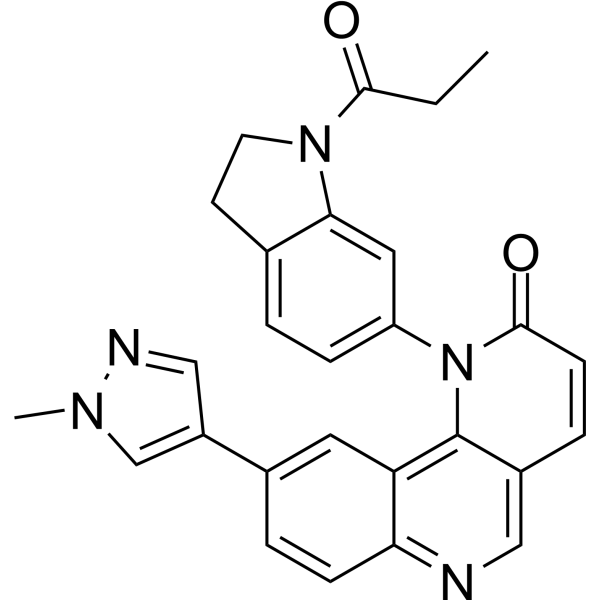
QL47R is an approximately isosteric analogue of QL47 (HY-80003). QL47R dose not inhibit the biochemical kinase activity of BTK at concentrations below 10 μM. QL47R dose not display antiproliferative activity on B-Cell Lymphoma Cell Lines at concentrations of less than 10 μM.
For research use only. We do not sell to patients.
- Purity : 99.94%
- CAS No.: 1579278-89-9
- Formula: C27H23N5O2
- Molecular Weight:449.50
-
Storage:Powder -20°C, 3 years ; In solvent -80°C, 6 months , -20°C, 1 month

To place orders, for customer services and technical support, please contact: MedChemExpress USA
Tel: 609-228-6898 E-mail: [email protected] [email protected]


-
 Biological Activity
-
Chemical Information
-
Solvent & Solubility
- Protocols
- Purity & Documentation
- References
-
 Help & FAQs




Biological Activity
Description


Chemical Information
-
CAS No. 1579278-89-9
-
Appearance Solid
-
Molecular Weight 449.50
-
Formula C27H23N5O2
-
Color Off-white to light yellow
-
SMILES
O=C1C=CC2=CN=C3C=CC(C4=CN(C)N=C4)=CC3=C2N1C5=CC=C6C(N(CC6)C(CC)=O)=C5
-
Shipping
Room temperature in continental US; may vary elsewhere.
-
Storage
Powder -20°C 3 years In solvent -80°C 6 months -20°C 1 month


Solvent & Solubility
In Vitro:
DMSO : 100 mg/mL (222.47 mM; Need ultrasonic; Hygroscopic DMSO has a significant impact on the solubility of product, please use newly opened DMSO)
Please refer to the solubility information to select the appropriate solvent. Once prepared, please aliquot and store the solution to prevent product inactivation from repeated freeze-thaw cycles.
Storage method and period of stock solution: -80°C, 6 months; -20°C, 1 month. When stored at -80°C, please use it within 6 months. When stored at -20°C, please use it within 1 month.
Please refer to the solubility information to select the appropriate solvent. Once prepared, please aliquot and store the solution to prevent product inactivation from repeated freeze-thaw cycles.
Storage method and period of stock solution: -80°C, 6 months; -20°C, 1 month. When stored at -80°C, please use it within 6 months. When stored at -20°C, please use it within 1 month.
Concentration (start) × Volume (start) = Concentration (final) × Volume (final)


Purity & Documentation
-
Data Sheet (276 KB)
-
SDS (252 KB)
- English - EN (252 KB)
- Français - FR (252 KB)
- Deutsch - DE (252 KB)
- Norwegian - NO (252 KB)
- Español - ES (252 KB)
- Swedish - SV (252 KB)
- Italian - IT (252 KB)
- Korean - KR (252 KB)
- Portuguese - PT (252 KB)
-
Handling Instructions (2659 KB)
References


Complete Stock Solution Preparation Table
Please refer to the solubility information to select the appropriate solvent. Once prepared, please aliquot and store the solution to prevent product inactivation from repeated freeze-thaw cycles.
Storage method and period of stock solution: -80°C, 6 months; -20°C, 1 month. When stored at -80°C, please use it within 6 months. When stored at -20°C, please use it within 1 month.
| Optional Solvent | Concentration Solvent Mass | 1 mg | 5 mg | 10 mg | 25 mg |
|---|---|---|---|---|---|
| DMSO | 1 mM | 2.2247 mL | 11.1235 mL | 22.2469 mL | 55.6174 mL |
| 5 mM | 0.4449 mL | 2.2247 mL | 4.4494 mL | 11.1235 mL | |
| 10 mM | 0.2225 mL | 1.1123 mL | 2.2247 mL | 5.5617 mL | |
| 15 mM | 0.1483 mL | 0.7416 mL | 1.4831 mL | 3.7078 mL | |
| 20 mM | 0.1112 mL | 0.5562 mL | 1.1123 mL | 2.7809 mL | |
| 25 mM | 0.0890 mL | 0.4449 mL | 0.8899 mL | 2.2247 mL | |
| 30 mM | 0.0742 mL | 0.3708 mL | 0.7416 mL | 1.8539 mL | |
| 40 mM | 0.0556 mL | 0.2781 mL | 0.5562 mL | 1.3904 mL | |
| 50 mM | 0.0445 mL | 0.2225 mL | 0.4449 mL | 1.1123 mL | |
| 60 mM | 0.0371 mL | 0.1854 mL | 0.3708 mL | 0.9270 mL | |
| 80 mM | 0.0278 mL | 0.1390 mL | 0.2781 mL | 0.6952 mL | |
| 100 mM | 0.0222 mL | 0.1112 mL | 0.2225 mL | 0.5562 mL |


QL47R Related Classifications
HY-160245 Related Classifications
 Powered by Bioz