



AITRL/TNFSF18 Protein, Mouse
Based on 1 publication(s) in Google Scholar
AITRL, a type II transmembrane protein, is a ligand for glucocorticoid-induced TNFR-related protein (GITR). When AITRL binds to GITR, GITR can produce costimulatory signals that regulate T-cell proliferation and effector functions. GITR/AITRL interaction plays a role in the pathogenesis of tumor, inflammation, as well as autoimmune diseases. Besides, AITRL plays a role in endothelial cells (EC)-activation and increases STAT-1 phosphorylation and the expression of adhesion molecules (VCAM-1, ICAM-1). AITRL/TNFSF18 Protein, Mouse is a recombinant mouse AITRL (T47-S173) without tag, which is expressed in E.coli.
- Species: Mouse
- Source: E. coli
-
Storage:Stored at -20°C for 2 years from date of receipt. After reconstitution, it is stable at 4°C for 1 week or -20°C for longer (with carrier protein). It is recommended to freeze aliquots at -20°C or -80°C for extended storage.


To place orders, for customer services and technical support, please contact: MedChemExpress USA
Tel: 609-228-6898 E-mail: [email protected] [email protected]


-
 Biological Activity
-
Technical Parameters
-
Product Properties
- Documentation
- References
- Help & FAQs




Biological Activity
Description
AITRL, a type II transmembrane protein, is a ligand for glucocorticoid-induced TNFR-related protein (GITR). When AITRL binds to GITR, GITR can produce costimulatory signals that regulate T-cell proliferation and effector functions. GITR/AITRL interaction plays a role in the pathogenesis of tumor, inflammation, as well as autoimmune diseases[1]. Besides, AITRL plays a role in endothelial cells (EC)-activation and increases STAT-1 phosphorylation and the expression of adhesion molecules (VCAM-1, ICAM-1)[2]. AITRL/TNFSF18 Protein, Mouse is a recombinant mouse AITRL (T47-S173) without tag, which is expressed in E.coli.
Background
GITRL (AITRL), a type II transmembrane protein, is a ligand for glucocorticoid-induced TNFR-related protein (GITR). GITR, a member of the TNFR superfamily, is expressed in T cells, natural killer cells and some myeloid cells[1]. And murine GITRL has been detected on dendritic cells (DCs), monocytes, macrophages, B cells, endothelial cells, osteoclasts, and microglia cells[4].
When GITRL binds to GITR, GITR can produce costimulatory signals that regulate T-cell proliferation and effector functions. The interaction stimulates proliferation and cytokine production of both CD4+ Teff and Treg cells, and drives antitumor activity of CD8+ T cells[3]. Besides, GITRL plays a role in EC-activation and promotes adhesion in both mice and humans, which increases STAT-1 phosphorylation and the augmented expression of adhesion molecules such as VCAM-1 and ICAM-1[2]. Mouse GITRL can activate signal transduction, including inducing a tolerogenic effect in DCs and pro-inflammatory stimuli in macrophages[7].
Mouse GITRL shares < 55% common aa identity with human. Murine GITRL exists as a dimer[4]
GITR/GITRL interaction plays a role in the pathogenesis of tumor, inflammation, as well as autoimmune diseases[1]
In Vitro
AITRL (mouse, 5 μg/mL, 48 h) promotes the maturation of myeloid-derived suppressor cells (MDSCs) isolated from ESS mice[5].
AITRL (mouse, 2 μg/mL, 72 h) provides moderate costimulation to Treg cell proliferation[6].
In Vivo
AITRL (mouse, 2 mg/kg, i.v.) attenuates the suppressive effect of MDSCs in ESS mice[5].
Verified Bioactivity
The ED50 is <5 ng/mL as measured by PMBC, corresponding to a specific activity of >2 × 10⁵ units/mg.
MCE Validation Data
-
Purity - SDS-PAGE
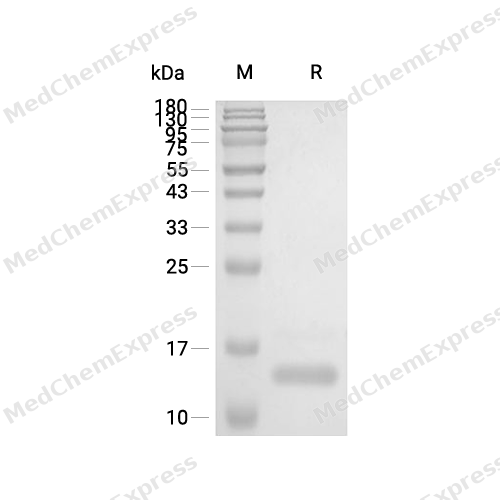
Purity - SDS-PAGE


Publications (1)
-
Journal Impact Factor
-
Most Recent


Technical Parameters
-
Species Mouse
-
Source E. coli
-
Tag Tag Free
-
Accession
Q7TS55 (T47-S173)
-
Molecular Construction
-
N-term
-
AITRL (T47-S173)
Accession # Q7TS55 -
C-term
-
-
Protein Length
Partial Extracellular Domain
-
Synonyms
TNFSF18; Activation-Inducible TNF-Related Ligand; TNF Superfamily Member 18; GITRL; HGITRL; Glucocorticoid-Induced TNFR-Related Protein Ligand; AITRL; Tumor Necrosis Factor Superfamily Member 18; TL6; Tumor Necrosis Factor Ligand 2A; Tumor Necrosis Factor
-
AA Sequence
TAIESCMVKFELSSSKWHMTSPKPHCVNTTSDGKLKILQSGTYLIYGQVIPVDKKYIKDNAPFVVQIYKKNDVLQTLMNDFQILPIGGVYELHAGDNIYLKFNSKDHIQKTNTYWGIILMPDLPFIS
-
Molecular Weight
Approximately 15 kDa, based on SDS-PAGE under reducing conditions.
-
Purity
≥ 95%, as determined by reducing SDS-PAGE.


Product Properties
Lyophilized powder
Lyophilized from a 0.22 μm filtered solution of PBS.
<0.2 EU/μg, determined by LAL method.
It is not recommended to reconstitute to a concentration less than 100 μg/mL in ddH2O. For long term storage it is recommended to add a carrier protein (0.1% BSA, 5% HSA, 10% FBS or 5% Trehalose).
Stored at -20°C for 2 years from date of receipt. After reconstitution, it is stable at 4°C for 1 week or -20°C for longer (with carrier protein). It is recommended to freeze aliquots at -20°C or -80°C for extended storage.
Room temperature in continental US; may vary elsewhere.


Documentation
-
Data Sheet (264 KB)
-
SDS (251 KB)
- English - EN (251 KB)
- Français - FR (251 KB)
- Deutsch - DE (251 KB)
- Norwegian - NO (251 KB)
- Español - ES (251 KB)
- Swedish - SV (251 KB)
- Italian - IT (251 KB)
- Korean - KR (251 KB)
- Portuguese - PT (251 KB)
-
Handling Instructions (2659 KB)


References
[1]. Tian J, et al. The Role of GITR/GITRL Interaction in Autoimmune Diseases. Front Immunol. 2020 Oct 9;11:588682. [Content Brief]
[2]. Park MS, et al. The association of the activation-inducible tumor necrosis factor receptor and ligand with lumbar disc herniation. Yonsei Med J. 2007 Oct 31;48(5):839-46. [Content Brief]
[3]. Lacal PM, et al. Glucocorticoid-induced tumor necrosis factor receptor family-related ligand triggering upregulates vascular cell adhesion molecule-1 and intercellular adhesion molecule-1 and promotes leukocyte adhesion. J Pharmacol Exp Ther. 2013 Oct;347(1):164-72. [Content Brief]
[4]. Wang F, et al. Structures of mouse and human GITR-GITRL complexes reveal unique TNF superfamily interactions. Nat Commun. 2021 Mar 2;12(1):1378. [Content Brief]
[5]. Placke T, et al. Glucocorticoid-induced TNFR-related (GITR) protein and its ligand in antitumor immunity: functional role and therapeutic modulation. Clin Dev Immunol. 2010;2010:239083. [Content Brief]
[6]. Tian J, et al. Increased GITRL Impairs the Function of Myeloid-Derived Suppressor Cells and Exacerbates Primary Sjögren Syndrome. J Immunol. 2019 Mar 15;202(6):1693-1703. [Content Brief]
[7]. Chen M, et al. IFN-β induces the proliferation of CD4+CD25+Foxp3+ regulatory T cells through upregulation of GITRL on dendritic cells in the treatment of multiple sclerosis. J Neuroimmunol. 2012 Jan 18;242(1-2):39-46. [Content Brief]
[8]. Nocentini G, et al. Pharmacological modulation of GITRL/GITR system: therapeutic perspectives. Br J Pharmacol. 2012 Apr;165(7):2089-99. [Content Brief]

Calculators
Concentration (start) × Volume (start) = Concentration (final) × Volume (final)


 Powered by Bioz

