



AKR1C2 Protein, Human

Based on 1 Customer Validation
AKR1C2 Protein, Human is a recombinant human AKR1C2. AKR1C2 is a member of the aldo/keto reductase superfamily and has critical roles in the tumorigenesis and progression of malignant tumours.
- Species: Human
- Source: E. coli
-
Storage:Stored at -80°C for 1 year from date of receipt. It is stable at -20°C for 3 months after opening. It is recommended to freeze aliquots at -80°C for extended storage. Avoid repeated freeze-thaw cycles.


To place orders, for customer services and technical support, please contact: MedChemExpress USA
Tel: 609-228-6898 E-mail: [email protected] [email protected]


-
 Biological Activity
-
Technical Parameters
-
Product Properties
- Documentation
- References
- Help & FAQs




Biological Activity
Description
AKR1C2 Protein, Human is a recombinant human AKR1C2. AKR1C2 is a member of the aldo/keto reductase superfamily and has critical roles in the tumorigenesis and progression of malignant tumours[1].
Background
Aldo-keto reductases family 1 member C2 (AKR1C2), a member of the aldo/keto reductase superfamily, can metabolize dihydrotestosterone (DHT) into 5α-androstane-3α,17β-diol (3α-diol). It has been discovered pivotal in the development of urogenital, gastrointestinal cancers and more[1].
Verified Bioactivity
The enzyme activity of this recombinant protein is testing in progress, we cannot offer a guarantee yet.
MCE Validation Data
-
Purity - SDS-PAGE
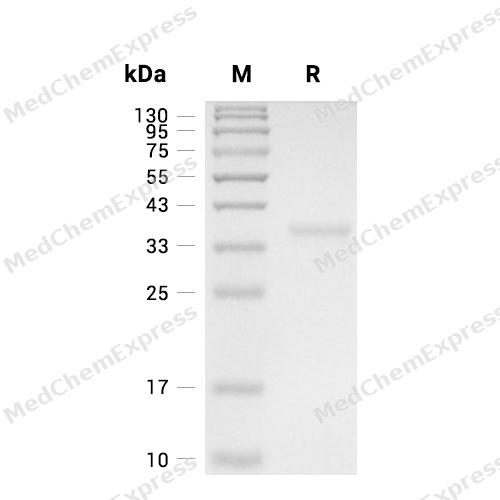
Purity - SDS-PAGE


Technical Parameters
-
Species Human
-
Source E. coli
-
Tag Tag Free
-
Accession
P52895 (M1-Y323)
-
Molecular Construction
-
N-term
-
AKR1C2 (M1-Y323)
Accession # P52895 -
C-term
-
-
Protein Length
Full Length
-
Synonyms
AKR1C2; DD/BABP; Prev. DDH2; Aldo-Keto Reductase Family 1, Member C2 (Dihydrodiol Dehydrogenase 2; Bile Acid Binding Protein; 3-Alpha Hydroxysteroid Dehydrogenase, Type III); Prev. TDD; Dihydrodiol Dehydrogenase/Bile Acid-Binding Protein; DD2; Trans-1,2-D
-
AA Sequence
MDSKYQCVKLNDGHFMPVLGFGTYAPAEVPKSKALEAVKLAIEAGFHHIDSAHVYNNEEQVGLAIRSKIADGSVKREDIFYTSKLWSNSHRPELVRPALERSLKNLQLDYVDLYLIHFPVSVKPGEEVIPKDENGKILFDTVDLCATWEAMEKCKDAGLAKSIGVSNFNHRLLEMILNKPGLKYKPVCNQVECHPYFNQRKLLDFCKSKDIVLVAYSALGSHREEPWVDPNSPVLLEDPVLCALAKKHKRTPALIALRYQLQRGVVVLAKSYNEQRIRQNVQVFEFQLTSEEMKAIDGLNRNVRYLTLDIFAGPPNYPFSDEY
-
Predicted Molecular Mass
36.7 kDa
-
Molecular Weight
Approximately 35 kDa, based on SDS-PAGE under reducing conditions.
-
Purity
≥ 90%, as determined by reducing SDS-PAGE.


Product Properties
Solution
Supplied as a 0.22 μm filter solution of 20 mM Tris, 100 mM NaCl, 1 mM DTT, pH 8.0.
Note: For SPR assay, please replace the buffer. Primary amine components (e.g., Tris, imidazole) can affect protein-coupled chips.
<1 EU/μg, determined by LAL method.
Stored at -80°C for 1 year from date of receipt. It is stable at -20°C for 3 months after opening. It is recommended to freeze aliquots at -80°C for extended storage. Avoid repeated freeze-thaw cycles.
Shipping with dry ice.


Documentation
-
Data Sheet (262 KB)
-
SDS (254 KB)
- English - EN (254 KB)
- Français - FR (254 KB)
- Deutsch - DE (254 KB)
- Norwegian - NO (254 KB)
- Español - ES (254 KB)
- Swedish - SV (254 KB)
- Italian - IT (254 KB)
- Korean - KR (254 KB)
- Portuguese - PT (254 KB)
-
Handling Instructions (2659 KB)


References

Calculators
Concentration (start) × Volume (start) = Concentration (final) × Volume (final)


 Powered by Bioz

