



Animal-Free IL-1 beta Protein, Mouse (His)
Based on 1 publication(s) in Google Scholar
IL-1 beta protein is a potent pro-inflammatory cytokine and major endogenous pyrogen that induces immune cell effects such as prostaglandin synthesis, neutrophil activation, T- and B-cell activation, and fibroblast proliferation . It promotes Th17 differentiation and synergizes with IL12 to promote Th1 IFNG synthesis. Animal-Free IL-1 beta Protein, Mouse (His) is the recombinant mouse-derived animal-FreeIL-1 beta protein, expressed by E. coli , with C-His labeled tag. This product is for cell culture use only.
- Species: Mouse
- Source: E. coli
-
Storage:Stored at -20°C for 2 years from date of receipt. After reconstitution, it is stable at 4°C for 1 week or -20°C for longer (with carrier protein). It is recommended to freeze aliquots at -20°C or -80°C for extended storage.


To place orders, for customer services and technical support, please contact: MedChemExpress USA
Tel: 609-228-6898 E-mail: [email protected] [email protected]


-
 Biological Activity
-
Technical Parameters
-
Product Properties
- Documentation
- Help & FAQs




Biological Activity
Description
IL-1 beta protein is a potent pro-inflammatory cytokine and major endogenous pyrogen that induces immune cell effects such as prostaglandin synthesis, neutrophil activation, T- and B-cell activation, and fibroblast proliferation . It promotes Th17 differentiation and synergizes with IL12 to promote Th1 IFNG synthesis. Animal-Free IL-1 beta Protein, Mouse (His) is the recombinant mouse-derived animal-FreeIL-1 beta protein, expressed by E. coli , with C-His labeled tag. This product is for cell culture use only.
Background
IL-1 beta Protein is a potent pro-inflammatory cytokine that was initially discovered as the major endogenous pyrogen. It has various effects on immune cells, such as inducing prostaglandin synthesis, activating neutrophils, promoting T-cell activation and cytokine production, stimulating B-cell activation and antibody production, and increasing fibroblast proliferation and collagen production. IL-1 beta Protein also plays a role in promoting the differentiation of Th17 cells and works synergistically with IL12 to induce the synthesis of IFNG by Th1 cells. Moreover, it contributes to angiogenesis by inducing VEGF production in collaboration with TNF and IL6. IL-1 beta Protein is involved in the transduction of inflammation downstream of pyroptosis, where its mature form is specifically released into the extracellular environment through the gasdermin-D (GSDMD) pore. It exists as a monomer and interacts with MEFV, as well as integrins ITGAV:ITGBV and ITGA5:ITGB1, which are required for IL1B signaling. IL-1 beta Protein also interacts with the cargo receptor TMED10 and HSP90AB1 and HSP90B1, which facilitate the translocation of cargo into the ERGIC.
Verified Bioactivity
1.Measure by its ability to induce D10.G4.1 cells proliferation. The ED50 for this effect is< 8 pg/mL. The specific activity of recombinan tmouse IL-1 beta is approximately >1.2x 10⁸ IU/mg.
2.Measured in a cell proliferation assay using D10.G4.1 mouse helper T cells. The ED50 for this effect is 7.610 pg/mL, corresponding to a specific activity is 1.314×10^8 units/mg.
MCE Validation Data
-
Purity - SDS-PAGE
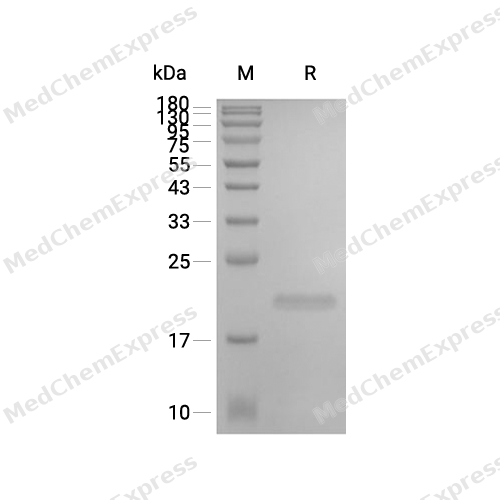
Purity - SDS-PAGE
-
Bioactivity - Cell-Based Assay
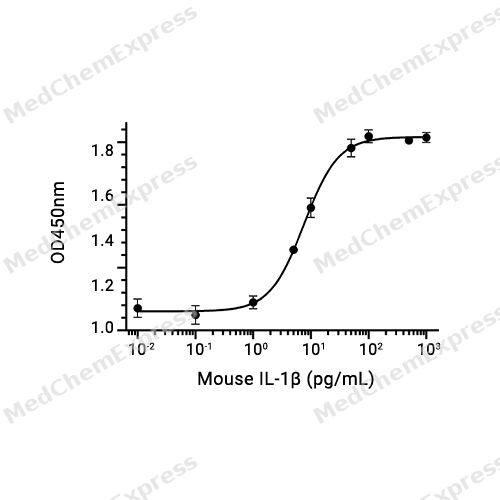
Bioactivity - Cell-Based Assay


Publications (1)
-
Journal Impact Factor
-
Most Recent
-
Cancer Lett
Circulating cytokine profiling and clustering identify biomarker predicting efficacy of ICI in combination with chemotherapy. [Abstract]2025 Oct 28:631:217918. PMID: 40701131


Technical Parameters
-
Species Mouse
-
Source E. coli
-
Tag C-6*His
-
Accession
P10749 (V118-S269)
-
Molecular Construction
-
N-term
-
IL-1β (V118-S269)
Accession # P10749 -
6*His
-
C-term
-
-
Protein Length
Full Length of Mature Protein
-
Synonyms
IL1B; IL-1B; Interleukin 1 Beta; Multifunctional Fusion Protein; IL1F2; Pro-Interleukin-1-Beta; Interleukin-1 Beta; Preinterleukin 1 Beta; IL1-BETA; Interleukin 1beta; IL-1 Beta; IL1beta; Catabolin; IL-1
-
AA Sequence
VPIRQLHYRLRDEQQKSLVLSDPYELKALHLNGQNINQQVIFSMSFVQGEPSNDKIPVALGLKGKNLYLSCVMKDGTPTLQLESVDPKQYPKKKMEKRFVFNKIEVKSKVEFESAEFPNWYISTSQAEHKPVFLGNNSGQDIIDFTMESVSS
-
Predicted Molecular Mass
18.3 kDa
-
Molecular Weight
Approximately 17 kDa, based on SDS-PAGE under reducing conditions.
-
Purity
≥ 95%, as determined by reducing SDS-PAGE.


Product Properties
Lyophilized powder
Lyophilized from a 0.22 μm filtered solution of PBS, pH 7.4 or PBS, pH 7.4, 8% trehalose.
<0.1 EU per 1 μg of the protein by the LAL method.
It is recommended to reconstitute to a concentration of 100-200 μg/mL in ddH2O. For long term storage it is recommended to add a carrier protein (0.1% BSA, 5% HSA, 10% FBS or 5% Trehalose).
Stored at -20°C for 2 years from date of receipt. After reconstitution, it is stable at 4°C for 1 week or -20°C for longer (with carrier protein). It is recommended to freeze aliquots at -20°C or -80°C for extended storage.
Room temperature in continental US; may vary elsewhere.


Documentation
-
Data Sheet (236 KB)
-
SDS (252 KB)
- English - EN (252 KB)
- Français - FR (252 KB)
- Deutsch - DE (252 KB)
- Norwegian - NO (252 KB)
- Español - ES (252 KB)
- Swedish - SV (252 KB)
- Italian - IT (252 KB)
- Korean - KR (252 KB)
- Portuguese - PT (252 KB)
-
Handling Instructions (2659 KB)

Calculators
Concentration (start) × Volume (start) = Concentration (final) × Volume (final)


 Powered by Bioz

