



Animal-Free IL-33 Protein, Mouse (His)
Based on 1 Customer Validation
IL-33 protein activates NF-kappa-B and MAPK signaling, inducing Th2 cell maturation and cytokine secretion. It activates mast cells, basophils, eosinophils, and natural killer cells and enhances macrophage polarization. Animal-Free IL-33 Protein, Mouse (His) is the recombinant mouse-derived animal-FreeIL-33 protein, expressed by E. coli , with C-His labeled tag. This product is for cell culture use only.
- Species: Mouse
- Source: E. coli
-
Storage:Stored at -20°C for 2 years from date of receipt. After reconstitution, it is stable at 4°C for 1 week or -20°C for longer (with carrier protein). It is recommended to freeze aliquots at -20°C or -80°C for extended storage.


To place orders, for customer services and technical support, please contact: MedChemExpress USA
Tel: 609-228-6898 E-mail: [email protected] [email protected]


-
 Biological Activity
-
Technical Parameters
-
Product Properties
- Documentation
- Help & FAQs




Biological Activity
Description
IL-33 protein activates NF-kappa-B and MAPK signaling, inducing Th2 cell maturation and cytokine secretion. It activates mast cells, basophils, eosinophils, and natural killer cells and enhances macrophage polarization. Animal-Free IL-33 Protein, Mouse (His) is the recombinant mouse-derived animal-FreeIL-33 protein, expressed by E. coli , with C-His labeled tag. This product is for cell culture use only.
Background
The IL-33 Protein, a cytokine, binds to and signals through the IL1RL1/ST2 receptor, activating NF-kappa-B and MAPK signaling pathways in target cells. It is implicated in the maturation of Th2 cells, inducing the secretion of T-helper type 2-associated cytokines. Furthermore, IL-33 is involved in the activation of mast cells, basophils, eosinophils, and natural killer cells, acting as an enhancer of the polarization of alternatively activated macrophages. It serves as a chemoattractant for Th2 cells and may function as an 'alarmin,' amplifying immune responses during tissue injury. Notably, it induces rapid UCP2-dependent mitochondrial rewiring, attenuating the generation of reactive oxygen species and preserving the integrity of the Krebs cycle required for the persistent production of itaconate, leading to GATA3-dependent differentiation of inflammation-resolving alternatively activated macrophages. In quiescent endothelia, the uncleaved form of IL-33 is constitutively and abundantly expressed, acting as a chromatin-associated nuclear factor with transcriptional repressor properties, potentially sequestering nuclear NF-kappaB/RELA and lowering the expression of its targets. This form is rapidly lost upon angiogenic or pro-inflammatory activation.
Verified Bioactivity
1.Measure by its ability to induce proliferation in D10.G4.1 cells. The ED50 for this effect is <40 pg/mL. The specific activity of recombinant mouse IL-33 is >2 x 10⁶ IU/mg.
2.Measured by its binding ability in a functional ELISA. Immobilized Mouse ST2 at 5 μg/ml (100 μl/well) can bind biotinylated Mouse IL-33, The ED50 for this effect is 18.61 ng/mL.
MCE Validation Data
-
Purity - SDS-PAGE
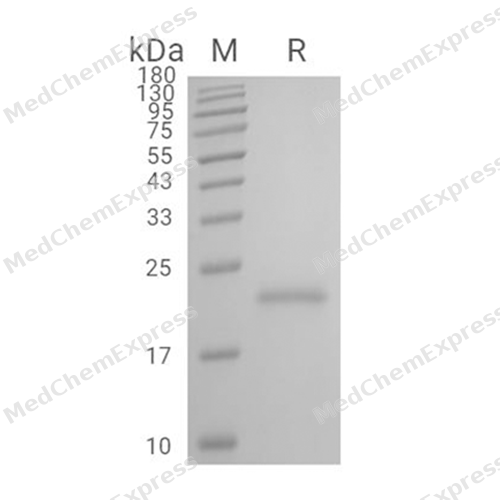
Purity - SDS-PAGE
-
Bioactivity - ELISA
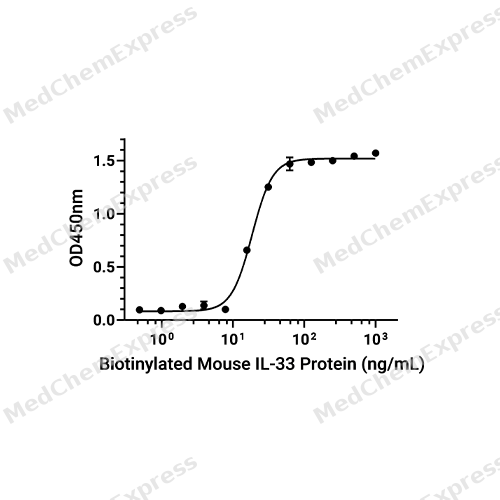
Bioactivity - ELISA


Technical Parameters
-
Species Mouse
-
Source E. coli
-
Tag C-6*His
-
Accession
Q8BVZ5 (S109-I266)
-
Molecular Construction
-
N-term
-
IL-33 (S109-I266)
Accession # Q8BVZ5 -
6*His
-
C-term
-
-
Protein Length
Full length of Mature Protein
-
Synonyms
IL33; DVS27-Related Protein; Prev. C9orf26; Chromosome 9 Open Reading Frame 26 (NF-HEV); NF-HEV; Interleukin-1 Family, Member 11; IL1F11; Alternative Protein IL33; Interleukin-33; IL-1F11; DVS27; NFEHEV; Nuclear Factor From High Endothelial Venules; IL-33
-
AA Sequence
SIQGTSLLTQSPASLSTYNDQSVSFVLENGCYVINVDDSGKDQEQDQVLLRYYESPCPASQSGDGVDGKKLMVNMSPIKDTDIWLHANDKDYSVELQRGDVSPPEQAFFVLHKKSSDFVSFECKNLPGTYIGVKDNQLALVEEKDESCNNIMFKLSKI
-
Predicted Molecular Mass
18.5 kDa
-
Molecular Weight
Approximately 17-25 kDa, based on SDS-PAGE under reducing conditions.
-
Purity
≥ 95%, as determined by reducing SDS-PAGE.


Product Properties
Lyophilized powder
1.Lyophilized from a 0.22 μm filtered solution of PBS, pH 7.4, 6% trehalose.
2. Lyophilized from a 0.22 μm filtered solution of PBS, pH 7.4.
Please refer to the lot-specific COA for specific buffer information.
<0.1 EU/μg, determined by LAL method.
It is recommended to reconstitute to a concentration of 100-200 μg/mL in ddH2O. For long term storage it is recommended to add a carrier protein (0.1% BSA, 5% HSA, 10% FBS or 5% Trehalose).
Stored at -20°C for 2 years from date of receipt. After reconstitution, it is stable at 4°C for 1 week or -20°C for longer (with carrier protein). It is recommended to freeze aliquots at -20°C or -80°C for extended storage.
Room temperature in continental US; may vary elsewhere.


Documentation
-
Data Sheet (237 KB)
-
SDS (252 KB)
- English - EN (252 KB)
- Français - FR (252 KB)
- Deutsch - DE (252 KB)
- Norwegian - NO (252 KB)
- Español - ES (252 KB)
- Swedish - SV (252 KB)
- Italian - IT (252 KB)
- Korean - KR (252 KB)
- Portuguese - PT (252 KB)
-
Handling Instructions (2659 KB)

Calculators
Concentration (start) × Volume (start) = Concentration (final) × Volume (final)


 Powered by Bioz

