



Animal-Free IL-4 Protein, Human (His)
Based on 2 publication(s) in Google Scholar
The IL-4 protein is primarily secreted by mast cells, T cells, eosinophils, and basophils and is critical for antibody production, hematopoiesis, and immune responses. It induces MHC class II expression on B cells, enhances IgE and IgG1 secretion, and modulates CD23 and IL31RA expression. Animal-Free IL-4 Protein, Human (His) is the recombinant human-derived animal-FreeIL-4 protein, expressed by E. coli , with C-His labeled tag.This product is for cell culture use only.
- Species: Human
- Source: E. coli
-
Storage:Stored at -20°C for 2 years from date of receipt. After reconstitution, it is stable at 4°C for 1 week or -20°C for longer (with carrier protein). It is recommended to freeze aliquots at -20°C or -80°C for extended storage.

To place orders, for customer services and technical support, please contact: MedChemExpress USA
Tel: 609-228-6898 E-mail: [email protected] [email protected]


-
 Biological Activity
-
Technical Parameters
-
Product Properties
- Documentation
- Help & FAQs


-

HY-P70568
IL-13 Protein, Human (HEK293, His) -
HY-18739
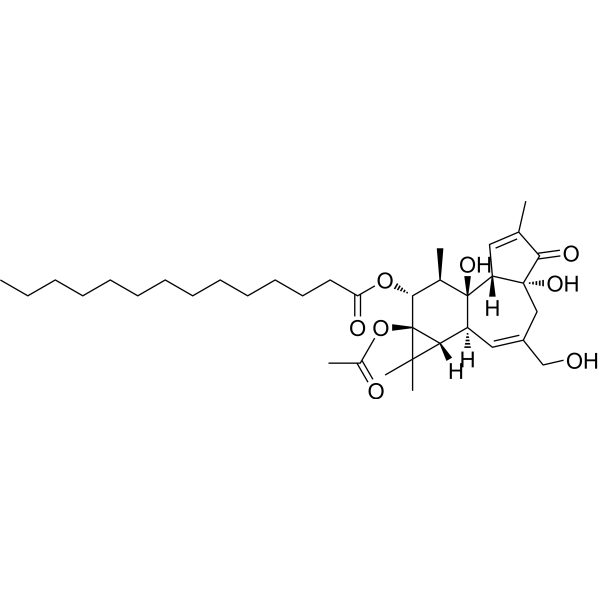
Phorbol 12-myristate 13-acetate -
HY-P7025
IFN-gamma Protein, Human -
HY-P700102AF
Animal-Free IL-13 Protein, Human (His) -
HY-P700086AF
Animal-Free GM-CSF Protein, Human (His) -
HY-P7058
TNF-alpha/TNFSF2 Protein, Human -
HY-P72795
IL-13 Protein, Human -
HY-P700112AF
Animal-Free IL-21 Protein, Human (His) -
HY-P7044AF
Animal-Free IL-6 Protein, Human (His) -
HY-P700108AF
Animal-Free IL-18 Protein, Human (His)


Biological Activity
Description
The IL-4 protein is primarily secreted by mast cells, T cells, eosinophils, and basophils and is critical for antibody production, hematopoiesis, and immune responses. It induces MHC class II expression on B cells, enhances IgE and IgG1 secretion, and modulates CD23 and IL31RA expression. Animal-Free IL-4 Protein, Human (His) is the recombinant human-derived animal-FreeIL-4 protein, expressed by E. coli , with C-His labeled tag.This product is for cell culture use only.
Background
The cytokine IL-4, primarily secreted by mast cells, T-cells, eosinophils, and basophils, plays a crucial role in regulating antibody production, hematopoiesis, inflammation, and the development of effector T-cell responses. IL-4 induces the expression of class II MHC molecules on resting B-cells and enhances both the secretion and cell surface expression of IgE and IgG1, contributing to immune responses. Additionally, IL-4 regulates the expression of the low-affinity Fc receptor for IgE (CD23) on both lymphocytes and monocytes and positively regulates IL31RA expression in macrophages. Furthermore, IL-4 stimulates autophagy in dendritic cells by interfering with mTORC1 signaling and inducing RUFY4. Beyond its immunological functions, IL-4 plays a critical role in higher functions of the normal brain, such as memory and learning. Upon binding to its receptor, IL-4R, IL-4 initiates signaling through two types of receptor complexes, type 1 mainly on hematopoietic cells and type 2 on nonhematopoietic cells, activating JAK3 and to a lesser extent JAK1 phosphorylation, leading to the activation of the signal transducer and activator of transcription 6/STAT6. IL-4 interacts with both IL-4R and IL13RA1 to mediate its diverse physiological effects.
Verified Bioactivity
Measure by its ability to induce TF-1 cells proliferation. The ED50 for this effect is <0.2 ng/mL. The specific activity of recombinant human IL-4 is approximately >2.8 x 10⁷ IU/mg


Publications (2)
-
Journal Impact Factor
-
Most Recent
-
Inflamm Res
Aldosterone induces renal lymphangiogenesis through macrophage-lymphatic endothelial cell transformation and Inhibition by esaxerenone. [Abstract]2025 May 24;74(1):85. PMID: 40413281 -
BMC Pulm Med
β-elemene inhibits tumor-promoting in small cell lung cancer by affecting M2 macrophages and TGF-β. [Abstract]2025 Feb 28;25(1):97. PMID: 40022030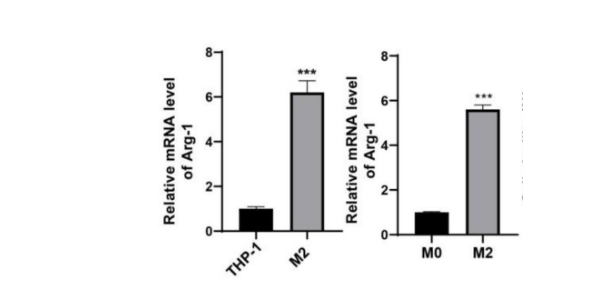
Animal-Free IL-4 Protein, Human (His) purchased from MedChemExpress. Usage Cited in: BMC Pulm Med. 2025 Feb 28;25(1):97. [Abstract]
IL-13, Human (HEK293, His) (5 ng/mL; 48 h). IL-4 and IL-13 induce the differentiation of M0 macrophages into M2 macrophages.


Technical Parameters
-
Species Human
-
Source E. coli
-
Tag C-6*His
-
Accession
P05112-1 (H25-S153)
-
Molecular Construction
-
N-term
-
IL-4 (H25-S153)
Accession # P05112-1 -
6*His
-
C-term
-
-
Protein Length
Full Length of Isoform-1
-
Synonyms
IL4; B_cell Stimulatory Factor 1; Interleukin 4; B-Cell Stimulatory Factor 1; IL-4; B Cell Growth Factor 1; Lymphocyte Stimulatory Factor 1; Binetrakin; Interleukin-4; Pitrakinra; BCGF-1; MGC79402; BCGF1; BSF-1; BSF1
-
AA Sequence
HKCDITLQEIIKTLNSLTEQKTLCTELTVTDIFAASKNTTEKETFCRAATVLRQFYSHHEKDTRCLGATAQQFHRHKQLIRFLKRLDRNLWGLAGLNSCPVKEANQSTLENFLERLKTIMREKYSKCSS
-
Predicted Molecular Mass
15.9 kDa
-
Molecular Weight
Approximately 12 kDa, based on SDS-PAGE under reducing conditions.
-
Purity
≥ 95%, as determined by reducing SDS-PAGE.


Product Properties
Lyophilized powder.
Lyophilized from a 0.22 μm filtered solution of PBS, pH 8.0, trehalose.
<0.1 EU per 1 μg of the protein by the LAL method.
It is recommended to reconstitute to a concentration of 100-200 μg/mL in ddH2O. For long term storage it is recommended to add a carrier protein (0.1% BSA, 5% HSA, 10% FBS or 5% Trehalose).
Stored at -20°C for 2 years from date of receipt. After reconstitution, it is stable at 4°C for 1 week or -20°C for longer (with carrier protein). It is recommended to freeze aliquots at -20°C or -80°C for extended storage.
Room temperature in continental US; may vary elsewhere.


Documentation
-
Data Sheet (236 KB)
-
SDS (252 KB)
- English - EN (252 KB)
- Français - FR (252 KB)
- Deutsch - DE (252 KB)
- Norwegian - NO (252 KB)
- Español - ES (252 KB)
- Swedish - SV (252 KB)
- Italian - IT (252 KB)
- Korean - KR (252 KB)
- Portuguese - PT (252 KB)
-
Handling Instructions (2659 KB)

Calculators
Concentration (start) × Volume (start) = Concentration (final) × Volume (final)


 Powered by Bioz

