



BACE1 Protein, Human (HEK293, N-His)
Based on 1 Customer Validation
BACE1 protein is crucial in proteolytic processing of amyloid precursor protein (APP), initiating cleavage at the N-terminus of the A-beta peptide sequence. This process results in the extracellular release of beta-cleaved soluble APP and a cell-associated C-terminal fragment. BACE1's cleavage activity extends to CHL1, demonstrating its versatility in substrate processing. BACE1 Protein, Human (HEK293, N-His) is the recombinant human-derived BACE1 protein, expressed by HEK293 , with N-6*His labeled tag.
- Species: Human
- Source: HEK293
-
Storage:Stored at -20°C for 2 years from date of receipt. After reconstitution, it is stable at 4°C for 1 week or -20°C for longer (with carrier protein). It is recommended to freeze aliquots at -20°C or -80°C for extended storage.


To place orders, for customer services and technical support, please contact: MedChemExpress USA
Tel: 609-228-6898 E-mail: [email protected] [email protected]


-
 Biological Activity
-
Technical Parameters
-
Product Properties
- Documentation
- Help & FAQs




Biological Activity
Description
BACE1 protein is crucial in proteolytic processing of amyloid precursor protein (APP), initiating cleavage at the N-terminus of the A-beta peptide sequence. This process results in the extracellular release of beta-cleaved soluble APP and a cell-associated C-terminal fragment. BACE1's cleavage activity extends to CHL1, demonstrating its versatility in substrate processing. BACE1 Protein, Human (HEK293, N-His) is the recombinant human-derived BACE1 protein, expressed by HEK293 , with N-6*His labeled tag.
Background
The BACE1 protein plays a pivotal role in the proteolytic processing of the amyloid precursor protein (APP). It initiates cleavage at the N-terminus of the A-beta peptide sequence, specifically between residues 671 and 672 of APP, resulting in the production and subsequent extracellular release of beta-cleaved soluble APP. Simultaneously, BACE1 generates a corresponding cell-associated C-terminal fragment, subsequently released by gamma-secretase. In addition to its primary target, BACE1 also exhibits cleavage activity on CHL1, as observed through its similarity in cleaving this substrate.
Verified Bioactivity
Measured by its ability to cleave a fluorogenic peptide substrate, Mca-SEVNLDAEFRK(Dpn)RR-NH2 (HY-P1859). Read at excitation and emission wavelengths of 320 nm and 405 nm. The specific activity is >3.5 pmoL/min/µg.
MCE Validation Data
-
Purity - SDS-PAGE
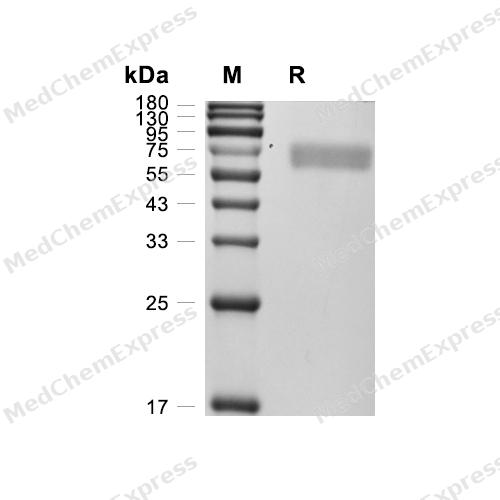
Purity - SDS-PAGE

Assay Procedure
Materials
Assay buffer: 0.1 M Sodium Acetate, pH 4.0
Test protein: BACE1 Protein, Human (HEK293, N-His) (HY-P700606)
Substrate: MCA-Ser-Glu-Val-Asn-Leu-Asp-Ala-Glu-Phe-Arg-Lys(DPN)-Arg-Arg-NH2 (HY-P1859)
Procedure
1. Reconstitute the protein with sterile water to a concentration of 200 μg/mL, then dilute human BACE1 protein to 20 μg/mL using assay buffer.
2. Dilute the substrate to 20 μM using the assay buffer.
3. Experimental group: 50 μL BACE1 + 50 μL, 20 μM substrate;
Control group: 50 μL assay buffer + 50 μL, 20 μM substrate.
4. In kinetic mode, read for 5 minutes at an excitation wavelength of 320 nm and an emission wavelength of 405 nm.
5. Calculate the specific activity:
| Specific Activity (pmol/min/μg) = | Adjusted Vmax* (RFU/min) × Conversion Factor** (pmol/RFU) |
| amount of enzyme (μg) |
*Adjusted for Control
**Derived using calibration standard


Technical Parameters
-
Species Human
-
Source HEK293
-
Tag N-6*His
-
Accession
P56817-1 (T22-T457)
-
Gene ID23621
-
Molecular Construction
-
N-term
-
6*His
-
BACE1 (T22-T457)
Accession # P56817-1 -
C-term
-
-
Protein Length
Extracellular Domain
-
Synonyms
BACE1; CDNA FLJ54690, Highly Similar To Beta-Secretase 1; Prev. BACE; Beta-Site APP-Cleaving Enzyme 1, Isoform CRA_f; Membrane-Associated Aspartic Protease 2; Beta-Site APP-Cleaving Enzyme 1, Isoform CRA_e; Aspartyl Protease 2; Transmembrane Aspartic Prot
-
AA Sequence
TQHGIRLPLRSGLGGAPLGLRLPRETDEEPEEPGRRGSFVEMVDNLRGKSGQGYYVEMTVGSPPQTLNILVDTGSSNFAVGAAPHPFLHRYYQRQLSSTYRDLRKGVYVPYTQGKWEGELGTDLVSIPHGPNVTVRANIAAITESDKFFINGSNWEGILGLAYAEIARPDDSLEPFFDSLVKQTHVPNLFSLQLCGAGFPLNQSEVLASVGGSMIIGGIDHSLYTGSLWYTPIRREWYYEVIIVRVEINGQDLKMDCKEYNYDKSIVDSGTTNLRLPKKVFEAAVKSIKAASSTEKFPDGFWLGEQLVCWQAGTTPWNIFPVISLYLMGEVTNQSFRITILPQQYLRPVEDVATSQDDCYKFAISQSSTGTVMGAVIMEGFYVVFDRARKRIGFAVSACHVHDEFRTAAVEGPFVTLDMEDCGYNIPQTDESTLMT
-
Predicted Molecular Mass
49.3 kDa
-
Molecular Weight
Approximately 55-75 kDa, based on SDS-PAGE under reducing conditions, due to the glycosylation.
-
Glycosylation
Yes
-
Purity
≥ 95%, as determined by reducing SDS-PAGE.


Product Properties
Lyophilized powder
Lyophilized from a 0.22 μm filtered solution of PBS, pH 7.4.
<1 EU/μg, determined by LAL method.
It is not recommended to reconstitute to a concentration less than 100 μg/mL in ddH2O. For long term storage it is recommended to add a carrier protein (0.1% BSA, 5% HSA, 10% FBS or 5% Trehalose).
Stored at -20°C for 2 years from date of receipt. After reconstitution, it is stable at 4°C for 1 week or -20°C for longer (with carrier protein). It is recommended to freeze aliquots at -20°C or -80°C for extended storage.
Room temperature in continental US; may vary elsewhere.


Documentation
-
Data Sheet (238 KB)
-
SDS (254 KB)
- English - EN (254 KB)
- Français - FR (254 KB)
- Deutsch - DE (254 KB)
- Norwegian - NO (254 KB)
- Español - ES (254 KB)
- Swedish - SV (254 KB)
- Italian - IT (254 KB)
- Korean - KR (254 KB)
- Portuguese - PT (254 KB)
-
Handling Instructions (2659 KB)

Calculators
Concentration (start) × Volume (start) = Concentration (final) × Volume (final)


 Powered by Bioz

