



BCL2A1 Protein, Human (His)

Based on 1 Customer Validation
The BCL2A1 protein plays a critical role in resisting apoptosis triggered by IL-3 deprivation, suggesting its importance in the response of hematopoietic cells to external signals and may be involved in protecting endothelial cell survival during infection. It also inhibits serum starvation-induced apoptosis in mammary epithelial cells (HC11). BCL2A1 Protein, Human (His) is the recombinant human-derived BCL2A1 protein, expressed by E. coli , with N-His labeled tag.
- Species: Human
- Source: E. coli
-
Storage:Stored at -20°C for 2 years from date of receipt. After reconstitution, it is stable at 4°C for 1 week or -20°C for longer (with carrier protein). It is recommended to freeze aliquots at -20°C or -80°C for extended storage.


To place orders, for customer services and technical support, please contact: MedChemExpress USA
Tel: 609-228-6898 E-mail: [email protected] [email protected]


-
 Biological Activity
-
Technical Parameters
-
Product Properties
- Documentation
- Help & FAQs




Biological Activity
Description
The BCL2A1 protein plays a critical role in resisting apoptosis triggered by IL-3 deprivation, suggesting its importance in the response of hematopoietic cells to external signals and may be involved in protecting endothelial cell survival during infection. It also inhibits serum starvation-induced apoptosis in mammary epithelial cells (HC11). BCL2A1 Protein, Human (His) is the recombinant human-derived BCL2A1 protein, expressed by E. coli , with N-His labeled tag.
Background
The BCL2A1 protein plays a crucial role in retarding apoptosis induced by IL-3 deprivation, suggesting its involvement in the response of hemopoietic cells to external signals and its potential role in maintaining endothelial survival during infection. Additionally, BCL2A1 exhibits the ability to inhibit apoptosis induced by serum starvation in the mammary epithelial cell line HC11. The protein interacts directly with various key players in the apoptotic pathway, including BAK1, BID, BMF, BBC3, BCL2L11/BIM, BAX isoform Sigma, PMAIP1, RTL10/BOP, ING4, and UBQLN4. This extensive interaction network underscores the multifaceted role of BCL2A1 in modulating apoptotic processes.
MCE Validation Data
-
Purity - SDS-PAGE
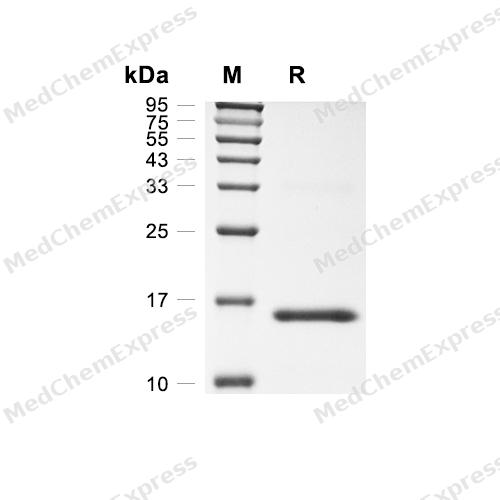
Purity - SDS-PAGE


Technical Parameters
-
Species Human
-
Source E. coli
-
Tag N-6*His
-
Accession
Q16548 (M1-S152)
-
Molecular Construction
-
N-term
-
His
-
BCL2A1 (M1-S152)
Accession # Q16548 -
C-term
-
-
Protein Length
Partial
-
Synonyms
BCL2A1; ACC-1; Prev. HBPA1; ACC2; BCL2L5; ACC1; BFL1; Bcl-2-Like Protein 5; GRS; Bcl2-L-5; Hemopoietic-Specific Early Response Protein; Hematopoietic BCL2-Related Protein A1; Bcl-2-Related Protein A1; Protein GRS; Protein BFL-1; BCL2 Related Protein A1; A
-
AA Sequence
MTDCEFGYIYRLAQDYLQCVLQIPQPGSGPSKTSRVLQNVAFSVQKEVEKNLKSCLDNVNVVSVDTARTLFNQVMEKEFEDGIINWGRIVTIFAFEGILIKKLLRQQIAPDVDTYKEISYFVAEFIMNNTGEWIRQNGGWENGFVKKFEPKS
-
Molecular Weight
Approximately 16-17 kDa
-
Purity
≥ 95%, as determined by reducing SDS-PAGE.


Product Properties
Lyophilized powder.
Lyophilized from a 0.22 μm filtered solution of PBS, pH 7.4.
<1 EU/μg, determined by LAL method.
It is not recommended to reconstitute to a concentration less than 100 μg/mL in ddH2O. For long term storage it is recommended to add a carrier protein (0.1% BSA, 5% HSA, 10% FBS or 5% Trehalose).
Stored at -20°C for 2 years from date of receipt. After reconstitution, it is stable at 4°C for 1 week or -20°C for longer (with carrier protein). It is recommended to freeze aliquots at -20°C or -80°C for extended storage.
Room temperature in continental US; may vary elsewhere.


Documentation
-
Data Sheet (235 KB)
-
SDS (251 KB)
- English - EN (251 KB)
- Français - FR (251 KB)
- Deutsch - DE (251 KB)
- Norwegian - NO (251 KB)
- Español - ES (251 KB)
- Swedish - SV (251 KB)
- Italian - IT (251 KB)
- Korean - KR (251 KB)
- Portuguese - PT (251 KB)
-
Handling Instructions (2659 KB)

Calculators
Concentration (start) × Volume (start) = Concentration (final) × Volume (final)


 Powered by Bioz

