



beta-NGF Protein, Rat (HEK293, His)
Based on 4 publication(s) in Google Scholar
Nerve Growth Factor-β (Beta-NGF; NGF) is a neurotrophic factor that regulates neuronal survival and differentiation. NGF is also a seminal plasma protein involved in ovulation and luteinizing. NGF has potential functions in the female reproductive system to help overcome the current problem of early embryo loss.
- Species: Rat
- Source: HEK293
-
Storage:Stored at -20°C for 2 years from date of receipt. After reconstitution, it is stable at 4°C for 1 week or -20°C for longer (with carrier protein). It is recommended to freeze aliquots at -20°C or -80°C for extended storage.


To place orders, for customer services and technical support, please contact: MedChemExpress USA
Tel: 609-228-6898 E-mail: [email protected] [email protected]


-
 Biological Activity
-
Technical Parameters
-
Product Properties
- Documentation
- Help & FAQs




Biological Activity
Description
Nerve Growth Factor-β (Beta-NGF; NGF) is a neurotrophic factor that regulates neuronal survival and differentiation. NGF is also a seminal plasma protein involved in ovulation and luteinizing. NGF has potential functions in the female reproductive system to help overcome the current problem of early embryo loss[1][2][3].
Background
Nerve Growth Factor-β (Beta-NGF; NGF) is a basic protein of 118 amino acids which acts are a trophic factor for sensory and sympathetic neurons of the peripheral nervous system, and on cholinergic neurons of the anterior basal cerebrum[1]. NGF involves in the regulation of neuronal survival and differentiation. Elevated levels of NGF are associated with the risk of post-traumatic stress disorder (PTSD). The trauma response leads to methylation of DNA nucleotides responsible for NGF expression. NGF levels have shown increased sympathetic fiber density proportional to NGF messenger RNA (mRNA) levels. NGF is also a seminal plasma protein commonly found in mammals. For example, NGF acts as an ovulation stimulating factor in camels and has been shown to have luteinizing effects in bulls. NGF has a potential function in the female reproductive system. For example, NGF plays an important role in ovulation induction, LH release, ovulation, luteal development, progesterone (P4) production, vascularization of luteal body, and gonadotropin response. Application of NGF to cattle enhances steroid production, luteal formation and function by increasing LH release, and leads to increased mRNA expression of markers of pregnancy and development downstream. In addition, the potential luteinizing effect of NGF could help overcome the current problem of early embryo loss[2][3]. The similarity between human and bovine NGF protein sequence was 90.87%. Meanwhile, the similarity rate of human NGF with rat and mouse was 85.89% and 85.06%, respectively.
Verified Bioactivity
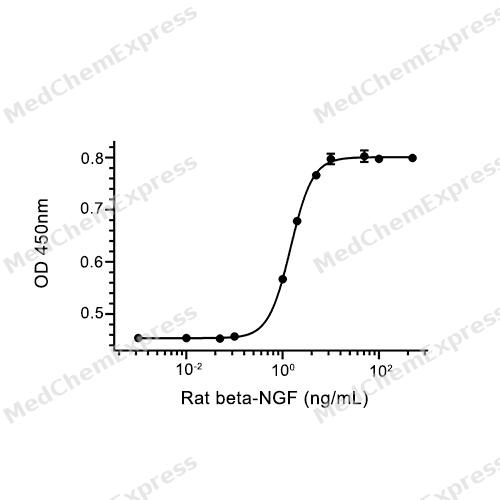
Measured in a cell proliferation assay using TF 1 human erythroleukemic cells. The ED50 for this effect is 1.463 ng/mL, corresponding to a specific activity is 6.835×10⁵ units/mg.
MCE Validation Data
-
Bioactivity - Cell-Based Assay
Bioactivity - Cell-Based Assay


Publications (4)
-
Journal Impact Factor
-
Most Recent
-
J Nanobiotechnology
Bilayer nerve guidance conduits for continuous delivery of NGF@ZIF-8 nanoparticles for peripheral nerve injury repair. [Abstract]2026 May 25. PMID: 42185827 -
J Transl Med
MaR1 and NGF combine to inhibit autophagy through the GSK-3β/β-catenin pathway to promote sciatic nerve repair. [Abstract]2026 Feb 9;24(1):361. PMID: 41664203 -
-
Mol Neurobiol
UBA52 Overexpression Ameliorates Intracerebral Hemorrhage-Associated Neuronal Apoptosis and Mitochondrial Dysfunction: A Protective Role in Neurons. [Abstract]2026 Jan 19;63(1):371. PMID: 41553582


Technical Parameters
-
Species Rat
-
Source HEK293
-
Tag C-10*His
-
Accession
P25427 (E19-G241)
-
Gene ID310738
-
Protein Length
Full Length of Mature Protein (with Propeptide)
-
Synonyms
NGF; Beta-NGF; Prev. NGFB; Pro-Nerve Growth Factor Long; Beta-Nerve Growth Factor; HSAN5; Nerve Growth Factor (Beta Polypeptide); Nerve Growth Factor; Nerve Growth Factor, Beta Subunit
-
AA Sequence
EPYTDSNVPEGDSVPEAHWTKLQHSLDTALRRARSAPAEPIAARVTGQTRNITVDPKLFKKRRLRSPRVLFSTQPPPTSSDTLDLDFQAHGTISFNRTHRSKRSSTHPVFHMGEFSVCDSVSVWVGDKTTATDIKGKEVTVLGEVNINNSVFKQYFFETKCRAPNPVESGCRGIDSKHWNSYCTTTHTFVKALTTDDKQAAWRFIRIDTACVCVLSRKAARRG
-
Predicted Molecular Mass
26.4 kDa
-
Molecular Weight
Approximately 15 kDa & 42 kDa, based on SDS-PAGE under reducing conditions.
-
Glycosylation
Yes
-
Purity
≥ 90%, as determined by reducing SDS-PAGE.


Product Properties
Lyophilized powder
Lyophilized from a 0.22 μm filtered solution of PBS, 6% trehalose, pH 7.4.
<1 EU/μg, determined by LAL method.
It is not recommended to reconstitute to a concentration less than 100 μg/mL in ddH2O.
Stored at -20°C for 2 years from date of receipt. After reconstitution, it is stable at 4°C for 1 week or -20°C for longer (with carrier protein). It is recommended to freeze aliquots at -20°C or -80°C for extended storage.
Room temperature in continental US; may vary elsewhere.


Documentation
-
Data Sheet (238 KB)
-
SDS (252 KB)
- English - EN (252 KB)
- Français - FR (252 KB)
- Deutsch - DE (252 KB)
- Norwegian - NO (252 KB)
- Español - ES (252 KB)
- Swedish - SV (252 KB)
- Italian - IT (252 KB)
- Korean - KR (252 KB)
- Portuguese - PT (252 KB)
-
Handling Instructions (2659 KB)

Calculators
Concentration (start) × Volume (start) = Concentration (final) × Volume (final)


 Powered by Bioz

