



BLMH/Bleomycin Hydrolase Protein, Mouse (His)
Bleomycin Hydrolase Protein (BLMH) is crucial for cellular defense, inactivating the antitumor drug Bleomycin (BLM) by hydrolyzing its carboxamide bond. This neutralizes BLM's cytotoxic effects, protecting normal and malignant cells. BLMH's exact physiological function is unknown, but its significance in maintaining cellular balance and defending against harmful agents is evident. BLMH/Bleomycin Hydrolase Protein, Mouse (His) is the recombinant mouse-derived BLMH/Bleomycin Hydrolase Protein, expressed by E. coli , with N-His labeled tag.
- Species: Mouse
- Source: E. coli
-
Storage:Stored at -80°C for 1 year from date of receipt. It is stable at -20°C for 3 months after opening. It is recommended to freeze aliquots at -80°C for extended storage. Avoid repeated freeze-thaw cycles.


To place orders, for customer services and technical support, please contact: MedChemExpress USA
Tel: 609-228-6898 E-mail: [email protected] [email protected]


-
 Biological Activity
-
Technical Parameters
-
Product Properties
- Documentation
- Help & FAQs




Biological Activity
Description
Bleomycin Hydrolase Protein (BLMH) is crucial for cellular defense, inactivating the antitumor drug Bleomycin (BLM) by hydrolyzing its carboxamide bond. This neutralizes BLM's cytotoxic effects, protecting normal and malignant cells. BLMH's exact physiological function is unknown, but its significance in maintaining cellular balance and defending against harmful agents is evident. BLMH/Bleomycin Hydrolase Protein, Mouse (His) is the recombinant mouse-derived BLMH/Bleomycin Hydrolase Protein, expressed by E. coli , with N-His labeled tag.
Background
BLM hydrolase, also known as Bleomycin hydrolase, plays a crucial role in cellular defense mechanisms by catalyzing the inactivation of the antitumor drug Bleomycin (BLM), a glycopeptide. This enzymatic activity involves the hydrolysis of the carboxamide bond within the B-aminoalaninamide moiety of BLM, leading to its inactivation. This process serves to protect both normal and malignant cells from the toxic effects of BLM. While the precise physiological function of BLM hydrolase remains unclear, its ability to neutralize the cytotoxic impact of BLM highlights its significance in cellular homeostasis and defense against potentially harmful agents.
MCE Validation Data
-
Purity - SDS-PAGE
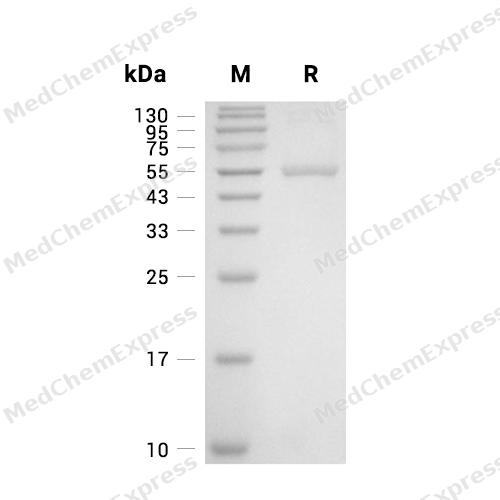
Purity - SDS-PAGE


Technical Parameters
-
Species Mouse
-
Source E. coli
-
Tag N-His
-
Accession
Q8R016 (N2-E455)
-
Molecular Construction
-
N-term
-
His
-
BLMH (N2-E455)
Accession # Q8R016 -
C-term
-
-
Protein Length
Full Length
-
Synonyms
BLMH; BLM Hydrolase; Bleomycin Hydrolase; BMH; BH
-
AA Sequence
NNAGLNSEKVSALIQKLNSDPQFVLAQNVGTTHDLLDICLRRATVQGAQHVFQHVVPQEGKPVTNQKSSGRCWIFSCLNVMRLPFMKKFNIEEFEFSQSYLFFWDKVERCYFFLNAFVDTAQKKEPEDGRLVQYLLMNPTNDGGQWDMLVNIVEKYGVVPKKCFPESHTTEATRRMNDILNHKMREFCIRLRNLVHSGATKGEISSTQDAMMEEIFRVVCICLGNPPETFTWEYRDKDKNYHKIGPITPLQFYKEHVKPLFNMEDKICFVNDPRPQHKYNKLYTVDYLSNMVGGRKTLYNNQPIDFLKKMVAASIKDGEAVWFGCDVGKHFNGKLGLSDMNVYDHELVFGVSLKNMNKAERLAFGESLMTHAMTFTAVSEKDNQEGTFVKWRVENSWGEDHGHKGYLCMTDEWFSEYVYEVVVDKKHVPEEVLAVLEQEPIVLPAWDPMGALAE
-
Predicted Molecular Mass
53.3 kDa
-
Molecular Weight
Approximately 47 kDa, based on SDS-PAGE under reducing conditions.
-
Purity
≥ 90%, as determined by reducing SDS-PAGE.


Product Properties
Solution
<1 EU/μg, determined by LAL method.
Stored at -80°C for 1 year from date of receipt. It is stable at -20°C for 3 months after opening. It is recommended to freeze aliquots at -80°C for extended storage. Avoid repeated freeze-thaw cycles.
Shipping with dry ice.


Documentation
-
Data Sheet (237 KB)
-
SDS (251 KB)
- English - EN (251 KB)
- Français - FR (251 KB)
- Deutsch - DE (251 KB)
- Norwegian - NO (251 KB)
- Español - ES (251 KB)
- Swedish - SV (251 KB)
- Italian - IT (251 KB)
- Korean - KR (251 KB)
- Portuguese - PT (251 KB)
-
Handling Instructions (2659 KB)

Calculators
Concentration (start) × Volume (start) = Concentration (final) × Volume (final)


 Powered by Bioz

