



Carbonic Anhydrase 2 Protein, Mouse (HEK293, His)

Based on 1 Customer Validation
Carbonic Anhydrase 2 Protein is a member of the carbonic anhydrase isozyme family, responsible for catalyzing the reversible hydration of carbon dioxide. Mutations in CA2 are linked to osteopetrosis and renal tubular acidosis. The gene exhibits biased expression in various tissues, notably in the stomach and colon. CA2 plays vital role in the regulation of ion transport and pH balance and is involved in many biological processes. Carbonic Anhydrase 2 Protein, Mouse (HEK293, His) is the recombinant mouse-derived Carbonic Anhydrase 2 protein, expressed by HEK293 , with C-His labeled tag.
- Species: Mouse
- Source: HEK293
-
Storage:Stored at -80°C for 1 year from date of receipt. It is stable at -20°C for 3 months after opening. It is recommended to freeze aliquots at -80°C for extended storage. Avoid repeated freeze-thaw cycles.


To place orders, for customer services and technical support, please contact: MedChemExpress USA
Tel: 609-228-6898 E-mail: [email protected] [email protected]


-
 Biological Activity
-
Technical Parameters
-
Product Properties
- Documentation
- Help & FAQs




Biological Activity
Description
Carbonic Anhydrase 2 Protein is a member of the carbonic anhydrase isozyme family, responsible for catalyzing the reversible hydration of carbon dioxide. Mutations in CA2 are linked to osteopetrosis and renal tubular acidosis. The gene exhibits biased expression in various tissues, notably in the stomach and colon. CA2 plays vital role in the regulation of ion transport and pH balance and is involved in many biological processes. Carbonic Anhydrase 2 Protein, Mouse (HEK293, His) is the recombinant mouse-derived Carbonic Anhydrase 2 protein, expressed by HEK293 , with C-His labeled tag.
Background
Carbonic Anhydrase 2 (CA2) is a member of the carbonic anhydrase isozyme family, responsible for catalyzing the reversible hydration of carbon dioxide. Dysregulation of this enzyme is linked to conditions such as osteopetrosis and renal tubular acidosis. Two transcript variants encoding distinct isoforms have been identified. In addition to its fundamental role in carbon dioxide metabolism, the protein exhibits biased expression in various tissues, with notable levels in the stomach and colon, as well as eight other tissues. It can also hydrate cyanamide to urea. CA2 is essential for bone resorption and osteoclast differentiation. CA2 plays vital role in the regulation of ion transport and pH balance and is involved in many biological processes. Moreover, CA2 downregulation promoted HCC metastasis and invasion. It serves as a suppressor of HCC metastasis and EMT and is correlated with favorable overall survival (OS) in HCC patients[1][2][3][4].
Verified Bioactivity
Measured by its esterase activity. The specific activity is > 400 pmol/min/µg.
MCE Validation Data
-
Purity - SDS-PAGE
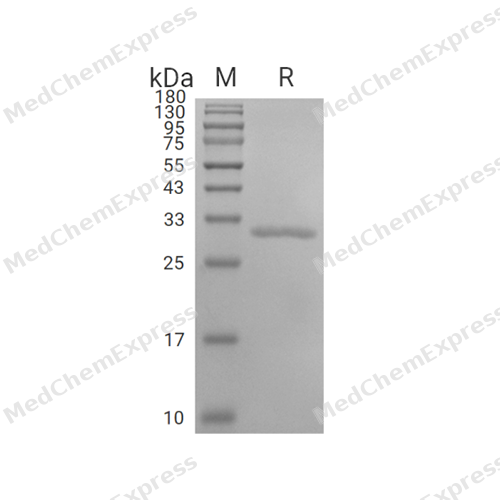
Purity - SDS-PAGE


Technical Parameters
-
Species Mouse
-
Source HEK293
-
Tag C-His
-
Accession
AAH55291 (S2-K260)
-
Molecular Construction
-
N-term
-
CA2 (S2-K260)
Accession # AAH55291 -
His
-
C-term
-
-
Protein Length
Full Length
-
Synonyms
CA2; CAC; Carbonic Anhydrase 2; Epididymis Secretory Protein Li 282; Carbonic Anhydrase II; Epididymis Luminal Protein 76; CA-II; Carbonic Anhydrase B; Carbonate Dehydratase II; Carbonic Dehydratase; Cyanamide Hydratase CA2; Carbonic Anhydrase; CAII; HEL-
-
AA Sequence
SHHWGYSKHNGPENWHKDFPIANGDRQSPVDIDTATAHHDPALQPLLISYDKAASKSIVNNGHSFNVEFDDSQDNAVLKGGPLSDSYRLIQFHFHWGSSDGQGSEHTVNKKKYAAELHLVHWNTKYGDFGKAVQQPDGLAVLGIFLKIGPASQGLQKVLEALHSIKTKGKRAAFANFDPCSLLPGNLDYWTYPGSLTTPPLLECVTWIVLREPITVSSEQMSHFRTLNFNEEGDAEEAMVDNWRPAQPLKNRKIKASFK
-
Predicted Molecular Mass
30 kDa
-
Molecular Weight
Approximately 30-35 kDa, based on SDS-PAGE under reducing conditions, due to the glycosylation.
-
Purity
≥ 95%, as determined by reducing SDS-PAGE.


Product Properties
Solution
Supplied as a 0.22 μm filtered solution of PBS, pH 7.4.
<1 EU/μg, determined by LAL method.
Stored at -80°C for 1 year from date of receipt. It is stable at -20°C for 3 months after opening. It is recommended to freeze aliquots at -80°C for extended storage. Avoid repeated freeze-thaw cycles.
Shipping with dry ice.


Documentation
-
Data Sheet (237 KB)
-
SDS (254 KB)
- English - EN (254 KB)
- Français - FR (254 KB)
- Deutsch - DE (254 KB)
- Norwegian - NO (254 KB)
- Español - ES (254 KB)
- Swedish - SV (254 KB)
- Italian - IT (254 KB)
- Korean - KR (254 KB)
- Portuguese - PT (254 KB)
-
Handling Instructions (2659 KB)

Calculators
Concentration (start) × Volume (start) = Concentration (final) × Volume (final)


 Powered by Bioz

