



CCL24/Eotaxin-2 Protein, Rat

Based on 1 Customer Validation
CCL24/Eotaxin-2 Protein, Rat is a CC chemokine that interacts with the chemokine receptor CCR3 to induce eosinophil chemotaxis and mediate atopic diseases, parasitic infections and systemic diseases, as well as promote cellular transport and regulate inflammatory and fibrotic activities. CCL24/Eotaxin-2 Protein, Rat is a recombinant rat CCL24/Eotaxin-2 (V27-V119) protein expressed by E. coli.
- Species: Rat
- Source: E. coli
-
Storage:Stored at -20°C for 2 years from date of receipt. After reconstitution, it is stable at 4°C for 1 week or -20°C for longer (with carrier protein). It is recommended to freeze aliquots at -20°C or -80°C for extended storage.


To place orders, for customer services and technical support, please contact: MedChemExpress USA
Tel: 609-228-6898 E-mail: [email protected] [email protected]


-
 Biological Activity
-
Technical Parameters
-
Product Properties
- Documentation
- References
- Help & FAQs




Biological Activity
Description
CCL24/Eotaxin-2 Protein, Rat is a CC chemokine that interacts with the chemokine receptor CCR3 to induce eosinophil chemotaxis and mediate atopic diseases, parasitic infections and systemic diseases, as well as promote cellular transport and regulate inflammatory and fibrotic activities. CCL24/Eotaxin-2 Protein, Rat is a recombinant rat CCL24/Eotaxin-2 (V27-V119) protein expressed by E. coli[1].
Background
CCL24, also known as eosinophil chemotactic protein 2 (eotaxin-2) and myeloid progenitor inhibitory factor 2 (MPIF-2), is a small cytokine of the CC chemokine family, located on chromosome 7 in the human genome. CCL24 is highly chemotactic for resting T lymphocytes and eosinophils and has low chemotactic activity for neutrophils, but not for monocytes and activated lymphocytes. By binding to its sole receptor CCR3, of which CCR3, is present mainly on eosinophils, but also on basophils, monocytes, Th2 lymphocytes, epithelial cells and airway smooth muscle. CCL24 mainly mediates atopic diseases, parasitic infections and systemic diseases, but also promotes cellular transport and regulates inflammatory and fibrotic activities[1][2].
In Vivo
CCL24 blocker significantly attenuates liver fibrosis in the thioacetamide (TAA) rat model and exhibits significantly lower liver enzyme levels. Compared to the vector-treated group, Sirius red collagen staining is reduced by 80%, as well as hepatic collagen[2].
Verified Bioactivity
Measured by its ability to chemoattract BaF3 mouse pro-B cells transfected with mouse CCR3. The ED50 for this effect is 2.611 ng/mL, corresponding to a specific activity is 3.829×10^5 U/mg.
MCE Validation Data
-
Purity - SDS-PAGE
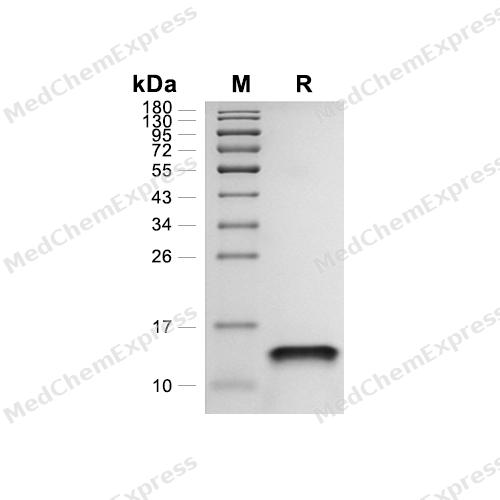
Purity - SDS-PAGE
-
Bioactivity - Cell-Based Assay
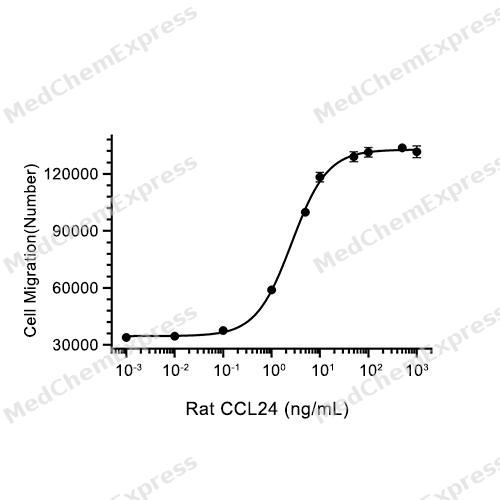
Bioactivity - Cell-Based Assay


Technical Parameters
-
Species Rat
-
Source E. coli
-
Tag Tag Free
-
Accession
Q5PPP2 (V27-V119)
-
Molecular Construction
-
N-term
-
CCL24 (V27-V119)
Accession # Q5PPP2 -
C-term
-
-
Protein Length
Partial
-
Synonyms
CCL24; CK-Beta-6; Prev. SCYA24; Small Inducible Cytokine Subfamily A (Cys-Cys), Member 24; Eotaxin-2; Eosinophil Chemotactic Protein 2; MPIF-2; Chemokine (C-C Motif) Ligand 24; MPIF2; Small-Inducible Cytokine A24; Myeloid Progenitor Inhibitory Factor 2; C
-
AA Sequence
VTIPSSCCVTFISKKIPVNRVISYQLANGSICPKAGVIFITKKGHKICTDPKLPWVQKHIKNLDAKRNQPSEGAKALGPKFVIQKLRGNSTKV
-
Predicted Molecular Mass
10.2 kDa
-
Molecular Weight
Approximately 14 kDa, based on SDS-PAGE under reducing conditions.
-
Purity
≥ 95%, as determined by reducing SDS-PAGE.


Product Properties
Lyophilized powder.
Lyophilized from a 0.22 μm filtered solution of 20 mM PB,150 mM NaCl, pH 7.4.
<1 EU/μg, determined by LAL method.
It is not recommended to reconstitute to a concentration less than 100 μg/mL in ddH2O. For long term storage it is recommended to add a carrier protein (0.1% BSA, 5% HSA, 10% FBS or 5% Trehalose).
Stored at -20°C for 2 years from date of receipt. After reconstitution, it is stable at 4°C for 1 week or -20°C for longer (with carrier protein). It is recommended to freeze aliquots at -20°C or -80°C for extended storage.
Room temperature in continental US; may vary elsewhere.


Documentation
-
Data Sheet (262 KB)
-
SDS (252 KB)
- English - EN (252 KB)
- Français - FR (252 KB)
- Deutsch - DE (252 KB)
- Norwegian - NO (252 KB)
- Español - ES (252 KB)
- Swedish - SV (252 KB)
- Italian - IT (252 KB)
- Korean - KR (252 KB)
- Portuguese - PT (252 KB)
-
Handling Instructions (2659 KB)


References
[1]. Hui Li, et al. Trophoblasts-derived chemokine CCL24 promotes the proliferation, growth and apoptosis of decidual stromal cells in human early pregnancy. Int J Clin Exp Pathol. 2013 May 15;6(6):1028-37. [Content Brief]
[2]. Michal Segal-Salto, et al. A blocking monoclonal antibody to CCL24 alleviates liver fibrosis and inflammation in experimental models of liver damage. JHEP Rep. 2020 Jan 2;2(1):100064. [Content Brief]

Calculators
Concentration (start) × Volume (start) = Concentration (final) × Volume (final)


 Powered by Bioz

