



CD204/MSR1 Protein, Mouse (HEK293, His)
Based on 1 publication(s) in Google Scholar
CD204/MSR1 Protein, a membrane glycoprotein, crucially contributes to cholesterol accumulation in arterial walls during atherogenesis. With two receptor subunits, it facilitates endocytosis of various macromolecules, including modified low-density lipoproteins (LDL). As a homotrimer, CD204/MSR1 engages in key interactions, including its association with MYO18A, highlighting its functional role in cellular processes. CD204/MSR1 Protein, Mouse (HEK293, His) is the recombinant mouse-derived CD204/MSR1 protein, expressed by HEK293 , with N-His labeled tag.
- Species: Mouse
- Source: HEK293
-
Storage:Stored at -20°C for 2 years from date of receipt. After reconstitution, it is stable at 4°C for 1 week or -20°C for longer (with carrier protein). It is recommended to freeze aliquots at -20°C or -80°C for extended storage.


To place orders, for customer services and technical support, please contact: MedChemExpress USA
Tel: 609-228-6898 E-mail: [email protected] [email protected]


-
 Biological Activity
-
Technical Parameters
-
Product Properties
- Documentation
- Help & FAQs




Biological Activity
Description
CD204/MSR1 Protein, a membrane glycoprotein, crucially contributes to cholesterol accumulation in arterial walls during atherogenesis. With two receptor subunits, it facilitates endocytosis of various macromolecules, including modified low-density lipoproteins (LDL). As a homotrimer, CD204/MSR1 engages in key interactions, including its association with MYO18A, highlighting its functional role in cellular processes. CD204/MSR1 Protein, Mouse (HEK293, His) is the recombinant mouse-derived CD204/MSR1 protein, expressed by HEK293 , with N-His labeled tag.
Background
CD204/MSR1 Protein, a membrane glycoprotein, plays a crucial role in the pathological accumulation of cholesterol in arterial walls during atherogenesis. Comprising two types of receptor subunits, this protein facilitates the endocytosis of a diverse array of macromolecules, including modified low-density lipoproteins (LDL). As a homotrimer, CD204/MSR1 engages in key interactions, such as its association with MYO18A, contributing to its functional role in cellular processes.
Verified Bioactivity
Measured by its binding ability in a functional ELISA. Immobilized Recombinant Mouse CD204 at 5 µg/mL (100 µL/well) can bind biotinylated advanced glycation endproducts of bovine serum albumin (AGE-BSA). The ED50 for this effect is 92.81 ng/mL.
MCE Validation Data
-
Purity - SDS-PAGE
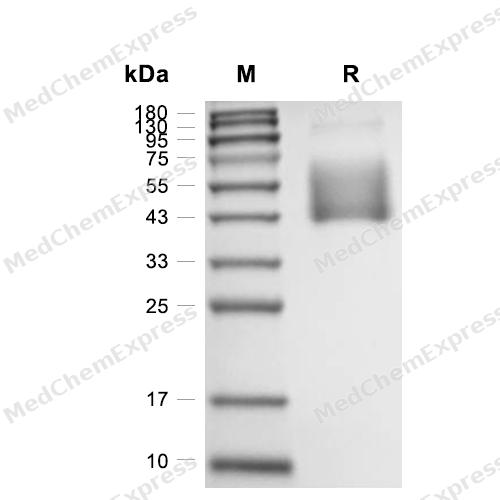
Purity - SDS-PAGE
-
Bioactivity - ELISA
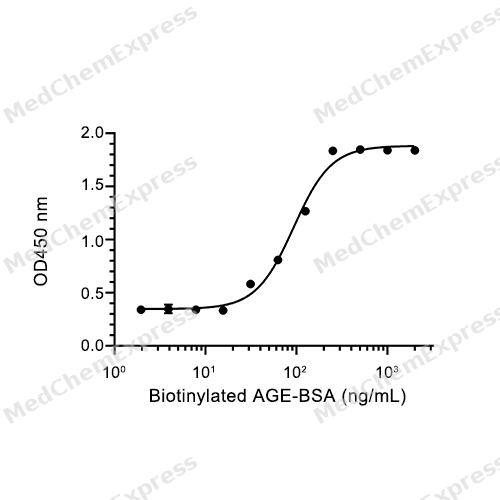
Bioactivity - ELISA


Publications (1)
-
Journal Impact Factor
-
Most Recent
-
Int Immunopharmacol
Structural polysaccharide PCP1 from Polygonatum cyrtonema Hua attenuates atherosclerosis via dual-target suppression of CD36/MSR1 and TLR4/NF-κB pathways. [Abstract]2025 Dec 3:166:115644. PMID: 41045802


Technical Parameters
-
Species Mouse
-
Source HEK293
-
Tag N-His
-
Accession
AAH03814.1 (W83-V354)
-
Molecular Construction
-
N-term
-
His
-
CD204/MSR1 (W83-V354)
Accession # AAH03814.1 -
C-term
-
-
Protein Length
Partial Extracellular Domain
-
Synonyms
MSR1; Macrophage Acetylated LDL Receptor I And II; Macrophage Scavenger Receptor 1; Scavenger Receptor Class A Member 1; SCARA1; CDNA FLJ55770, Highly Similar To Macrophage Scavenger Receptor Types I And II; SR-AIII; Macrophage Scavenger Receptor Type III
-
AA Sequence
WEMKNCLVCSRNTSDTSQGPMEKENTSNVEMRFTIIMAHMKDMEERIQSISNSKADLIDTGRFQNFSMATDQRLNDILLQLNSLILSVQEHGNSLDAISKSLQSLNMTLLDVQLHTETLHVRVRESTAKQQEDISKLEERVYKVSAEVQSVKEEQAHVEQEVKQEVRVLNNITNDLRLKDWEHSQTLKNITFIQGPPGPQGEKGDRGLTGQTGPPGAPGIRGIPGVKGDRGQIGFPGGRGNPGAPGKPGRSGSPGPKGQKGEKGSVGGSRSV
-
Molecular Weight
Approximately 42-75 kDa, based on SDS-PAGE under reducing conditions, due to the glycosylation.
-
Glycosylation
Yes
-
Purity
≥ 90%, as determined by reducing SDS-PAGE.


Product Properties
Lyophilized powder.
Lyophilized from a 0.2 μm filtered solution of PBS, pH 7.4. Normally 5 % - 8 % trehalose, mannitol and 0.01% Tween 80 are added as protectants before lyophilization.
<1 EU/μg, determined by LAL method.
It is not recommended to reconstitute to a concentration less than 100 μg/mL in ddH2O.
Stored at -20°C for 2 years from date of receipt. After reconstitution, it is stable at 4°C for 1 week or -20°C for longer (with carrier protein). It is recommended to freeze aliquots at -20°C or -80°C for extended storage.
Room temperature in continental US; may vary elsewhere.


Documentation
-
Data Sheet (261 KB)
-
SDS (251 KB)
- English - EN (251 KB)
- Français - FR (251 KB)
- Deutsch - DE (251 KB)
- Norwegian - NO (251 KB)
- Español - ES (251 KB)
- Swedish - SV (251 KB)
- Italian - IT (251 KB)
- Korean - KR (251 KB)
- Portuguese - PT (251 KB)
-
Handling Instructions (2659 KB)

Calculators
Concentration (start) × Volume (start) = Concentration (final) × Volume (final)


 Powered by Bioz

