



CD204/MSR1 Protein, Rat (HEK293, His)

Based on 1 Customer Validation
CD204/MSR1 Protein is a homo-trimeric transmembrane glycoprotein, holds key inflammatory roles in multiple pathophysiologic processes. MSR1 is highly expressed in lung, arteries, and adipose tissue. CD204/MSR1 Protein, Rat (HEK293, His) is the recombinant rat-derived CD204/MSR1 protein, expressed by HEK293 , with N-His labeled tag.
- Species: Rat
- Source: HEK293
-
Storage:Stored at -20°C for 2 years from date of receipt. After reconstitution, it is stable at 4°C for 1 week or -20°C for longer (with carrier protein). It is recommended to freeze aliquots at -20°C or -80°C for extended storage.


To place orders, for customer services and technical support, please contact: MedChemExpress USA
Tel: 609-228-6898 E-mail: [email protected] [email protected]


-
 Biological Activity
-
Technical Parameters
-
Product Properties
- Documentation
- References
- Help & FAQs




Biological Activity
Description
CD204/MSR1 Protein is a homo-trimeric transmembrane glycoprotein, holds key inflammatory roles in multiple pathophysiologic processes. MSR1 is highly expressed in lung, arteries, and adipose tissue[1]. CD204/MSR1 Protein, Rat (HEK293, His) is the recombinant rat-derived CD204/MSR1 protein, expressed by HEK293 , with N-His labeled tag.
Background
MSR1, also known as scavenger receptor-A (SR-A) or cluster of differentiation 204 (CD204), holds key inflammatory roles in multiple pathophysiologic processes. Present primarily on the surface of various types of macrophage, this receptor variably affects processes such as atherosclerosis, innate and adaptive immunity, lung and liver disease, and more recently, cancer. MSR1 has been shown to be important for M2 polarisation. Therefore, the role it carries or MSR1 is in part determined by the type of macrophage in which MSR1 is expressed and location within which the macrophages reside. The role of MSR1 is often dichotomous, being either host protective or detrimental to the pathogenesis of disease[1].
Verified Bioactivity
Measured by its binding ability in a functional ELISA. Immobilized Recombinant Rat CD204 at 5 µg/mL (100 µL/well) can bind biotinylated advanced glycation endproducts of bovine serum albumin (AGE-BSA). The ED50 for this effect is 303.8 ng/mL.
MCE Validation Data
-
Purity - SDS-PAGE
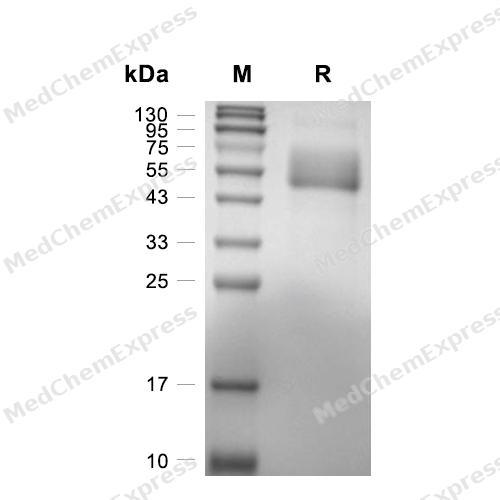
Purity - SDS-PAGE
-
Bioactivity - ELISA
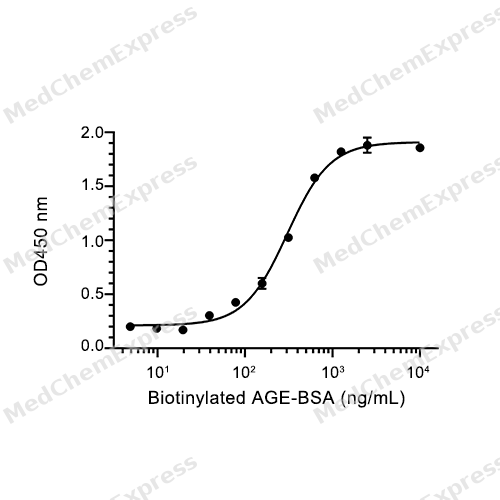
Bioactivity - ELISA


Technical Parameters
-
Species Rat
-
Source HEK293
-
Tag N-6*His
-
Accession
NP_001178868.1 (W134-S509)
-
Molecular Construction
-
N-term
-
His
-
MSR1 (W134-S509)
Accession # NP_001178868.1 -
C-term
-
-
Protein Length
Extracellular Domain
-
Synonyms
MSR1; Macrophage Acetylated LDL Receptor I And II; Macrophage Scavenger Receptor 1; Scavenger Receptor Class A Member 1; SCARA1; CDNA FLJ55770, Highly Similar To Macrophage Scavenger Receptor Types I And II; SR-AIII; Macrophage Scavenger Receptor Type III
-
AA Sequence
WEMKNCLVGSANTSDTSQTLTGKENTSKAEMGFTIAMERMKALEERVQSISDSKAGLLDTDRFQNFSMATDQRLNDLLLQLNSLISSVQEHGESLDAISKSLQSLNTTLLDVQVHTETLNVKVRESTAKQQEDISKLEERVHKVSAEIQSVKEEQEHVEQEVKQEVKVLNNITNDLRLKDWEHSQTLKNITLIQGPPGPPGEKGDKGLTGQSGPPGVPGARGPPGPKGDQGPVGFPGGRGYPGAPGKAGRSGFPGPKGQKGEKGRAGISTSLKTVRLVDGSGPHEGRVEIFHEGQWGTICDDRWDIRAGQVVCRSLGYQDVLTVHKRAHFGQGTGPIWLNEVMCFGRESSIENCKISKWGELGCSHAEDAGVTCTS
-
Molecular Weight
Approximately 51-60 kDa, based on SDS-PAGE under reducing conditions.
-
Glycosylation
Yes
-
Purity
≥ 95%, as determined by reducing SDS-PAGE.


Product Properties
Lyophilized powder.
Lyophilized from a 0.22 μm filtered solution of PBS, pH 7.4.
<1 EU/μg, determined by LAL method.
It is not recommended to reconstitute to a concentration less than 100 μg/mL in ddH2O. For long term storage it is recommended to add a carrier protein (0.1% BSA, 5% HSA, 10% FBS or 5% Trehalose).
Stored at -20°C for 2 years from date of receipt. After reconstitution, it is stable at 4°C for 1 week or -20°C for longer (with carrier protein). It is recommended to freeze aliquots at -20°C or -80°C for extended storage.
Room temperature in continental US; may vary elsewhere.


Documentation
-
Data Sheet (263 KB)
-
SDS (251 KB)
- English - EN (251 KB)
- Français - FR (251 KB)
- Deutsch - DE (251 KB)
- Norwegian - NO (251 KB)
- Español - ES (251 KB)
- Swedish - SV (251 KB)
- Italian - IT (251 KB)
- Korean - KR (251 KB)
- Portuguese - PT (251 KB)
-
Handling Instructions (2659 KB)


References

Calculators
Concentration (start) × Volume (start) = Concentration (final) × Volume (final)


 Powered by Bioz

