



CD30 Ligand/TNFSF8 Protein, Cynomolgus (HEK293, His)

Based on 1 Customer Validation
CD30 Ligand is a B cell surface antigen and a ligand for CD30 (TNFRSF8), playing an inhibitory role in CD40-mediated immunoglobulin class switching. CD30 Ligand is also a a marker for Hodgkin lymphoma and related hematologic malignancies, involves in activation and functioning of the T cell-dependent immune system. CD30 ligand is expressed by T and B lymphocytes, macrophages, and a variety of normal haematopoietic cells and derived tumours. CD30 ligand exerts pleiotropic effects on normal and malignant lymphoid cells, including death, differentiation, or cell division. As for CD30 ligand in cynomolgus contains a transmembrane domain belonging to the tumor necrosis factor (TNF) family. CD30 Ligand/TNFSF8 Protein, Cynomolgus (HEK293, His) is 172 amino acids in length (Q63-D234) and is expressed in the HEK293 cells with a N-terminal His-tag.
- Species: Cynomolgus
- Source: HEK293
-
Storage:Stored at -20°C for 2 years from date of receipt. After reconstitution, it is stable at 4°C for 1 week or -20°C for longer (with carrier protein). It is recommended to freeze aliquots at -20°C or -80°C for extended storage.


To place orders, for customer services and technical support, please contact: MedChemExpress USA
Tel: 609-228-6898 E-mail: [email protected] [email protected]


-
 Biological Activity
-
Technical Parameters
-
Product Properties
- Documentation
- References
- Help & FAQs




Biological Activity
Description
CD30 Ligand is a B cell surface antigen and a ligand for CD30 (TNFRSF8), playing an inhibitory role in CD40-mediated immunoglobulin class switching[1]. CD30 Ligand is also a a marker for Hodgkin lymphoma and related hematologic malignancies, involves in activation and functioning of the T cell-dependent immune system[2]. CD30 ligand is expressed by T and B lymphocytes, macrophages, and a variety of normal haematopoietic cells and derived tumours. CD30 ligand exerts pleiotropic effects on normal and malignant lymphoid cells, including death, differentiation, or cell division[3]. As for CD30 ligand in cynomolgus contains a transmembrane domain belonging to the tumor necrosis factor (TNF) family. CD30 Ligand/TNFSF8 Protein, Cynomolgus (HEK293, His) is 172 amino acids in length (Q63-D234) and is expressed in the HEK293 cells with a N-terminal His-tag.
Background
CD30 Ligand (CD30L) is a B cell surface antigen and a ligand for CD30 (TNFRSF8), playing an inhibitory role in CD40-mediated immunoglobulin class switching[1].
CD30L is a type II membrane-associated glycoprotein belonging to the tumor necrosis factor (TNF) family, structurally related to tumour necrosis superfamily members TNF alpha, TNF beta, and CD40[1][3].
CD30L enhances cell proliferation of some lymphoma cell lines, while to induce cell death and reduce cell proliferation of other lymphoma cell lines to play a pathophysiologic role in Hodgkin's and some non-Hodgkin's lymphomas. CD30L also enhances release of cytokine IL-6, TNF, LT-a[2].
CD30L exerts pleiotropic effects on normal and malignant lymphoid cells, including death, differentiation, or cell division regulation[3].
CD30L is mainly expressed on activated T cells, B cells, macrophages and DCs, while CD30/CD30L mainly expressed on the surface of activated CD4+ T cells in the lamina propria (LP), especially at the early stage of Th17 cell differentiation. CD30L deficiency could inhibit Th17 cell differentiation and production of IL-17A in the intestinal mucosa[4].
CD30L acts as a pro-inflammatory cytokines, is involved in the adaptive immune response in ulcerative colitis (UC), the level of which shows positive correlation with the severity of UC[5].
Verified Bioactivity
Measured by its binding ability in a functional ELISA. Immobilized Cynomolgus CD30L at 10 μg/mL (100 μ L/well) can bind biotinylated human CD30. The ED50 for this effect is 3.499 ng/mL.
MCE Validation Data
-
Purity - SDS-PAGE
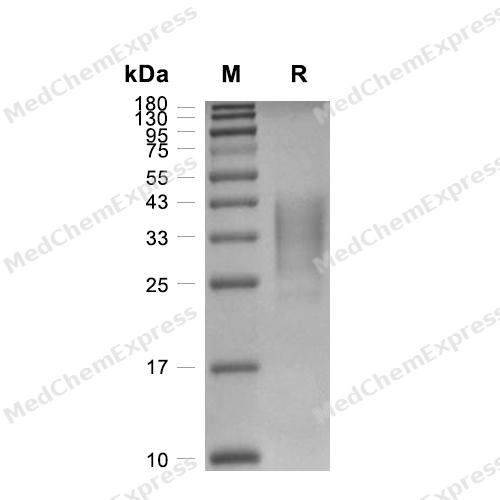
Purity - SDS-PAGE
-
Bioactivity - ELISA
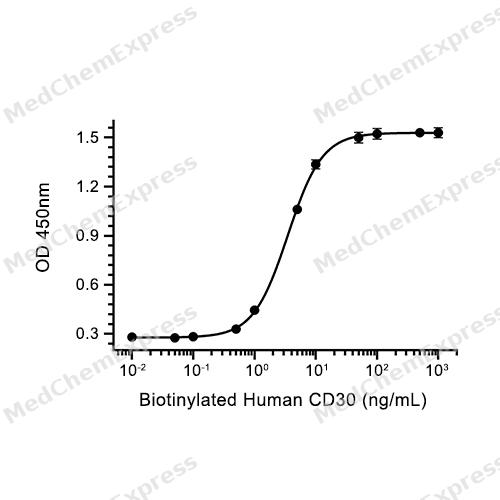
Bioactivity - ELISA


Technical Parameters
-
Species Cynomolgus
-
Source HEK293
-
Tag N-His
-
Accession
G7P2F1 (Q63-D234)
-
Gene ID/
-
Molecular Construction
-
N-term
-
His
-
CD30L (Q63-D234)
Accession # G7P2F1 -
C-term
-
-
Protein Length
Extracellular Domain
-
Synonyms
TNFSF8; CD153 Antigen; Prev. CD30LG; CD30-L; Tumor Necrosis Factor Ligand Superfamily Member 8; CD30L; CD30 Ligand; Tumor Necrosis Factor Superfamily Member 8; CD153; Tumor Necrosis Factor Ligand 3A; Tumor Necrosis Factor (Ligand) Superfamily, Member 8; C
-
AA Sequence
QRTDSIPNSPDNIPLRGGNCSEDLLCILKRAPFKKSWAYLQVAKHLNKTKLSWNKDGILHGVRYQDGNLVIQFPGLYFIICQLQFLVQCPNNSVDLKLELLINKHIKKQALVTVCESGMQTKHVYQNLSQFLLDYLQVNTTVSVNVDTFQYIDTSTFPLENVLSVFLYSNSD
-
Predicted Molecular Mass
19.6 kDa
-
Molecular Weight
Approximately 38 kDa, based on SDS-PAGE under reducing conditions.
-
Glycosylation
Yes
-
Purity
≥ 95%, as determined by reducing SDS-PAGE.


Product Properties
Lyophilized powder.
Lyophilized from a 0.2 μm filtered solution of PBS, pH 7.4. Normally 5 % - 8 % trehalose, mannitol and 0.01% Tween 80 are added as protectants before lyophilization.
<1 EU/μg, determined by LAL method.
It is not recommended to reconstitute to a concentration less than 100 μg/mL in ddH2O. For long term storage it is recommended to add a carrier protein (0.1% BSA, 5% HSA, 10% FBS or 5% Trehalose).
Stored at -20°C for 2 years from date of receipt. After reconstitution, it is stable at 4°C for 1 week or -20°C for longer (with carrier protein). It is recommended to freeze aliquots at -20°C or -80°C for extended storage.
Room temperature in continental US; may vary elsewhere.


Documentation
-
Data Sheet (264 KB)
-
SDS (251 KB)
- English - EN (251 KB)
- Français - FR (251 KB)
- Deutsch - DE (251 KB)
- Norwegian - NO (251 KB)
- Español - ES (251 KB)
- Swedish - SV (251 KB)
- Italian - IT (251 KB)
- Korean - KR (251 KB)
- Portuguese - PT (251 KB)
-
Handling Instructions (2659 KB)


References
[1]. Cerutti A, et al. CD30 is a CD40-inducible molecule that negatively regulates CD40-mediated immunoglobulin class switching in non-antigen-selected human B cells. Immunity. 1998 Aug;9(2):247-56. [Content Brief]
[2]. Gruss H-J, et al. CD30 ligand, a member of the TNF ligand superfamily, with growth and activation control CD30+ lymphoid and lymphoma cells. Leuk Lymphoma. 1996 Feb;20(5-6):397-409. [Content Brief]
[3]. Pera MF, et al. CD30 and its ligand: possible role in regulation of teratoma stem cells. APMIS. 1998 Jan;106(1):169-72; discussion 173. [Content Brief]
[4]. Wang X, et al. CD30L/CD30 signaling regulates the formation of the tumor immune microenvironment and inhibits intestinal tumor development of colitis-associated colon cancer in mice. Int Immunopharmacol. 2020 Jul;84:106531. [Content Brief]
[5]. Mei C, et al. CD30L+ classical monocytes play a pro-inflammatory role in the development of ulcerative colitis in patients. Mol Immunol. 2021 Oct;138:10-19. [Content Brief]

Calculators
Concentration (start) × Volume (start) = Concentration (final) × Volume (final)


 Powered by Bioz

