



CD47 Protein, Cynomolgus/Rhesus Macaque (HEK293, His)
Based on 1 Customer Validation
CD47 is a leukocyte surface antigen, and high expression of CD47 helps tumors escape. CD47 inhibition leads to the activation of CD103+ dendritic cells, which leads to the recruitment and activation of natural killer cells and inhibits cancer development. CD47 Protein, Cynomolgus/Rhesus Macaque (HEK293, His) is the recombinant Rhesus Macaque, cynomolgus-derived CD47 protein, expressed by HEK293 , with C-His labeled tag.
- Species: Rhesus Macaque; Cynomolgus
- Source: HEK293
-
Storage:Stored at -20°C for 2 years from date of receipt. After reconstitution, it is stable at 4°C for 1 week or -20°C for longer (with carrier protein). It is recommended to freeze aliquots at -20°C or -80°C for extended storage.


To place orders, for customer services and technical support, please contact: MedChemExpress USA
Tel: 609-228-6898 E-mail: [email protected] [email protected]


-
 Biological Activity
-
Technical Parameters
-
Product Properties
- Documentation
- References
- Help & FAQs




Biological Activity
Description
CD47 is a leukocyte surface antigen, and high expression of CD47 helps tumors escape. CD47 inhibition leads to the activation of CD103+ dendritic cells, which leads to the recruitment and activation of natural killer cells and inhibits cancer development. CD47 Protein, Cynomolgus/Rhesus Macaque (HEK293, His) is the recombinant Rhesus Macaque, cynomolgus-derived CD47 protein, expressed by HEK293 , with C-His labeled tag.
Background
CD47 is a receptor for the C-terminal cell-binding domain of leukocyte surface antigen and thrombospondin. CD47 controls the increase in intracellular calcium concentration when cells adhere to the extracellular matrix and may play a role in membrane trafficking and signal transduction. The CD47 gene has broad tissue distribution and low expression on Rh erythrocytes. High expression levels of CD47 help cancer cells evade the immune system. For example, studies have found that high expression of CD47 is associated with poor prognosis in HCC patients. CD47 inhibition can enhance the ability of CD103+ DCs to take up tumor DNA, thereby stimulating the cGAS-STING pathway and promoting the infiltration and activation of liver natural killer cells in cancer cells. CD47 also binds to proteins including thrombospondin-1 (TSP-1), signal regulatory protein alpha (SIRPα), integrins, and protein tyrosine phosphatase substrate with SH2 domain-1 (SHPS-1). Ligand. and regulates phagocytosis of macrophages, migration of neutrophils, and activation of dendritic cells, T cells, and B cells. Some CD47 antibodies may inhibit the CD47-SIRPα axis to enhance phagocytosis of cancer cells.
Verified Bioactivity
1.Immobilized Cynomolgus/Rhesus macaque CD47, His Tag at 5 μg/mL (100 μl/well) on the plate. Dose response curve for Human SIRP alpha, hFc Tag with the EC50 of ≤1 μg/mL determined by ELISA.
2.Measured by its binding ability in a functional ELISA. Immobilized Human SIRP alpha at 2 μg/mL (100 μL/well) can bind Cynomolgus CD47. The ED50 for this effect is ≤1 μg/mL.
MCE Validation Data
-
Purity - SDS-PAGE
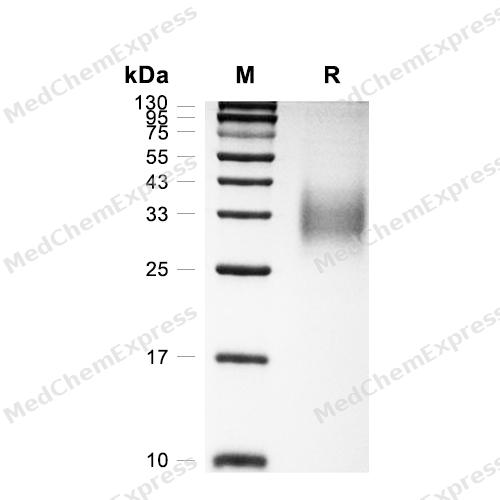
Purity - SDS-PAGE


Technical Parameters
-
Species Rhesus Macaque; Cynomolgus
-
Source HEK293
-
Tag C-His
-
Accession
F7A802/NP_001253446 (Q19-N142)
-
Molecular Construction
-
N-term
-
CD47 (Q19-N142)
Accession # F7A802/NP_001253446 -
His
-
C-term
-
-
Protein Length
Partial
-
Synonyms
CD47; Antigen Identified By Monoclonal Antibody 1D8; Prev. MER6; Integrin-Associated Protein; Leukocyte Surface Antigen CD47; Rh-Related Antigen; IAP; CD47 Glycoprotein; Antigenic Surface Determinant Protein OA3; Integrin-Associated Signal Transducer; OA3
-
AA Sequence
QLLFNKTKSVEFTFCNDTVVIPCFVTNMEAQNTTEVYVKWKFKGRDIYTFDGALNKSTAPANFSSAKIEVSQLLKGDASLKMDKSDAVSHTGNYTCEVTELTREGETIIELKYRVVSWFSPNEN
-
Molecular Weight
Approximately 30-43 kDa, based on SDS-PAGE under reducing conditions, due to the glycosylation.
-
Glycosylation
Yes
-
Purity
≥ 95%, as determined by reducing SDS-PAGE.


Product Properties
Lyophilized powder.
Lyophilized from a 0.22 μm filtered solution of PBS, pH 7.4.
<1 EU/μg, determined by LAL method.
It is not recommended to reconstitute to a concentration less than 100 μg/mL in ddH2O. For long term storage it is recommended to add a carrier protein (0.1% BSA, 5% HSA, 10% FBS or 5% Trehalose).
Stored at -20°C for 2 years from date of receipt. After reconstitution, it is stable at 4°C for 1 week or -20°C for longer (with carrier protein). It is recommended to freeze aliquots at -20°C or -80°C for extended storage.
Room temperature in continental US; may vary elsewhere.


Documentation
-
Data Sheet (263 KB)
-
SDS (251 KB)
- English - EN (251 KB)
- Français - FR (251 KB)
- Deutsch - DE (251 KB)
- Norwegian - NO (251 KB)
- Español - ES (251 KB)
- Swedish - SV (251 KB)
- Italian - IT (251 KB)
- Korean - KR (251 KB)
- Portuguese - PT (251 KB)
-
Handling Instructions (2659 KB)


References
[1]. Wang S, et al. Blocking CD47 promotes antitumour immunity through CD103+ dendritic cell-NK cell axis in murine hepatocellular carcinoma model. J Hepatol. 2022 Aug;77(2):467-478. [Content Brief]
[2]. Hayat SMG, et al. CD47: role in the immune system and application to cancer therapy. Cell Oncol (Dordr). 2020 Feb;43(1):19-30. [Content Brief]

Calculators
Concentration (start) × Volume (start) = Concentration (final) × Volume (final)


 Powered by Bioz

