



Chemerin/RARRES2 Protein, Human (HEK293, His)
Based on 2 publication(s) in Google Scholar
Chemerin/RARRES2 protein is an adipokine secreted by adipocytes that is activated by CMKLR1 and serves as a CMKLR2 ligand to complexly regulate adipogenesis, metabolism, and inflammation. It actively regulates adipocyte differentiation, affects lipid and glucose metabolism, and plays a role in angiogenesis. Chemerin/RARRES2 Protein, Human (HEK293, His) is the recombinant human-derived Chemerin/RARRES2 protein, expressed by HEK293 , with C-6*His labeled tag.
- Species: Human
- Source: HEK293
-
Storage:Stored at -20°C for 2 years from date of receipt. After reconstitution, it is stable at 4°C for 1 week or -20°C for longer (with carrier protein). It is recommended to freeze aliquots at -20°C or -80°C for extended storage.


To place orders, for customer services and technical support, please contact: MedChemExpress USA
Tel: 609-228-6898 E-mail: [email protected] [email protected]


-
 Biological Activity
-
Technical Parameters
-
Product Properties
- Documentation
- Help & FAQs


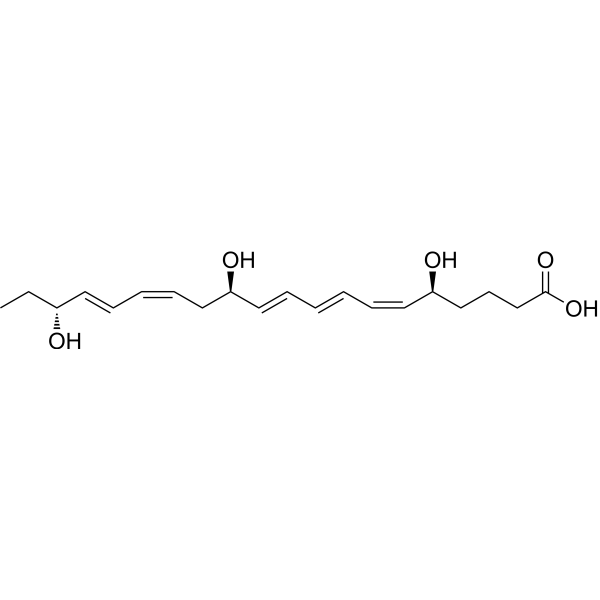


Biological Activity
Description
Chemerin/RARRES2 protein is an adipokine secreted by adipocytes that is activated by CMKLR1 and serves as a CMKLR2 ligand to complexly regulate adipogenesis, metabolism, and inflammation. It actively regulates adipocyte differentiation, affects lipid and glucose metabolism, and plays a role in angiogenesis. Chemerin/RARRES2 Protein, Human (HEK293, His) is the recombinant human-derived Chemerin/RARRES2 protein, expressed by HEK293 , with C-6*His labeled tag.
Background
Chemerin/RARRES2 protein, an adipocyte-secreted adipokine, intricately regulates adipogenesis, metabolism, and inflammation by activating the chemokine-like receptor 1 (CMKLR1) and also functioning as a ligand for CMKLR2. While it can bind to C-C chemokine receptor-like 2 (CCRL2) with lower affinity than CMKLR1 or CMKLR2, its primary role involves positive regulation of adipocyte differentiation and modulation of adipocyte gene expression related to lipid and glucose metabolism. Additionally, Chemerin/RARRES2 plays a potential role in angiogenesis, a critical process for white adipose tissue expansion. Acting as a pro-inflammatory adipokine, it stimulates the secretion of pro-inflammatory and prodiabetic adipokines, adversely impacting adipose tissue metabolic function and leading to systemic effects such as impaired insulin sensitivity, altered glucose and lipid metabolism, and compromised vascular function in other tissues. The protein exhibits both pro- and anti-inflammatory properties based on enzymatic cleavage by different proteases, functioning as a chemotactic factor for leukocyte populations expressing CMKLR1 and exerting an anti-inflammatory role by inhibiting TNF/TNFA-induced VCAM1 expression in vascular endothelial cells. This dual role suggests a potential link between chronic inflammation, obesity, and associated disorders like type 2 diabetes and cardiovascular disease, while also exhibiting an antimicrobial function in the skin.
Verified Bioactivity
1. Measured in a cell proliferation assay using HUVEC human ureteral epithelial cell. The ED50 for this effect is 7.695 ng/mL, corresponding to a specific activity is 1.3×10⁵ units/mg.
2. Measured by its ability to chemoattract BaF3 mouse pro-B cells transfected with human ChemR23. The ED50 for this effect is 12.63 ng/mL, corresponding to a specific activity is 7.918×10⁴ U/mg.
MCE Validation Data
-
Purity - SDS-PAGE
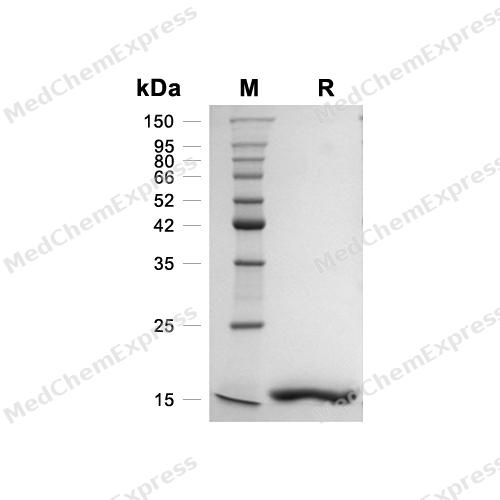
Purity - SDS-PAGE
-
Bioactivity - Cell-Based Assay
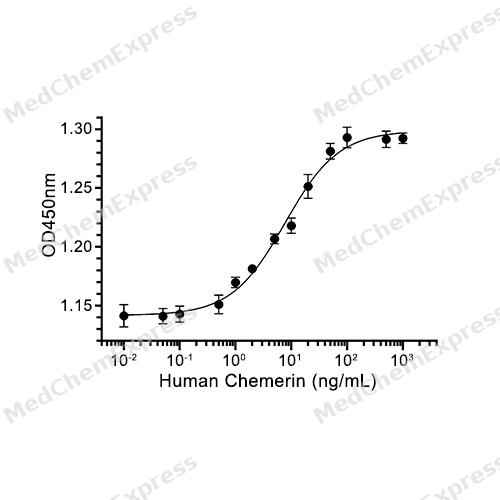
Bioactivity - Cell-Based Assay


Publications (2)
-
Journal Impact Factor
-
Most Recent
-
Mol Med
Chemerin alleviates the placental oxidative stress and improves fetal overgrowth of gestational diabetes mellitus mice induced by high fat diet. [Abstract]2024 Nov 30;30(1):239. PMID: 39616329 -
iScience
Integrative multiomics analysis identifies RARRES2 as a regulator of keloid pathogenesis through STAT3/HSPG2 signaling axis. [Abstract]2026 Apr 20;29(5):115797. PMID: 42170108


Technical Parameters
-
Species Human
-
Source HEK293
-
Tag C-6*His
-
Accession
Q99969 (E21-S157)
-
Molecular Construction
-
N-term
-
Chemerin (E21-S157)
Accession # Q99969 -
6*His
-
C-term
-
-
Protein Length
Full Length of Mature Protein
-
Synonyms
RARRES2; HP10433; Retinoic Acid Receptor Responder 2; Retinoic Acid Receptor Responder (Tazarotene Induced) 2; Chemerin; Tazarotene-Induced Gene 2 Protein; TIG2; RAR-Responsive Protein TIG2; Retinoic Acid Receptor Responder Protein 2
-
AA Sequence
ELTEAQRRGLQVALEEFHKHPPVQWAFQETSVESAVDTPFPAGIFVRLEFKLQQTSCRKRDWKKPECKVRPNGRKRKCLACIKLGSEDKVLGRLVHCPIETQVLREAEEHQETQCLRVQRAGEDPHSFYFPGQFAFS
-
Predicted Molecular Mass
16.9 kDa
-
Molecular Weight
Approximately 16-20 kDa, based on SDS-PAGE under reducing conditions.
-
Purity
≥ 95%, as determined by reducing SDS-PAGE.


Product Properties
Lyophilized powder
1.Lyophilized from a 0.22 μm filtered solution of 20 mM PB, 150 mM NaCl, pH 7.4.
2.Lyophilized from a 0.22 μm filtered solution of PBS, pH 7.4, 8% trehalose.
Please refer to the lot-specific COA for specific buffer information.
<1 EU/μg, determined by LAL method.
It is not recommended to reconstitute to a concentration less than 100 μg/mL in ddH2O. For long term storage it is recommended to add a carrier protein (0.1% BSA, 5% HSA, 10% FBS or 5% Trehalose).
Stored at -20°C for 2 years from date of receipt. After reconstitution, it is stable at 4°C for 1 week or -20°C for longer (with carrier protein). It is recommended to freeze aliquots at -20°C or -80°C for extended storage.
Room temperature in continental US; may vary elsewhere.


Documentation
-
Data Sheet (237 KB)
-
SDS (252 KB)
- English - EN (252 KB)
- Français - FR (252 KB)
- Deutsch - DE (252 KB)
- Norwegian - NO (252 KB)
- Español - ES (252 KB)
- Swedish - SV (252 KB)
- Italian - IT (252 KB)
- Korean - KR (252 KB)
- Portuguese - PT (252 KB)
-
Handling Instructions (2659 KB)

Calculators
Concentration (start) × Volume (start) = Concentration (final) × Volume (final)


 Powered by Bioz

