



Coagulation factor IX/F9 Protein, Human (HEK293, His)
Based on 1 publication(s) in Google Scholar
Factor IX (F9) is a vitamin K-dependent plasma protein that plays a critical role in the intrinsic pathway of coagulation. Factor IX coordinates the conversion of factor X to its active form in the presence of Ca(2+) ions, phospholipids, and factor VIIIa. Coagulation factor IX/F9 Protein, Human (HEK293, His) is the recombinant human-derived Coagulation factor IX/F9 protein, expressed by HEK293 , with C-6*His labeled tag.
- Species: Human
- Source: HEK293
-
Storage:Stored at -80°C for 1 year from date of receipt. It is stable at -20°C for 3 months after opening. It is recommended to freeze aliquots at -80°C for extended storage. Avoid repeated freeze-thaw cycles.


To place orders, for customer services and technical support, please contact: MedChemExpress USA
Tel: 609-228-6898 E-mail: [email protected] [email protected]


-
 Biological Activity
-
Technical Parameters
-
Product Properties
- Documentation
- Help & FAQs




Biological Activity
Description
Factor IX (F9) is a vitamin K-dependent plasma protein that plays a critical role in the intrinsic pathway of coagulation. Factor IX coordinates the conversion of factor X to its active form in the presence of Ca(2+) ions, phospholipids, and factor VIIIa. Coagulation factor IX/F9 Protein, Human (HEK293, His) is the recombinant human-derived Coagulation factor IX/F9 protein, expressed by HEK293 , with C-6*His labeled tag.
Background
Coagulation factor IX, also known as F9, is a vitamin K-dependent plasma protein crucial for blood coagulation, particularly in the intrinsic pathway. This protein plays a pivotal role in converting factor X to its active form in the presence of Ca(2+) ions, phospholipids, and factor VIIIa. As a key component of the coagulation cascade, factor IX contributes to the formation of a stable blood clot, preventing excessive bleeding. The described mechanism highlights the intricate interplay of factor IX with other coagulation factors and cofactors, underscoring its essential role in maintaining hemostasis.
Verified Bioactivity
1. Measured by its ability to cleave the fluorogenic peptide substrate, Mca-RPKPVE-Nval-WRK(Dnp)-NH2. Read at excitation and emission wavelengths of 320 nm and 405 nm (top read).The specific activity is >110.07 pmol/min/μg, as measured under the described conditions.
2. Measured by its ability to cleave the peptide substrate Z-D-Arg-Gly-Arg-pNA and the specific activity is >20 pmol/min/ug. (Activation description: The proenzyme needs to be activated by Thermolysin for an activated form.)
MCE Validation Data
-
Purity - SDS-PAGE
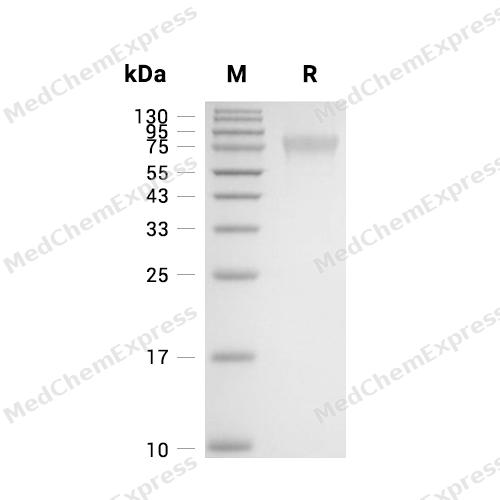
Purity - SDS-PAGE


Publications (1)
-
Journal Impact Factor
-
Most Recent


Technical Parameters
-
Species Human
-
Source HEK293
-
Tag C-6*His
-
Accession
P00740-1 (T29-T461)
-
Molecular Construction
-
N-term
-
F9 (T29-T461)
Accession # P00740-1 -
6*His
-
C-term
-
-
Protein Length
Full Length of Mature Protein (with Propeptide)
-
Synonyms
F9; Autoprothrombin IIA; Coagulation Factor IX; Coagulant Factor IX; FIX; Christmas Disease; Plasma Thromboplastic Component; Hemophilia B; Plasma Thromboplastin Component; Factor IX F9; Christmas Factor; Factor IX; PTC; Factor 9; Truncated Coagulation Fa
-
AA Sequence
TVFLDHENANKILNRPKRYNSGKLEEFVQGNLERECMEEKCSFEEAREVFENTERTTEFWKQYVDGDQCESNPCLNGGSCKDDINSYECWCPFGFEGKNCELDVTCNIKNGRCEQFCKNSADNKVVCSCTEGYRLAENQKSCEPAVPFPCGRVSVSQTSKLTRAETVFPDVDYVNSTEAETILDNITQSTQSFNDFTRVVGGEDAKPGQFPWQVVLNGKVDAFCGGSIVNEKWIVTAAHCVETGVKITVVAGEHNIEETEHTEQKRNVIRIIPHHNYNAAINKYNHDIALLELDEPLVLNSYVTPICIADKEYTNIFLKFGSGYVSGWGRVFHKGRSALVLQYLRVPLVDRATCLRSTKFTIYNNMFCAGFHEGGRDSCQGDSGGPHVTEVEGTSFLTGIISWGEECAMKGKYGIYTKVSRYVNWIKEKTKLT
-
Predicted Molecular Mass
49.8 kDa
-
Molecular Weight
Approximately 60-90 kDa, based on SDS-PAGE under reducing conditions.
-
Glycosylation
Yes
-
Purity
≥ 95%, as determined by reducing SDS-PAGE.


Product Properties
Solution
1.Supplied as a 0.22 μm filtered solution of 20 mM Tris-HCl, 150 mM NaCl, 10% glycerol, pH 8.0.
2.Supplied as a 0.22 μm filtered solution of PBS, pH 7.4.
Please refer to the lot-specific COA for specific buffer information.
Note: For SPR assay, please replace the buffer. Primary amine components (e.g., Tris, imidazole) can affect protein-coupled chips.
<1 EU/μg, determined by LAL method.
Stored at -80°C for 1 year from date of receipt. It is stable at -20°C for 3 months after opening. It is recommended to freeze aliquots at -80°C for extended storage. Avoid repeated freeze-thaw cycles.
Shipping with dry ice.


Documentation
-
Data Sheet (238 KB)
-
SDS (254 KB)
- English - EN (254 KB)
- Français - FR (254 KB)
- Deutsch - DE (254 KB)
- Norwegian - NO (254 KB)
- Español - ES (254 KB)
- Swedish - SV (254 KB)
- Italian - IT (254 KB)
- Korean - KR (254 KB)
- Portuguese - PT (254 KB)
-
Handling Instructions (2659 KB)

Calculators
Concentration (start) × Volume (start) = Concentration (final) × Volume (final)


 Powered by Bioz

