



Coagulation factor XIII A/F13A Protein, Human (HEK293, His)

Based on 1 Customer Validation
Coagulation factor XIII A chain is the A chain of factor XIII. As a coagulation factor, Factor XIII A chain alters clot stabilization and bleeding. Factor XIII A chain regulates multiple aspects of wound healing: stabilizes fibrin clots and extracellular matrix, modulates monocyte functions, promote angiogenesis, and upregulates proangiogenic early growth response transcription factor 1.
Coagulation factor XIII A/F13A Protein, Human (HEK293, His) is the recombinant human-derived Coagulation factor XIII A/F13A protein, expressed by HEK293 , with C-6*His labeled tag.
- Species: Human
- Source: HEK293
-
Storage:Stored at -80°C for 1 year from date of receipt. It is stable at -20°C for 3 months after opening. It is recommended to freeze aliquots at -80°C for extended storage. Avoid repeated freeze-thaw cycles.


To place orders, for customer services and technical support, please contact: MedChemExpress USA
Tel: 609-228-6898 E-mail: [email protected] [email protected]


-
 Biological Activity
-
Technical Parameters
-
Product Properties
- Documentation
- Help & FAQs




Biological Activity
Description
Coagulation factor XIII A chain is the A chain of factor XIII. As a coagulation factor, Factor XIII A chain alters clot stabilization and bleeding. Factor XIII A chain regulates multiple aspects of wound healing: stabilizes fibrin clots and extracellular matrix, modulates monocyte functions, promote angiogenesis, and upregulates proangiogenic early growth response transcription factor 1[1][2][3][4].
Coagulation factor XIII A/F13A Protein, Human (HEK293, His) is the recombinant human-derived Coagulation factor XIII A/F13A protein, expressed by HEK293 , with C-6*His labeled tag.
Background
Coagulation factor XIII is critical in the coagulation cascade chain, and enhances the stability of blood clot formation. Factor XIII is involved in trauma, wound healing, tissue repair, pregnancy, and even bone metabolism. Factor XIII can bind to αvβ3 integrin, inducing VEGFR-2 activation, promoting endothelial cell proliferation and survival, and angiogenesis[1].
Factor XIII, a transglutaminase, is a complex of two A (gene F13A1) chains with catalytic activity and two B chains (gene F13B)[2]. Factor XIII A chain can be activated by thrombin and Ca2+. Factor XIII A usually exists in the cytoplasm of certain cells, particularly platelets and monocytes/macrophages[3].
Factor XIII A chain plays a role in wound healing, inflammatory and malignant diseases[4].
Verified Bioactivity
The enzyme activity of this recombinant protein is testing in progress, we cannot offer a guarantee yet.
MCE Validation Data
-
Purity - SDS-PAGE
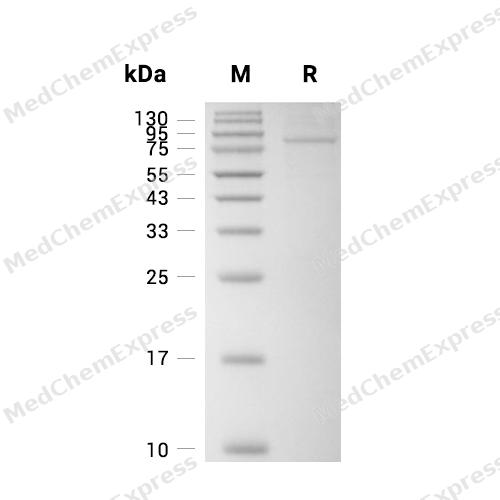
Purity - SDS-PAGE


Technical Parameters
-
Species Human
-
Source HEK293
-
Tag C-6*His
-
Accession
AAH27963.1 (G39-M732)
-
Molecular Construction
-
N-term
-
F13A (G39-M732)
Accession # AAH27963.1 -
6*His
-
C-term
-
-
Protein Length
Full Length of Coagulation factor XIII A chain Chain
-
Synonyms
F13A1; Coagulation Factor XIII, A Polypeptide; Prev. F13A; Transglutaminase. Plasma; Protein-Glutamine Gamma-Glutamyltransferase A Chain; Coagulation Factor XIII; Coagulation Factor XIII, A1 Polypeptide; FSF, A Subunit; Coagulation Factor XIIIa; Fibrinoli
-
AA Sequence
GVNLQEFLNVTSVHLFKERWDTNKVDHHTDKYENNKLIVRRGQSFYVQIDFSRPYDPRRDLFRVEYVIGRYPQENKGTYIPVPIVSELQSGKWGAKIVMREDRSVRLSIQSSPKCIVGKFRMYVAVWTPYGVLRTSRNPETDTYILFNPWCEDDAVYLDNEKEREEYVLNDIGVIFYGEVNDIKTRSWSYGQFEDGILDTCLYVMDRAQMDLSGRGNPIKVSRVGSAMVNAKDDEGVLVGSWDNIYAYGVPPSAWTGSVDILLEYRSSENPVRYGQCWVFAGVFNTFLRCLGIPARIVTNYFSAHDNDANLQMDIFLEEDGNVNSKLTKDSVWNYHCWNEAWMTRPDLPVGFGGWQAVDSTPQENSDGMYRCGPASVQAIKHGHVCFQFDAPFVFAEVNSDLIYITAKKDGTHVVENVDATHIGKLIVTKQIGGDGMMDITDTYKFQEGQEEERLALETALMYGAKKPLNTEGVMKSRSNVDMDFEVENAVLGKDFKLSITFRNNSHNRYTITAYLSANITFYTGVPKAEFKKETFDVTLEPLSFKKEAVLIQAGEYMGQLLEQASLHFFVTARINETRDVLAKQKSTVLTIPEIIIKVRGTQVVGSDMTVIVEFTNPLKETLRNVWVHLDGPGVTRPMKKMFREIRPNSTVQWEEVCRPWVSGHRKLIASMSSDSLRHVYGELDVQIQRRPSM
-
Predicted Molecular Mass
80.3 kDa
-
Molecular Weight
Approximately 80-90 kDa, based on SDS-PAGE under reducing conditions.
-
Glycosylation
Yes
-
Purity
≥ 95%, as determined by reducing SDS-PAGE.


Product Properties
Solution
1.Supplied as a 0.22 μm filtered solution of 50 mM NaCl, 5% sucrose, 0.3% histidine , pH 8.0.
2.Supplied as a 0.22 μm filtered solution of 20 mM Tris-HCl, 5% sucrose, 10% glycerol, 0.02% Tween 80, pH 8.0.
Note: For SPR assay, please replace the buffer. Primary amine components (e.g., Tris, imidazole) can affect protein-coupled chips.
Please refer to the lot-specific COA for specific buffer information.
<1 EU/μg, determined by LAL method.
Stored at -80°C for 1 year from date of receipt. It is stable at -20°C for 3 months after opening. It is recommended to freeze aliquots at -80°C for extended storage. Avoid repeated freeze-thaw cycles.
Shipping with dry ice.


Documentation
-
Data Sheet (240 KB)
-
SDS (252 KB)
- English - EN (252 KB)
- Français - FR (252 KB)
- Deutsch - DE (252 KB)
- Norwegian - NO (252 KB)
- Español - ES (252 KB)
- Swedish - SV (252 KB)
- Italian - IT (252 KB)
- Korean - KR (252 KB)
- Portuguese - PT (252 KB)
-
Handling Instructions (2659 KB)

Calculators
Concentration (start) × Volume (start) = Concentration (final) × Volume (final)


 Powered by Bioz

