



Complement factor H/CFH Protein, Human (HEK293, His, solution)

Based on 1 Customer Validation
Complement factor H/CFH Protein, Human (HEK293, His, solution) is a recombinant complement factor H (CFH) protein with His tag. Human complement factor H, a central complement control protein, is a member of the regulators of complement activation family.
- Species: Human
- Source: HEK293
-
Storage:Stored at -80°C for 1 year from date of receipt. It is stable at -20°C for 3 months after opening. It is recommended to freeze aliquots at -80°C for extended storage. Avoid repeated freeze-thaw cycles.


To place orders, for customer services and technical support, please contact: MedChemExpress USA
Tel: 609-228-6898 E-mail: [email protected] [email protected]


-
 Biological Activity
-
Technical Parameters
-
Product Properties
- Documentation
- References
- Help & FAQs




Biological Activity
Description
Complement factor H/CFH Protein, Human (HEK293, His, solution) is a recombinant complement factor H (CFH) protein with His tag. Human complement factor H, a central complement control protein, is a member of the regulators of complement activation family[1].
Background
Complement factor H (CFH) is a component of the mammalian complement system, which regulates the alternative pathway of complement activation and protects the host cell from inappropriate complement activation. CFH is a key regulator of innate immunity, and CFH deficiency leads to membranoproliferative glomerulonephritis type II[2].
MCE Validation Data
-
Purity - SDS-PAGE
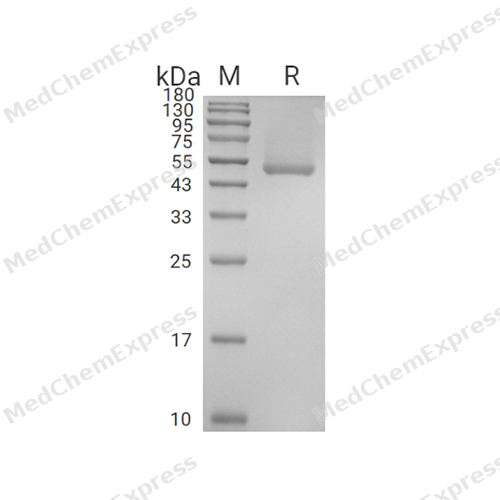
Purity - SDS-PAGE


Technical Parameters
-
Species Human
-
Source HEK293
-
Tag C-6*His
-
Accession
P08603-2 (E19-L449)
-
Molecular Construction
-
N-term
-
CFH (K79-V445)
Accession # P08603-2 -
6*His
-
C-term
-
-
Protein Length
Partial
-
Synonyms
CFH; H Factor 1 (Complement); Prev. HF1; Adrenomedullin Binding Protein; Prev. HF2; Beta-1-H-Globulin; Prev. HF; Factor H-Like 1; ARMS1; H Factor 1; ARMD4; Factor H; FHL1; AHUS1; HUS; AMBP1; Age-Related Maculopathy Susceptibility 1; CFHL3; H Factor 2 (Com
-
AA Sequence
EDCNELPPRRNTEILTGSWSDQTYPEGTQAIYKCRPGYRSLGNVIMVCRKGEWVALNPLRKCQKRPCGHPGDTPFGTFTLTGGNVFEYGVKAVYTCNEGYQLLGEINYRECDTDGWTNDIPICEVVKCLPVTAPENGKIVSSAMEPDREYHFGQAVRFVCNSGYKIEGDEEMHCSDDGFWSKEKPKCVEISCKSPDVINGSPISQKIIYKENERFQYKCNMGYEYSERGDAVCTESGWRPLPSCEEKSCDNPYIPNGDYSPLRIKHRTGDEITYQCRNGFYPATRGNTAKCTSTGWIPAPRCTLKPCDYPDIKHGGLYHENMRRPYFPVAVGKYYSYYCDEHFETPSGSYWDHIHCTQDGWSPAVPCLRKCYFPYLENGYNQNYGRKFVQGKSIDVACHPGYALPKAQTTVTCMENGWSPTPRCIRVSFTL
-
Predicted Molecular Mass
50 kDa
-
Molecular Weight
Approximately 50 kDa, based on SDS-PAGE under reducing conditions.
-
Glycosylation
Yes
-
Purity
≥ 95%, as determined by reducing SDS-PAGE.


Product Properties
Solution
Supplied as a 0.22 μm filtered solution of PBS, 20% Glycerol, 5% trehalose, pH 7.4.
<1 EU/μg, determined by LAL method.
Stored at -80°C for 1 year from date of receipt. It is stable at -20°C for 3 months after opening. It is recommended to freeze aliquots at -80°C for extended storage. Avoid repeated freeze-thaw cycles.
Shipping with dry ice.


Documentation
-
Data Sheet (263 KB)
-
SDS (252 KB)
- English - EN (252 KB)
- Français - FR (252 KB)
- Deutsch - DE (252 KB)
- Norwegian - NO (252 KB)
- Español - ES (252 KB)
- Swedish - SV (252 KB)
- Italian - IT (252 KB)
- Korean - KR (252 KB)
- Portuguese - PT (252 KB)
-
Handling Instructions (2659 KB)


References
[1]. Cui T, et al. Human complement factor H is a novel diagnostic marker for lung adenocarcinoma. Int J Oncol. 2011;39(1):161-168. [Content Brief]
[2]. Mandal MN, et al. Complement factor H: spatial and temporal expression and localization in the eye. Invest Ophthalmol Vis Sci. 2006;47(9):4091-4097. [Content Brief]

Calculators
Concentration (start) × Volume (start) = Concentration (final) × Volume (final)


 Powered by Bioz

