



CPLX2/Complexin-2 Protein, Human (His)

Based on 1 Customer Validation
Complexin-2 (CPLX2) protein plays a key role in regulating synaptic vesicle dynamics, acting as a negative regulator of synaptic vesicle cluster formation. It precisely affects vesicle localization to the presynaptic membrane. CPLX2/Complexin-2 Protein, Human (His) is the recombinant human-derived CPLX2/Complexin-2 protein, expressed by E. coli , with N-His labeled tag.
- Species: Human
- Source: E. coli
-
Storage:Stored at -20°C for 2 years from date of receipt. After reconstitution, it is stable at 4°C for 1 week or -20°C for longer (with carrier protein). It is recommended to freeze aliquots at -20°C or -80°C for extended storage.


To place orders, for customer services and technical support, please contact: MedChemExpress USA
Tel: 609-228-6898 E-mail: [email protected] [email protected]


-
 Biological Activity
-
Technical Parameters
-
Product Properties
- Documentation
- Help & FAQs




Biological Activity
Description
Complexin-2 (CPLX2) protein plays a key role in regulating synaptic vesicle dynamics, acting as a negative regulator of synaptic vesicle cluster formation. It precisely affects vesicle localization to the presynaptic membrane. CPLX2/Complexin-2 Protein, Human (His) is the recombinant human-derived CPLX2/Complexin-2 protein, expressed by E. coli , with N-His labeled tag.
Background
Complexin-2 (CPLX2) protein assumes a pivotal role in modulating synaptic vesicle dynamics within postmitotic neurons. It acts as a negative regulator, specifically impeding the formation of synaptic vesicle clusters at the active zone, thereby influencing the precise localization of vesicles to the presynaptic membrane. Intriguingly, CPLX2 also exhibits a positive regulatory impact on the later stages of exocytosis, participating in the release of various cytoplasmic vesicles, including synaptic vesicles and other secretory vesicles. Its involvement extends to mast cell exocytosis, underlining its versatile role in cellular processes. Notably, CPLX2 achieves these regulatory effects through direct binding to the SNARE core complex, a molecular ensemble encompassing SNAP25, VAMP2, and STX1A, thereby contributing to the intricate orchestration of neurotransmitter release and vesicle dynamics at the synapse.
MCE Validation Data
-
Purity - SDS-PAGE
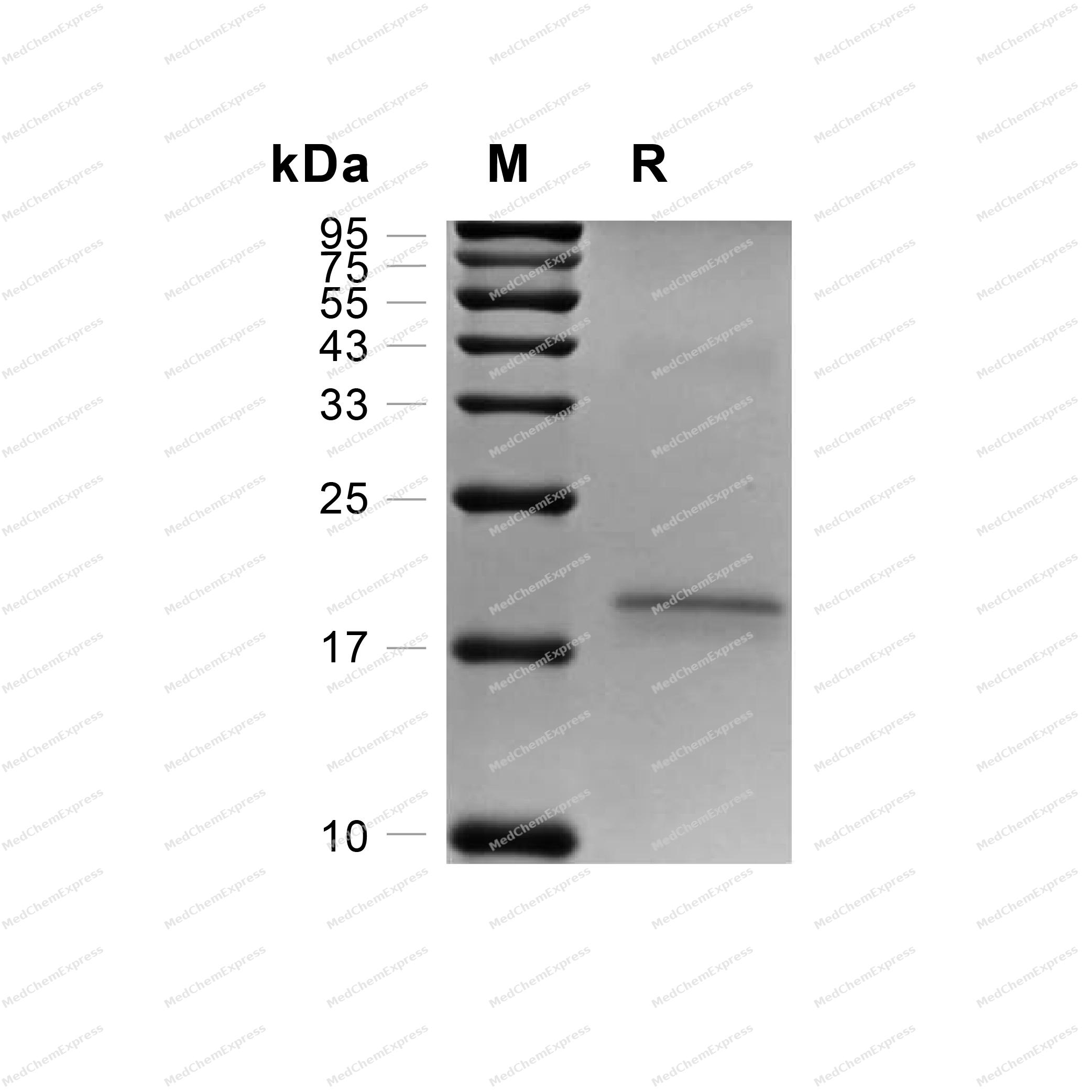
Purity - SDS-PAGE


Technical Parameters
-
Species Human
-
Source E. coli
-
Tag N-His
-
Accession
Q6PUV4 (D2-K134)
-
Molecular Construction
-
N-term
-
His
-
CPLX2 (D2-K134)
Accession # Q6PUV4 -
C-term
-
-
Protein Length
Full Length
-
Synonyms
CPLX2; CPX II; Complexin 2; Synaphin 1; Complexin-2; Synaphin-1; CPX-2; 921-L; DKFZp547D155; CPX2; Complexin II; Hfb1
-
AA Sequence
DFVMKQALGGATKDMGKMLGGEEEKDPDAQKKEEERQEALRQQEEERKAKHARMEAEREKVRQQIRDKYGLKKKEEKEAEEKAALEQPCEGSLTRPKKAIPAGCGDEEEEEEESILDTVLKYLPGPLQDMFKK
-
Molecular Weight
Approximately 21 kDa, based on SDS-PAGE under reducing conditions.
-
Purity
≥ 90%, as determined by reducing SDS-PAGE.


Product Properties
Lyophilized powder.
Lyophilized from a 0.22 μm filtered solution of PBS, pH 7.4.
<1 EU/μg, determined by LAL method.
It is not recommended to reconstitute to a concentration less than 100 μg/mL in ddH2O. For long term storage it is recommended to add a carrier protein (0.1% BSA, 5% HSA, 10% FBS or 5% Trehalose).
Stored at -20°C for 2 years from date of receipt. After reconstitution, it is stable at 4°C for 1 week or -20°C for longer (with carrier protein). It is recommended to freeze aliquots at -20°C or -80°C for extended storage.
Room temperature in continental US; may vary elsewhere.


Documentation
-
Data Sheet (235 KB)
-
SDS (252 KB)
- English - EN (252 KB)
- Français - FR (252 KB)
- Deutsch - DE (252 KB)
- Norwegian - NO (252 KB)
- Español - ES (252 KB)
- Swedish - SV (252 KB)
- Italian - IT (252 KB)
- Korean - KR (252 KB)
- Portuguese - PT (252 KB)
-
Handling Instructions (2659 KB)

Calculators
Concentration (start) × Volume (start) = Concentration (final) × Volume (final)


 Powered by Bioz

