



CRELD2 Protein, Human (329a.a, HEK293, His)

Based on 1 Customer Validation
CRELD2 Protein, potentially acting as a protein disulfide isomerase, may play a role in the unfolded protein response. It is also implicated in regulating the transport of the alpha4-beta2 neuronal acetylcholine receptor, showcasing its versatility in cellular processes related to protein folding and neuronal receptor dynamics. These functions suggest CRELD2's involvement in maintaining cellular homeostasis. CRELD2 Protein, Human (329a.a, HEK293, His) is the recombinant human-derived CRELD2 protein, expressed by HEK293 , with C-6*His labeled tag.
- Species: Human
- Source: HEK293
-
Storage:Stored at -20°C for 2 years from date of receipt. After reconstitution, it is stable at 4°C for 1 week or -20°C for longer (with carrier protein). It is recommended to freeze aliquots at -20°C or -80°C for extended storage.


To place orders, for customer services and technical support, please contact: MedChemExpress USA
Tel: 609-228-6898 E-mail: [email protected] [email protected]


-
 Biological Activity
-
Technical Parameters
-
Product Properties
- Documentation
- References
- Help & FAQs




Biological Activity
Description
CRELD2 Protein, potentially acting as a protein disulfide isomerase, may play a role in the unfolded protein response. It is also implicated in regulating the transport of the alpha4-beta2 neuronal acetylcholine receptor, showcasing its versatility in cellular processes related to protein folding and neuronal receptor dynamics. These functions suggest CRELD2's involvement in maintaining cellular homeostasis. CRELD2 Protein, Human (329a.a, HEK293, His) is the recombinant human-derived CRELD2 protein, expressed by HEK293 , with C-6*His labeled tag.
Background
CRELD2 protein, likely functioning as a protein disulfide isomerase, may contribute to the intricate processes associated with the unfolded protein response. Additionally, there is a potential role for CRELD2 in the regulation of the transport of the alpha4-beta2 neuronal acetylcholine receptor. These functions highlight the versatility of CRELD2 in cellular processes related to protein folding and neuronal receptor dynamics, suggesting its involvement in maintaining cellular homeostasis.
Verified Bioactivity
Measured by its ability to induce adhesion of ATDC5 mouse chondrogenic cells. The ED50 for this effect is typically 0.7722 μg/mL.
MCE Validation Data
-
Bioactivity - Cell-Based Assay
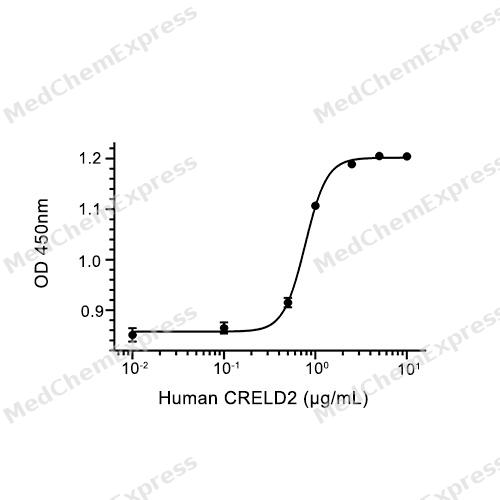
Bioactivity - Cell-Based Assay


Technical Parameters
-
Species Human
-
Source HEK293
-
Tag C-6*His
-
Accession
Q6UXH1-1 (A25-L353)
-
Molecular Construction
-
N-term
-
CRELD2 (A25-L353)
Accession # Q6UXH1-1 -
6*His
-
C-term
-
-
Protein Length
Full Length of Isoform-1
-
Synonyms
CRELD2; Cysteine-Rich With EGF-Like Domain Protein 2; CRELD Disulfide Isomerase 2; Protein Disulfide Isomerase CRELD2; Cysteine Rich With EGF Like Domains 2; MGC11256
-
AA Sequence
AKKPTPCHRCRGLVDKFNQGMVDTAKKNFGGGNTAWEEKTLSKYESSEIRLLEILEGLCESSDFECNQMLEAQEEHLEAWWLQLKSEYPDLFEWFCVKTLKVCCSPGTYGPDCLACQGGSQRPCSGNGHCSGDGSRQGDGSCRCHMGYQGPLCTDCMDGYFSSLRNETHSICTACDESCKTCSGLTNRDCGECEVGWVLDEGACVDVDECAAEPPPCSAAQFCKNANGSYTCEECDSSCVGCTGEGPGNCKECISGYAREHGQCADVDECSLAEKTCVRKNENCYNTPGSYVCVCPDGFEETEDACVPPAEAEATEGESPTQLPSREDL
-
Predicted Molecular Mass
36.4 kDa
-
Molecular Weight
Approximately 42 kDa, based on SDS-PAGE under reducing conditions.
-
Glycosylation
Yes
-
Purity
≥ 95%, as determined by reducing SDS-PAGE.


Product Properties
Lyophilized powder.
Lyophilized from a 0.22 μm filtered solution of 20 mM PB, 150 mM NaCl, pH 7.4.
<1 EU/μg, determined by LAL method.
It is not recommended to reconstitute to a concentration less than 100 μg/mL in ddH2O. For long term storage it is recommended to add a carrier protein (0.1% BSA, 5% HSA, 10% FBS or 5% Trehalose).
Stored at -20°C for 2 years from date of receipt. After reconstitution, it is stable at 4°C for 1 week or -20°C for longer (with carrier protein). It is recommended to freeze aliquots at -20°C or -80°C for extended storage.
Room temperature in continental US; may vary elsewhere.


Documentation
-
Data Sheet (264 KB)
-
SDS (252 KB)
- English - EN (252 KB)
- Français - FR (252 KB)
- Deutsch - DE (252 KB)
- Norwegian - NO (252 KB)
- Español - ES (252 KB)
- Swedish - SV (252 KB)
- Italian - IT (252 KB)
- Korean - KR (252 KB)
- Portuguese - PT (252 KB)
-
Handling Instructions (2659 KB)


References
[1]. Ortiz JA, et al. The cysteine-rich with EGF-like domains 2 (CRELD2) protein interacts with the large cytoplasmic domain of human neuronal nicotinic acetylcholine receptor alpha4 and beta2 subunits. J Neurochem. 2005 Dec;95(6):1585-96. [Content Brief]
[2]. Tang Q, et al. CRELD2, endoplasmic reticulum stress, and human diseases. Front Endocrinol (Lausanne). 2023 Mar 2;14:1117414. [Content Brief]
[3]. Maslen CL, et al. CRELD2: gene mapping, alternate splicing, and comparative genomic identification of the promoter region. Gene. 2006 Nov 1;382:111-20 [Content Brief]
[4]. Boyle ST, et al. ROCK-mediated selective activation of PERK signalling causes fibroblast reprogramming and tumour progression through a CRELD2-dependent mechanism. Nat Cell Biol. 2020 Jul;22(7):882-895. [Content Brief]
[5]. Dennis EP, et al. CRELD2 Is a Novel LRP1 Chaperone That Regulates Noncanonical WNT Signaling in Skeletal Development. J Bone Miner Res. 2020 Aug;35(8):1452-1469. [Content Brief]

Calculators
Concentration (start) × Volume (start) = Concentration (final) × Volume (final)


 Powered by Bioz

