



CTACK/CCL27 Protein, Mouse

Based on 1 Customer Validation
CTACK/CCL27 protein plays a crucial role in chemokine activity and cell chemotaxis. It regulates T cell chemotaxis and actin cytoskeletal reorganization, suggesting its involvement in immune responses and cell motility. CTACK/CCL27 Protein, Mouse is the recombinant mouse-derived CTACK/CCL27 protein, expressed by E. coli , with tag free.
- Species: Mouse
- Source: E. coli
-
Storage:Stored at -20°C for 2 years from date of receipt. After reconstitution, it is stable at 4°C for 1 week or -20°C for longer (with carrier protein). It is recommended to freeze aliquots at -20°C or -80°C for extended storage.


To place orders, for customer services and technical support, please contact: MedChemExpress USA
Tel: 609-228-6898 E-mail: [email protected] [email protected]


-
 Biological Activity
-
Technical Parameters
-
Product Properties
- Documentation
- Help & FAQs




Biological Activity
Description
CTACK/CCL27 protein plays a crucial role in chemokine activity and cell chemotaxis. It regulates T cell chemotaxis and actin cytoskeletal reorganization, suggesting its involvement in immune responses and cell motility. CTACK/CCL27 Protein, Mouse is the recombinant mouse-derived CTACK/CCL27 protein, expressed by E. coli , with tag free.
Background
CTACK/CCL27 protein serves a vital role by enabling chemokine activity and participating in cell chemotaxis. It acts upstream of positive regulation of T cell chemotaxis and positive regulation of actin cytoskeleton reorganization, suggesting its involvement in immune responses and cellular motility. This protein is located in the extracellular region and nucleus, highlighting its versatility in cellular processes. With a broad expression pattern across various tissues, including the genitourinary system, hip, liver, sensory organ, and skeleton, CTACK/CCL27 exhibits a widespread impact on different physiological contexts. The orthologous relationship with human CCL27 emphasizes the evolutionary conservation and functional relevance of this chemokine protein across species.
Verified Bioactivity
Measured by its ability to chemoattract HUT78 cells. The ED50 for this effect is 0.0145 μg/mL, corresponding to a specific activity is 6.897×10⁴ U/mg.
MCE Validation Data
-
Purity - SDS-PAGE
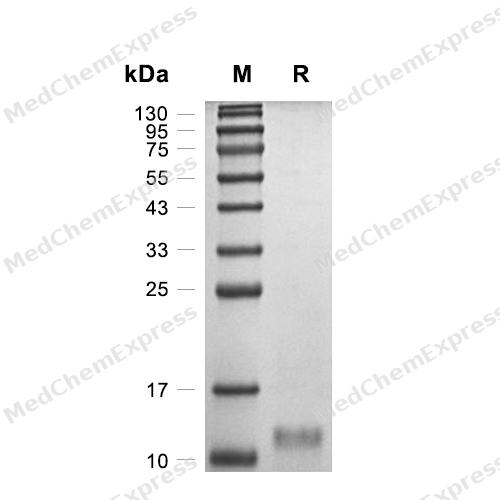
Purity - SDS-PAGE
-
Bioactivity - Cell-Based Assay
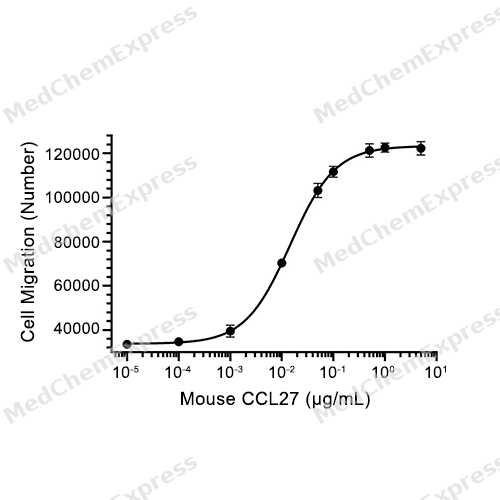
Bioactivity - Cell-Based Assay


Technical Parameters
-
Species Mouse
-
Source E. coli
-
Tag Tag Free
-
Accession
NP_035466 (L26-N120)
-
Molecular Construction
-
N-term
-
CCL27 (L26-N120)
Accession # NP_035466 -
C-term
-
-
Protein Length
Full Length of Mature Protein
-
Synonyms
CCL27; CC Chemokine ILC; Prev. SCYA27; Cutaneous T-Cell Attracting Chemokine; CTACK; IL-11 R-Alpha-Locus Chemokine; ILC; IL-11 Ralpha-Locus Chemokine; Skinkine; Small-Inducible Cytokine A27; ESkine; C-C Motif Chemokine 27; PESKY; Cutaneous T-Cell-Attracti
-
AA Sequence
LPLPSSTSCCTQLYRQPLPSRLLRRIVHMELQEADGDCHLQAVVLHLARRSVCVHPQNRSLARWLERQGKRLQGTVPSLNLVLQKKMYSNPQQQN
-
Predicted Molecular Mass
10.9 kDa
-
Molecular Weight
Approximately 11 kDa, based on SDS-PAGE under reducing conditions.
-
Purity
≥ 95%, as determined by reducing SDS-PAGE.


Product Properties
Lyophilized powder.
Lyophilized from a 0.22 μm filtered solution of 4 mM HCl, 5% trehalose, 5% mannitol and 0.01% Tween 80.
<1 EU/μg, determined by LAL method.
It is not recommended to reconstitute to a concentration less than 100 μg/mL in ddH2O.
Stored at -20°C for 2 years from date of receipt. After reconstitution, it is stable at 4°C for 1 week or -20°C for longer (with carrier protein). It is recommended to freeze aliquots at -20°C or -80°C for extended storage.
Room temperature in continental US; may vary elsewhere.


Documentation
-
Data Sheet (235 KB)
-
SDS (251 KB)
- English - EN (251 KB)
- Français - FR (251 KB)
- Deutsch - DE (251 KB)
- Norwegian - NO (251 KB)
- Español - ES (251 KB)
- Swedish - SV (251 KB)
- Italian - IT (251 KB)
- Korean - KR (251 KB)
- Portuguese - PT (251 KB)
-
Handling Instructions (2659 KB)

Calculators
Concentration (start) × Volume (start) = Concentration (final) × Volume (final)


 Powered by Bioz

