



CXCL16 Protein, Human (HEK293, His)
Based on 1 publication(s) in Google Scholar
CXCL16, also known as SR-PSOX (scavenger receptor that binds phosphatidylserine and oxidized lipoprotein), is one member of the ELR-negative CXC chemokine subfamily. CXCL16 is a multifunctional protein involved in various inflammatory diseases, atherosclerosis, and cancer. CXCL16 can be observed in many cell types. CXCL16 Protein, Human (HEK293, His) is produced in HEK293 cells with a C-Terminal His-tag. It consists of 176 amino acids (N49-T224).
- Species: Human
- Source: HEK293
-
Storage:Stored at -20°C for 2 years from date of receipt. After reconstitution, it is stable at 4°C for 1 week or -20°C for longer (with carrier protein). It is recommended to freeze aliquots at -20°C or -80°C for extended storage.


To place orders, for customer services and technical support, please contact: MedChemExpress USA
Tel: 609-228-6898 E-mail: [email protected] [email protected]


-
 Biological Activity
-
Technical Parameters
-
Product Properties
- Documentation
- References
- Help & FAQs




Biological Activity
Description
CXCL16, also known as SR-PSOX (scavenger receptor that binds phosphatidylserine and oxidized lipoprotein), is one member of the ELR-negative CXC chemokine subfamily. CXCL16 is a multifunctional protein involved in various inflammatory diseases, atherosclerosis, and cancer. CXCL16 can be observed in many cell types[1][2]. CXCL16 Protein, Human (HEK293, His) is produced in HEK293 cells with a C-Terminal His-tag. It consists of 176 amino acids (N49-T224).
Background
CXCL16 is a membrane-bound chemokine. CXCL16 is expressed in soluble or transmembrane forms and can be observed in many cell types, including inflammatory cells (such as macrophages, neutrophils, dendritic cells and monocytes) and non-inflammatory cells (such as lung epithelial cells and renal cells). CXCL16 plays important roles both in the natural immune barrier and in the occurrence and development of autoimmune diseases[1][2].
The amino acid sequence of human CXCL16 protein has low homology between mouse, rat and dog CXCL16 protein.
CXCL16 is primarily expressed on the surface of antigen-presenting cells (APCs) and consists of a chemokine domain (~89 amino acids), a mucin-type stalk (~110 amino acids), a single-pass transmembrane domain (~20 amino acids), and a cytoplasmic tail (~27 amino acids). CXCL16 is the only ligand of the CXCR6 receptor. Soluble CXCL16 induces the migration of CXCR6+ cells (including Th1 cells, NK cells and activated CD8 + T-cells), M2-macrophage infiltration, interactions between APC and CD8 + T-cells, the cellular immune response and inflammatory response, and the development of thymocytes. Membrane-bound CXCL16 can promote the adhesion of CXCR6+ cells. CXCL16 specifically binds oxidized low-density lipoprotein (OxLDL), leading to its internalization and degradation. CXCL16 may play important roles in the formation of atherosclerotic lesions. CXCL16 on macrophages and dendritic cells mediates the adhesion and phagocytosis of bacteria, such as Escherichia coli and Staphylococcus aureus, and bacterial recognition is mediated by the chemokine domain of CXCL16[1][2].
CXCL16 is not only a chemokine, but is also a multifunctional protein. CXCL16 and CXCR6 are related to various inflammatory diseases, such as glomerulonephritis, pulmonary diseases, atherosclerosis, coronary artery disease, rheumatoid arthritis and many inflammation-related cancers. The chemokine domain of CXCL16 exerts potent anti-microbial activities against E. coli and S. aureus. CXCL16 acts as a mediator of innate immunity by attracting CXCR6-expressing cells, such as activated T cells and NKT cells. CXCL16 is also a novel mediator of the innate immune reactivities of keratinocytes in the human epidermis[1][2][3].
In Vitro
Recombinant human CXCL16 (1 ng/mL) induces cell migration in primary human monocytes or M2 macrophages[3].
Verified Bioactivity
1.Measured by its ability to chemoattract BaF3 mouse pro-B cells transfected with mouse CXCR6 and the ED50 is ≤250 ng/mL.
2.Measured by its ability to chemoattract activated Jurkat cells. The ED50 for this effect is 0.856 ng/mL, corresponding to a specific activity is 1.168×10⁶ U/mg.
MCE Validation Data
-
Purity - SDS-PAGE
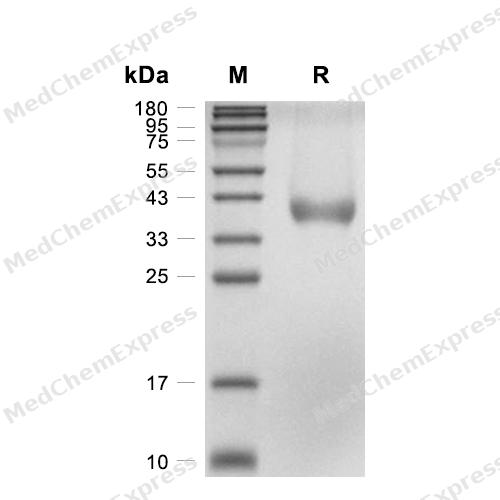
Purity - SDS-PAGE
-
Bioactivity - Cell-Based Assay
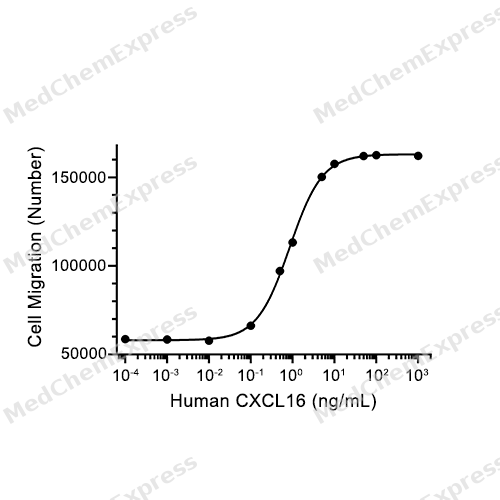
Bioactivity - Cell-Based Assay


Publications (1)
-
Journal Impact Factor
-
Most Recent
-
Int Immunopharmacol
MiR-625-5p is a potential therapeutic target in sepsis by regulating CXCL16/CXCR6 axis and endothelial barrier. [Abstract]2024 Aug 20:137:112508. PMID: 38889512


Technical Parameters
-
Species Human
-
Source HEK293
-
Tag C-His
-
Accession
Q9H2A7 (N30-T205)/NP_071342.2 (N49-T224)
-
Molecular Construction
-
N-term
-
CXCL16 (N30-T205)
Accession # Q9H2A7 -
His
-
C-term
-
-
Protein Length
Extracellular Domain
-
Synonyms
CXCL16; CXCLG16; C-X-C Motif Chemokine Ligand 16; Scavenger Receptor For Phosphatidylserine And Oxidized Low Density Lipoprotein; SR-PSOX; Chemokine (C-X-C Motif) Ligand 16; SRPSOX; Small-Inducible Cytokine B16; Transmembrane Chemokine CXCL16; CXC Chemoki
-
AA Sequence
NEGSVTGSCYCGKRISSDSPPSVQFMNRLRKHLRAYHRCLYYTRFQLLSWSVCGGNKDPWVQELMSCLDLKECGHAYSGIVAHQKHLLPTSPPISQASEGASSDIHTPAQMLLSTLQSTQRPTLPVGSLSSDKELTRPNETTIHTAGHSLAAGPEAGENQKQPEKNAGPTARTSAT
-
Predicted Molecular Mass
20.5 kDa
-
Molecular Weight
Approximately 35-45 kDa, based on SDS-PAGE under reducing conditions, due to the glycosylation.
-
Glycosylation
Yes
-
Purity
≥ 95%, as determined by reducing SDS-PAGE.


Product Properties
Lyophilized powder
Lyophilized from a 0.2 μm filtered solution of PBS, pH 7.4.
<1 EU/μg, determined by LAL method.
It is not recommended to reconstitute to a concentration less than 100 μg/mL in ddH2O. For long term storage it is recommended to add a carrier protein (0.1% BSA, 5% HSA, 10% FBS or 5% Trehalose).
Stored at -20°C for 2 years from date of receipt. After reconstitution, it is stable at 4°C for 1 week or -20°C for longer (with carrier protein). It is recommended to freeze aliquots at -20°C or -80°C for extended storage.
Room temperature in continental US; may vary elsewhere.


Documentation
-
Data Sheet (264 KB)
-
SDS (251 KB)
- English - EN (251 KB)
- Français - FR (251 KB)
- Deutsch - DE (251 KB)
- Norwegian - NO (251 KB)
- Español - ES (251 KB)
- Swedish - SV (251 KB)
- Italian - IT (251 KB)
- Korean - KR (251 KB)
- Portuguese - PT (251 KB)
-
Handling Instructions (2659 KB)


References
[1]. Tohyama M, et al. CXCL16 is a novel mediator of the innate immunity of epidermal keratinocytes. Int Immunol. 2007 Sep;19(9):1095-102. [Content Brief]
[2]. Jianhui Sun, et al. A Functional Variant of CXCL16 Is Associated With Predisposition to Sepsis and MODS in Trauma Patients: Genetic Association Studies. Front Genet. 2021 Sep 3;12:720313. [Content Brief]
[3]. Allaoui R, et al. Cancer-associated fibroblast-secreted CXCL16 attracts monocytes to promote stroma activation in triple-negative breast cancers. Nat Commun. 2016 Oct 11;7:13050. [Content Brief]

Calculators
Concentration (start) × Volume (start) = Concentration (final) × Volume (final)


 Powered by Bioz

