



FGFR-2 Protein, Mouse (HEK293, His)

Based on 1 Customer Validation
FGFR-2 Protein, Mouse (HEK293, His) is the recombinant mouse-derived FGFR-2, expressed by HEK293 , with C-6*His labeled tag.
- Species: Mouse
- Source: HEK293
-
Storage:Stored at -20°C for 2 years from date of receipt. After reconstitution, it is stable at 4°C for 1 week or -20°C for longer (with carrier protein). It is recommended to freeze aliquots at -20°C or -80°C for extended storage.


To place orders, for customer services and technical support, please contact: MedChemExpress USA
Tel: 609-228-6898 E-mail: [email protected] [email protected]


-
 Biological Activity
-
Technical Parameters
-
Product Properties
- Documentation
- Help & FAQs




Biological Activity
Description
FGFR-2 Protein, Mouse (HEK293, His) is the recombinant mouse-derived FGFR-2, expressed by HEK293 , with C-6*His labeled tag.
Background
FGFR2, also known as CD332 (differentiated cluster 332), is a receptor for fibroblast growth factor. FGFR2 plays an important role in embryonic development and tissue repair, especially bone and blood vessels. It promotes the proliferation of keratinocytes and immature osteoblasts and promotes the apoptosis of differentiated osteoblasts. After ligand binding, FGFR-2 α IIIc activates several signaling cascades, including phosphorylation of PLCG1, FRS2, and PAK4. Activation of PLCG1 triggers the production of cell signaling molecules such as diacylglycerol and inositol 1,4, 5-triphosphate. FRS2 phosphorylation leads to recruitment of GRB2, GAB1, PIK3R1, and SOS1, mediating activation of RAS, MAPK1/ERK2, MAPK3/ERK1, MAP kinase signaling pathways, and AKT1 signaling pathways. FGFR2 up-regulates PAI-1 via JAK2/STAT3 signaling and induces M2 polarization in colorectal cancer macrophages[1][2][3].
Verified Bioactivity
1.This product does not contain protein kinase domain.
2.Measured by its ability to inhibit FGF-acidic dependent proliferation of Balb/c 3T3 mouse fibroblasts. The ED50 for this effect is 1.667 ng/mL, corresponding to a specific activity is 6.0×10⁵ units/mg.
MCE Validation Data
-
Purity - SDS-PAGE
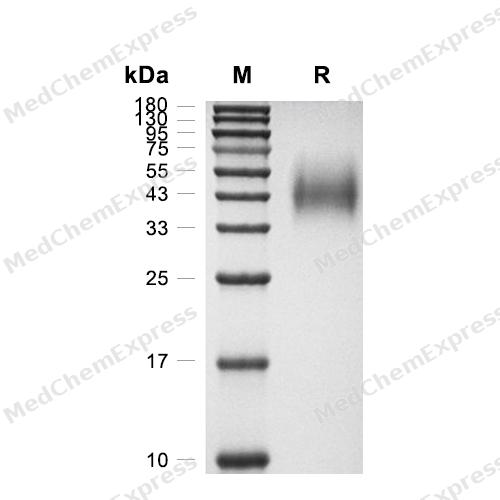
Purity - SDS-PAGE
-
Bioactivity - Cell-Based Assay
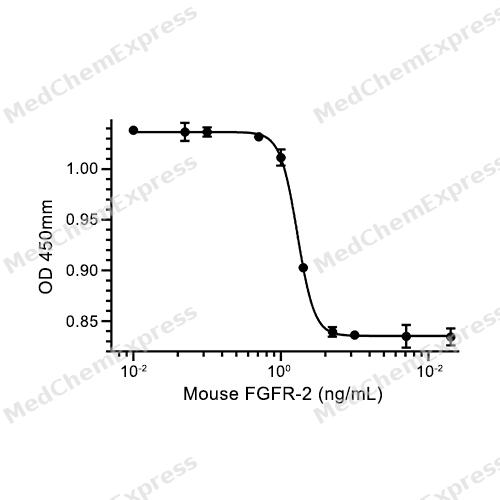
Bioactivity - Cell-Based Assay


Technical Parameters
-
Species Mouse
-
Source HEK293
-
Tag C-6*His
-
Accession
E9Q5C3/AAA39377.1 (R22-E263)
-
Molecular Construction
-
N-term
-
FGFR-2 (R22-E263)
Accession # E9Q5C3/AAA39377.1 -
His
-
C-term
-
-
Protein Length
Partial
-
Synonyms
FGFR2; Protein Tyrosine Kinase, Receptor Like 14; Prev. KGFR; Fibroblast Growth Factor Receptor; Prev. BEK; Receptor Protein-Tyrosine Kinase; Prev. CFD1; Craniofacial Dysostosis 1; Prev. JWS; Alternative Protein FGFR2; Keratinocyte Growth Factor Receptor;
-
AA Sequence
RPSFSLVEDTTLEPEGAPYWTNTEKMEKRLHAVPAANTVKFRCPAGGNPTPTMRWLKNGKEFKQEHRIGGYKVRNQHWSLIMESVVPSDKGNYTCLVENEYGSINHTYHLDVVERSPHRPILQAGLPANASTVVGGDVEFVCKVYSDAQPHIQWIKHVEKNGSKYGPDGLPYLKVLKHSGINSSNAEVLALFNVTEMDAGEYICKVSNYIGQANQSAWLTVLPKQQAPVREKEITASPDYLE
-
Molecular Weight
Approximately 52 kDa, based on SDS-PAGE under reducing conditions.
-
Glycosylation
Yes
-
Purity
≥ 95%, as determined by reducing SDS-PAGE.


Product Properties
Lyophilized powder.
Lyophilized from a 0.22 μm filtered solution of PBS, pH 7.4.
<1 EU/μg, determined by LAL method.
It is not recommended to reconstitute to a concentration less than 100 μg/mL in ddH2O. For long term storage it is recommended to add a carrier protein (0.1% BSA, 5% HSA, 10% FBS or 5% Trehalose).
Stored at -20°C for 2 years from date of receipt. After reconstitution, it is stable at 4°C for 1 week or -20°C for longer (with carrier protein). It is recommended to freeze aliquots at -20°C or -80°C for extended storage.
Room temperature in continental US; may vary elsewhere.


Documentation
-
Data Sheet (237 KB)
-
SDS (251 KB)
- English - EN (251 KB)
- Français - FR (251 KB)
- Deutsch - DE (251 KB)
- Norwegian - NO (251 KB)
- Español - ES (251 KB)
- Swedish - SV (251 KB)
- Italian - IT (251 KB)
- Korean - KR (251 KB)
- Portuguese - PT (251 KB)
-
Handling Instructions (2659 KB)

Calculators
Concentration (start) × Volume (start) = Concentration (final) × Volume (final)


 Powered by Bioz

