



Follistatin/FST Protein, Mouse (HEK293, His)
Based on 1 publication(s) in Google Scholar
Follistatin (FST) is a regulator of TGFβ family signaling and acts by selectively binding to TGFβ family ligands and preventing ligand binding to the receptor complex. Follistatin has the ability to suppress the follicle stimulating hormone (FSH). Follistatin/FST Protein, Mouse (HEK293, His) is produced in HEK293 cells with a C-Terminal 10*His-tag.
- Species: Mouse
- Source: HEK293
-
Storage:Stored at -20°C for 2 years from date of receipt. After reconstitution, it is stable at 4°C for 1 week or -20°C for longer (with carrier protein). It is recommended to freeze aliquots at -20°C or -80°C for extended storage.


To place orders, for customer services and technical support, please contact: MedChemExpress USA
Tel: 609-228-6898 E-mail: [email protected] [email protected]


-
 Biological Activity
-
Technical Parameters
-
Product Properties
- Documentation
- References
- Help & FAQs




Biological Activity
Description
Follistatin (FST) is a regulator of TGFβ family signaling and acts by selectively binding to TGFβ family ligands and preventing ligand binding to the receptor complex. Follistatin has the ability to suppress the follicle stimulating hormone (FSH)[1][2]. Follistatin/FST Protein, Mouse (HEK293, His) is produced in HEK293 cells with a C-Terminal 10*His-tag.
Background
Follistatin is first described as a follicle-stimulating hormone inhibiting substance present in ovarian follicular fluid. Follistatin binds activin A and myostatin with low nanomolar (nM) affinity, completely surrounds the ligand occluding all of the receptor binding sites and binds to the ligand[1][2].
Mature human Follistatin shares 97% amino acid sequence identity with mouse and rat Follistatin.
Follistatin is a 32-35-kDa glycoprotein composed of four domains including an N-terminal domain (ND) followed by three Follistatin domains (FSD1, FSD2, and FSD3). C-terminal splicing of Follistatin can occur to generate various isoforms including FS288 and FS315. Follistatin neutralizes the TGFβ ligands, myostatin and activin A, by forming a nearly irreversible non-signaling complex by surrounding the ligand and preventing interaction with TGFβ receptors. In humans, the gene encoding Follistatin is located on chromosome 5q11.2. The Follistatin protein contains a TGF-β binding site where activins, bone morphonegic proteins (BMPs) and growth differentiation factors (GDFs) are bound with high affinity and thereby neutralised. The ligand binding site for Follistatin overlaps with the type I and type II receptor binding sites for these ligands. Follistatin also contains a heparin binding site where proteoglycans in the extracellular matrix can bind, and therefore Follistatin is believed to bind the extracellular matrix. There are two major isoforms of Follistatin, FST288, which is anchored to the cell surface by interactions with heparin sulfate proteoglycans, and FST315, which is the predominant form found in circulation. The two isoforms arise from alternative splicing; the 315 isoform includes a 27 amino acid acidic C-terminal tail, which Follistatin 288 does not have. The acidic tail on Follistatin 315 neutralises the heparin binding site, thereby inhibiting the binding of Follistatin 315 to the extracellular matrix[1][2][3].
Follistatin as a liver-derived protein under the regulation of glucagon-to-insulin ratio suggests a relation to energy metabolism. In humans, aberrant expression of FST and activins are implicated in infertility. Follistatin is a potent tissue regulator in the gonad, pituitary gland, pregnancy membranes, vasculature, and liver[1][3].
In Vitro
Recombinant mouse Follistatin (.2 μg/mL; 1-48 hours) significantly inhibits P21 mRNA expression, and increases Pcna and Cyclin D2 mRNA expression in CD49f positive cells (CD49f+ cells) isolated from male murine salivary glands[4].
In Vivo
Recombinant mouse Follistatin (.5-1 μg; four does) is administered intranasally (5 μL) 1 h before each challenge in ovalbumin-sensitized BALB/c mice. Follistatin inhibits the allergen-specific Th2 immune response in mediastinal lymph nodes and mucus production in the lung[5].
Verified Bioactivity
1. Measured by its ability to neutralize Activin-mediated inhibition on MPC11 cell proliferation and the ED50 is 0.01-0.08 μg/mL in the presence of 10 ng/mL Human Activin A.
2. Measured in a cell proliferation assay using MPC-11 cells. The ED50 this effect is <0.5 μg/mL, corresponding to a specific activity is > 2×10³ units/mg.
MCE Validation Data
-
Purity - SDS-PAGE
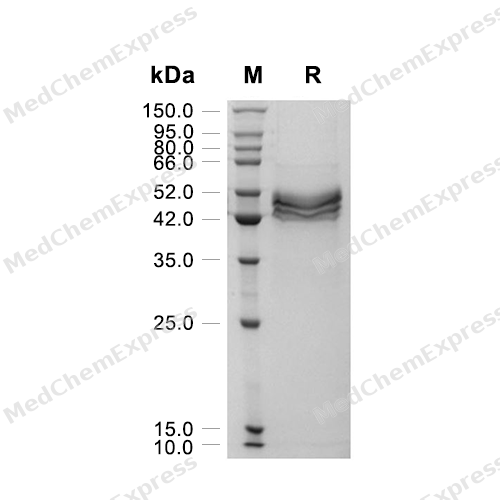
Purity - SDS-PAGE
-
Bioactivity - Cell-Based Assay
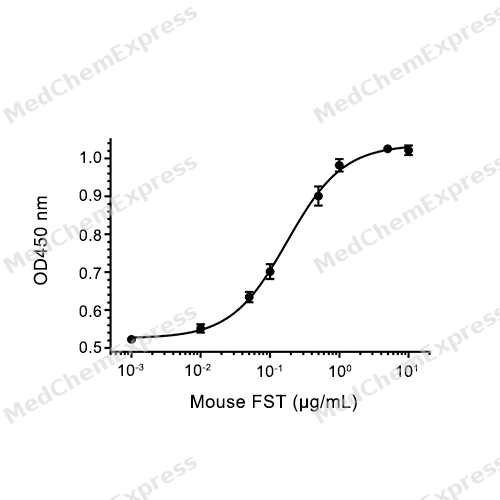
Bioactivity - Cell-Based Assay


Publications (1)
-
Journal Impact Factor
-
Most Recent
-
FASEB J
Hypoxia Exposure Promotes Th17 Cell Differentiation Through Activin A-PKM2 Axis to Exacerbate Autoimmune and Autoinflammatory Diseases. [Abstract]2025 Jun 30;39(12):e70696. PMID: 40515525


Technical Parameters
-
Species Mouse
-
Source HEK293
-
Tag C-10*His
-
Accession
P47931-1 (G30-W344)
-
Molecular Construction
-
N-term
-
FST (G30-W344)
Accession # P47931-1 -
10*His
-
C-term
-
-
Protein Length
Full Length of Isoform-1
-
Synonyms
FST; FS; Follistatin; Activin-Binding Protein
-
AA Sequence
GNCWLRQAKNGRCQVLYKTELSKEECCSTGRLSTSWTEEDVNDNTLFKWMIFNGGAPNCIPCKETCENVDCGPGKKCRMNKKNKPRCVCAPDCSNITWKGPVCGLDGKTYRNECALLKARCKEQPELEVQYQGKCKKTCRDVFCPGSSTCVVDQTNNAYCVTCNRICPEPSSSEQYLCGNDGVTYSSACHLRKATCLLGRSIGLAYEGKCIKAKSCEDIQCGGGKKCLWDSKVGRGRCSLCDELCPDSKSDEPVCASDNATYASECAMKEAACSSGVLLEVKHSGSCNSISEETEEEEEEEDQDYSFPISSILEW
-
Predicted Molecular Mass
36 kDa
-
Molecular Weight
Approximately 43-54 kDa, based on SDS-PAGE under reducing conditions, due to the glycosylation.
-
Glycosylation
Yes
-
Purity
≥ 95%, as determined by reducing SDS-PAGE.


Product Properties
Lyophilized powder
1.Lyophilized from a 0.22 μm filtered solution of PBS, pH 7.4, 5% trehalose, 5% mannitol, 0.01% tween 80.
2.Lyophilized from a 0.22 μm filtered solution of 20 mM PB, 150 mM NaCl, pH 7.4.
3.Lyophilized from a 0.22 μm filtered solution of PBS, pH 7.4.
4.Lyophilized from a 0.22 μm filtered solution of PBS, pH 7.4, 8% trehalose.
Please refer to the lot-specific COA for specific buffer information.
<1 EU/μg, determined by LAL method.
It is not recommended to reconstitute to a concentration less than 100 μg/mL in ddH2O. For long term storage it is recommended to add a carrier protein (0.1% BSA, 5% HSA, 10% FBS or 5% Trehalose).
Stored at -20°C for 2 years from date of receipt. After reconstitution, it is stable at 4°C for 1 week or -20°C for longer (with carrier protein). It is recommended to freeze aliquots at -20°C or -80°C for extended storage.
Room temperature in continental US; may vary elsewhere.


Documentation
-
Data Sheet (266 KB)
-
SDS (252 KB)
- English - EN (252 KB)
- Français - FR (252 KB)
- Deutsch - DE (252 KB)
- Norwegian - NO (252 KB)
- Español - ES (252 KB)
- Swedish - SV (252 KB)
- Italian - IT (252 KB)
- Korean - KR (252 KB)
- Portuguese - PT (252 KB)
-
Handling Instructions (2659 KB)


References
[1]. Jakob Schiøler Hansen, et al. Circulating follistatin in relation to energy metabolism. Mol Cell Endocrinol. 2016 Sep 15;433:87-93. [Content Brief]
[2]. Ryan G Walker, et al. Heparin-mediated dimerization of follistatin. Exp Biol Med (Maywood). 2021 Feb;246(4):467-482. [Content Brief]
[3]. D J Phillips, et al. Follistatin: a multifunctional regulatory protein. Front Neuroendocrinol. 1998 Oct;19(4):287-322. [Content Brief]
[4]. A Ikeda, et al. Follistatin expressed in mechanically-damaged salivary glands of male mice induces proliferation of CD49f+ cells. Sci Rep. 2020 Nov 17;10(1):19959. [Content Brief]
[5]. C L Hardy, et al. Follistatin is a candidate endogenous negative regulator of activin A in experimental allergic asthma. Clin Exp Allergy. 2006 Jul;36(7):941-50. [Content Brief]

Calculators
Concentration (start) × Volume (start) = Concentration (final) × Volume (final)


 Powered by Bioz

