



GITR Protein, Cynomolgus (HEK293, Fc)

Based on 1 Customer Validation
GITR Protein, Cynomolgus (HEK293, Fc) is the recombinant Rhesus Macaque-derived GITR protein, expressed by HEK293, with C-hFc labeled tag.
- Species: Rhesus Macaque
- Source: HEK293
-
Storage:Stored at -20°C for 2 years from date of receipt. After reconstitution, it is stable at 4°C for 1 week or -20°C for longer (with carrier protein). It is recommended to freeze aliquots at -20°C or -80°C for extended storage.


To place orders, for customer services and technical support, please contact: MedChemExpress USA
Tel: 609-228-6898 E-mail: [email protected] [email protected]


-
 Biological Activity
-
Technical Parameters
-
Product Properties
- Documentation
- Help & FAQs




Biological Activity
Description
GITR Protein, Cynomolgus (HEK293, Fc) is the recombinant Rhesus Macaque-derived GITR protein, expressed by HEK293, with C-hFc labeled tag.
Background
GITR (Glucocorticoid-induced TNFR-related protein, also known as TNFRSF18) is a type I transmembrane protein. GITR stimulates T lymphocyte proliferation and partially reverses the immunosuppressive function of CD4+CD25+ treg. GITR is expressed on regulatory T cells (Tregs) and some activated immune cells, including effector T lymphocytes, natural killer (NK) cells, and neutrophils. The amino acid sequence of human GITR protein has low homology with that of mouse GITR protein. GITR does not have any enzymatic activity, and the signal is propagated by recruiting members of the TRAF1 family, specifically TRAF1, TRAF2, and TRAF5, into the GITR signaling complex. Signal transduction is then mediated through the NF-kB and MAPK pathways. Protects T cells from cell death induced by TCR activation. GITR is activated by its ligand GITRL (TNFSF18). The NOS induction effect of GITR on mouse macrophages was time-dependent and dose-dependent. GITR inhibits proliferation and induces apoptosis of Multiple Myeloma (MM) cells in vitro and in vivo[1][2][3][4].
Verified Bioactivity
Measured by its binding ability in a functional ELISA. Immobilized Rhesus macaque GITR at 5 μg/mL (100 μL/well) can bind Biotinylated GITR Ligand. The ED50 for this effect is 0.9219 μg/mL, corresponding to a specific activity is 1.08×10^3 Unit/mg.
MCE Validation Data
-
Purity - SDS-PAGE
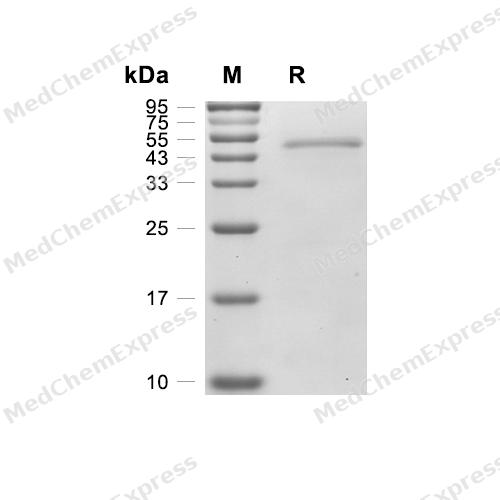
Purity - SDS-PAGE
-
Bioactivity - ELISA
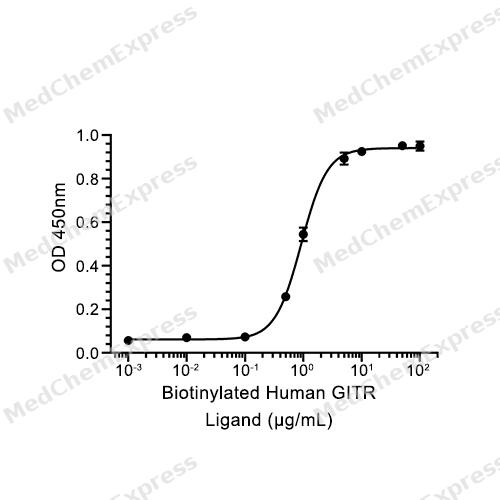
Bioactivity - ELISA


Technical Parameters
-
Species Rhesus Macaque
-
Source HEK293
-
Tag C-hFc
-
Accession
XP_005545180.2 (Q20-E155)
-
Gene ID102146362
-
Molecular Construction
-
N-term
-
GITR (Q20-E155)
Accession # XP_005545180.2 -
hFc
-
C-term
-
-
Protein Length
Partial
-
Synonyms
TNFRSF18; Glucocorticoid-Induced TNFR-Related Protein; TNF Receptor Superfamily Member 18; Activation-Inducible TNFR Family Receptor; AITR; Tumor Necrosis Factor Receptor Superfamily Member 18 Isoform 4; GITR; TNF Receptor Superfamily Activation-Inducible
-
AA Sequence
QRPTGGPGCGPGRLLLGTGKDARCCRVHPTRCCRDYQSEECCSEWDCVCVQPEFHCGNPCCTTCQHHPCPSGQGVQPQGKFSFGFRCVDCALGTFSRGHDGHCKPWTDCTQFGFLTVFPGNKTHNAVCVPGSPPAE
-
Predicted Molecular Mass
40.7 kDa
-
Molecular Weight
Approximately 49 kDa, based on SDS-PAGE under reducing conditions, due to the glycosylation.
-
Glycosylation
Yes
-
Purity
≥ 95%, as determined by reducing SDS-PAGE.


Product Properties
Lyophilized powder.
Lyophilized from a 0.22 μm filtered solution of 20 mM Tris-HCl, 150 mM NaCL, 100 mM arginine, 150 mM Glycine, pH 7.5.
Note: For SPR assay, please replace the buffer. Primary amine components (e.g., Tris, imidazole) can affect protein-coupled chips.
<1 EU/μg, determined by LAL method.
It is not recommended to reconstitute to a concentration less than 100 μg/mL in ddH2O. For long term storage it is recommended to add a carrier protein (0.1% BSA, 5% HSA, 10% FBS or 5% Trehalose).
Stored at -20°C for 2 years from date of receipt. After reconstitution, it is stable at 4°C for 1 week or -20°C for longer (with carrier protein). It is recommended to freeze aliquots at -20°C or -80°C for extended storage.
Room temperature in continental US; may vary elsewhere.


Documentation
-
Data Sheet (237 KB)
-
SDS (254 KB)
- English - EN (254 KB)
- Français - FR (254 KB)
- Deutsch - DE (254 KB)
- Norwegian - NO (254 KB)
- Español - ES (254 KB)
- Swedish - SV (254 KB)
- Italian - IT (254 KB)
- Korean - KR (254 KB)
- Portuguese - PT (254 KB)
-
Handling Instructions (2659 KB)

Calculators
Concentration (start) × Volume (start) = Concentration (final) × Volume (final)


 Powered by Bioz

