



gp130/IL6ST Protein, Mouse (HEK293, His)

Based on 1 Customer Validation
Glycoprotein 130 (gp130) is a trans-membrane protein, is the common signal-transducing receptor subunit of the interleukin-6 (IL-6) family. gp130 inhibits the cell growth and migration, decreases the STAT3 phosphorylation induced by IL-6, and decreases IL-6-induced increase of Ki67. gp130 shows anti-tumor, anti-inflammation and anti-nociceptive activity. gp130/IL6ST Protein, Mouse (617a.a, HEK293, His) is a recombinant protein with a His label and is produced by HEK293 cells.
- Species: Mouse
- Source: HEK293
-
Storage:Stored at -20°C for 2 years from date of receipt. After reconstitution, it is stable at 4°C for 1 week or -20°C for longer (with carrier protein). It is recommended to freeze aliquots at -20°C or -80°C for extended storage.


To place orders, for customer services and technical support, please contact: MedChemExpress USA
Tel: 609-228-6898 E-mail: [email protected] [email protected]


-
 Biological Activity
-
Technical Parameters
-
Product Properties
- Documentation
- References
- Help & FAQs




Biological Activity
Description
Glycoprotein 130 (gp130) is a trans-membrane protein, is the common signal-transducing receptor subunit of the interleukin-6 (IL-6) family[1]. gp130 inhibits the cell growth and migration[3], decreases the STAT3 phosphorylation induced by IL-6, and decreases IL-6-induced increase of Ki67. gp130 shows anti-tumor, anti-inflammation and anti-nociceptive activity[4][5]. gp130/IL6ST Protein, Mouse (617a.a, HEK293, His) is a recombinant protein with a His label and is produced by HEK293 cells.
Background
Glycoprotein 130 mRNA is ubiquitously expressed in the human body,exhibiting highest levels in saphenous vein, pericardium, ovary, omental adipose tissue, peritoneum, spleen lymphnodes, and trigeminal ganglia. And gp130 expression is significantly increased in adult organs compared to fetal organs. Moreover, gp130 is highly expressed in multiple types of cancers compared to normal tissues[3].
The amino acid sequence of human gp130 protein has low homology between mouse and rat gp130 protein.
gp130 signaling is initiated when autocrine or paracrine cyto-kines induce the dimerization of gp130 and an α-receptor subunit to form the receptor complex, leading to185the activation of downstream signaling cascades, such as the JAK/STAT, the PI3K/Akt, and the Ras/Raf/Mek/Erk1/2MAPK pathways. The activation of JAK/Stat3 pathway induces its target gene expression, resulting in cell growth and proliferation (cyclin D, CDC25 A, c-Myc, survivin), survival (survivin, Bcl-2, Bcl-XL), angiogenesis (VEGF), and cell migration (MMP-2, MMP-7, and MMP-9)[3].
gp130 is a IL-6 antagonist shows anti-tumor, anti-inflammation and antinociceptive activity[4]. gp130 decreases the STAT3 phosphorylation induced by IL-6, and decreases IL-6-induced increase of Ki67[5].
Verified Bioactivity
1.Measured by its ability to inhibit the IL-6Rα enhancement of IL-6 activity on M1 mouse myeloid leukemia cells and the ED50 is typically 0.6-3 μg/mL in the presence of 50 ng/mL human IL-6sR and 100 ng/mL human IL-6.
2.Measured by its ability to bind mouse IL-11Ra in a functional ELISA.
3.Immobilized Human gp130 at 5 μg/mL (100 μL/well) can bind Biotinylated Human IL-6 R alpha that produces 50% of the optimal binding response is found to be approximately ≤8 ng/mL.
4.Measured by its ability to inhibit IL-6-dependent proliferation of TF-1 cells. The ED50 this effect is 0.1185 ng/mL in the presence of 4 μg/mL Recombinant Human IL-6 R alpha , corresponding to a specific activity is 8.44×10^6 units/mg.
MCE Validation Data
-
Purity - SDS-PAGE
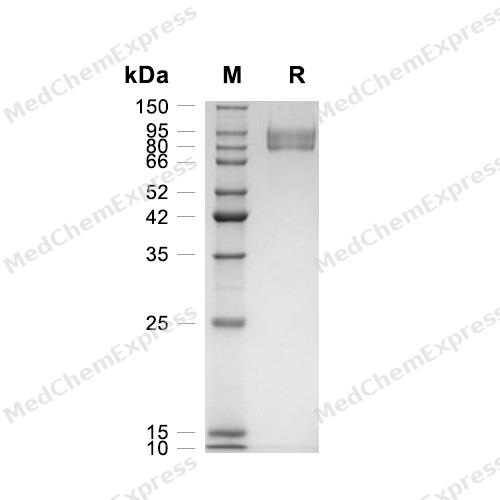
Purity - SDS-PAGE
-
Bioactivity - Cell-Based Assay
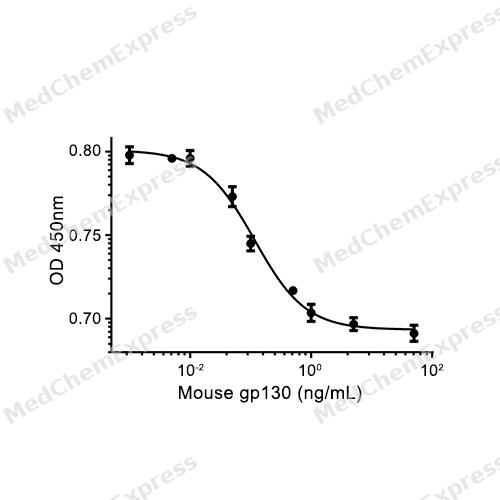
Bioactivity - Cell-Based Assay


Technical Parameters
-
Species Mouse
-
Source HEK293
-
Tag C-His
-
Accession
Q00560/NP_034690 (Q23-E617)
-
Molecular Construction
-
N-term
-
gp130 (E19-E617)
Accession # Q00560 -
His
-
C-term
-
-
Protein Length
Extracellular Domain
-
Synonyms
IL6ST; Interleukin Receptor Beta Chain; Interleukin 6 Cytokine Family Signal Transducer; Membrane Glycoprotein Gp130; Interleukin-6 Receptor Subunit Beta; IL6ST Nirs Variant 5; Membrane Glycoprotein 130; IL6ST Nirs Variant 2; IL-6RB; IL6ST Nirs Variant 3;
-
AA Sequence
QLLEPCGYIYPEFPVVQRGSNFTAICVLKEACLQHYYVNASYIVWKTNHAAVPREQVTVINRTTSSVTFTDVVLPSVQLTCNILSFGQIEQNVYGVTMLSGFPPDKPTNLTCIVNEGKNMLCQWDPGRETYLETNYTLKSEWATEKFPDCQSKHGTSCMVSYMPTYYVNIEVWVEAENALGKVSSESINFDPVDKVKPTPPYNLSVTNSEELSSILKLSWVSSGLGGLLDLKSDIQYRTKDASTWIQVPLEDTMSPRTSFTVQDLKPFTEYVFRIRSIKDSGKGYWSDWSEEASGTTYEDRPSRPPSFWYKTNPSHGQEYRSVRLIWKALPLSEANGKILDYEVILTQSKSVSQTYTVTGTELTVNLTNDRYVASLAARNKVGKSAAAVLTIPSPHVTAAYSVVNLKAFPKDNLLWVEWTPPPKPVSKYILEWCVLSENAPCVEDWQQEDATVNRTHLRGRLLESKCYQITVTPVFATGPGGSESLKAYLKQAAPARGPTVRTKKVGKNEAVLAWDQIPVDDQNGFIRNYSISYRTSVGKEMVVHVDSSHTEYTLSSLSSDTLYMVRMAAYTDEGGKDGPEFTFTTPKFAQGEIE
-
Molecular Weight
Approximately 80-90 kDa, based on SDS-PAGE under reducing conditions, due to the glycosylation.
-
Glycosylation
Yes
-
Purity
≥ 90%, as determined by reducing SDS-PAGE.


Product Properties
Lyophilized powder.
1.Lyophilized from a 0.22 μm filtered solution of PBS, pH 7.4, 15% trehalose.
2.Lyophilized from a 0.22 μm filtered solution of 20 mM PB, 150 mM NaCl, pH 7.4.
Please refer to the lot-specific COA for specific buffer information.
<1 EU/μg, determined by LAL method.
It is not recommended to reconstitute to a concentration less than 100 μg/mL in ddH2O. For long term storage it is recommended to add a carrier protein (0.1% BSA, 5% HSA, 10% FBS or 5% Trehalose).
Stored at -20°C for 2 years from date of receipt. After reconstitution, it is stable at 4°C for 1 week or -20°C for longer (with carrier protein). It is recommended to freeze aliquots at -20°C or -80°C for extended storage.
Room temperature in continental US; may vary elsewhere.


Documentation
-
Data Sheet (268 KB)
-
SDS (254 KB)
- English - EN (254 KB)
- Français - FR (254 KB)
- Deutsch - DE (254 KB)
- Norwegian - NO (254 KB)
- Español - ES (254 KB)
- Swedish - SV (254 KB)
- Italian - IT (254 KB)
- Korean - KR (254 KB)
- Portuguese - PT (254 KB)
-
Handling Instructions (2659 KB)


References
[1]. Cao Y, et al. Glycoprotein 130 is associated with adverse postoperative clinical outcomes of patients with late-stage non-metastatic gastric cancer. Sci Rep. 2016 Dec 5;6:38364. [Content Brief]
[2]. Nogueira-Silva C, et al. The role of glycoprotein 130 family of cytokines in fetal rat lung development. PLoS One. 2013 Jun 24;8(6):e67607. [Content Brief]
[3]. Xu S, et al. gp130: a promising drug target for cancer therapy. Expert Opin Ther Targets. 2013 Nov;17(11):1303-28. [Content Brief]
[4]. Boettger MK, et al. Differential effects of locally and systemically administered soluble glycoprotein 130 on pain and inflammation in experimental arthritis. Arthritis Res Ther. 2010;12(4):R140. [Content Brief]
[5]. Hong J, et al. Recombinant soluble gp130 protein reduces DEN-induced primary hepatocellular carcinoma in mice. Sci Rep. 2016 Apr 15;6:24397. [Content Brief]

Calculators
Concentration (start) × Volume (start) = Concentration (final) × Volume (final)


 Powered by Bioz

