



Histone deacetylase 1/HDAC1 Protein, Human (His-SUMO)
Based on 2 publication(s) in Google Scholar
Studies have confirmed that the histone deacetylase 1 (HDAC1) protein is a key enzyme that deacetylates lysine residues on core histones (H2A, H2B, H3, H4). This process establishes an epigenetic repressive signature that affects transcription, cell cycle, and developmental events. Histone deacetylase 1/HDAC1 Protein, Human (His-SUMO) is the recombinant human-derived Histone deacetylase 1/HDAC1 protein, expressed by E. coli , with N-SUMO, N-6*His labeled tag.
- Species: Human
- Source: E. coli
-
Storage:Stored at -20°C for 2 years from date of receipt. After reconstitution, it is stable at 4°C for 1 week or -20°C for longer (with carrier protein). It is recommended to freeze aliquots at -20°C or -80°C for extended storage.


To place orders, for customer services and technical support, please contact: MedChemExpress USA
Tel: 609-228-6898 E-mail: [email protected] [email protected]


-
 Biological Activity
-
Technical Parameters
-
Product Properties
- Documentation
- Help & FAQs




Biological Activity
Description
Studies have confirmed that the histone deacetylase 1 (HDAC1) protein is a key enzyme that deacetylates lysine residues on core histones (H2A, H2B, H3, H4). This process establishes an epigenetic repressive signature that affects transcription, cell cycle, and developmental events. Histone deacetylase 1/HDAC1 Protein, Human (His-SUMO) is the recombinant human-derived Histone deacetylase 1/HDAC1 protein, expressed by E. coli , with N-SUMO, N-6*His labeled tag.
Background
Histone deacetylase 1 (HDAC1) Protein serves as a pivotal enzyme that catalyzes the deacetylation of lysine residues located on the N-terminal regions of core histones, including H2A, H2B, H3, and H4. This deacetylation process contributes to the establishment of an epigenetic repression tag and plays crucial roles in transcriptional regulation, cell cycle progression, and developmental events. Functioning within large multiprotein complexes, HDAC1 is a component of the histone deacetylase NuRD complex, actively participating in chromatin remodeling. Beyond histones, HDAC1 exhibits deacetylase activity toward non-histone targets, including NR1D2, RELA, SP1, SP3, and TSHZ3. This versatile enzyme regulates the function of SP proteins (SP1 and SP3) through deacetylation, and it forms part of the BRG1-RB1-HDAC1 complex, which negatively regulates CREST-mediated transcription in resting neurons. Furthermore, HDAC1 acts as a protein decrotonylase, mediating the decrotonylation of histones, thereby expanding its enzymatic repertoire. The multifaceted activities of HDAC1 underscore its central role in epigenetic regulation and diverse cellular processes.
Verified Bioactivity
The enzyme activity of this recombinant protein is testing in progress, we cannot offer a guarantee yet.
MCE Validation Data
-
Purity - SDS-PAGE
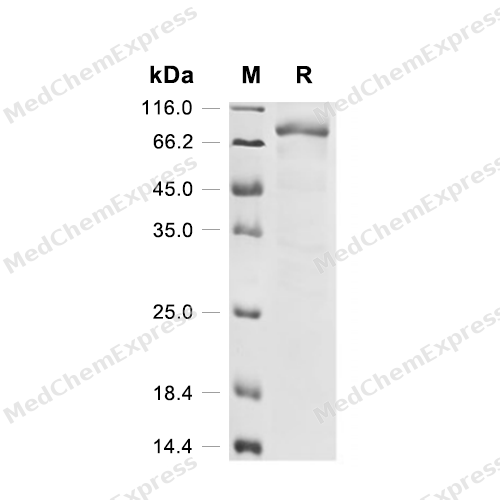
Purity - SDS-PAGE


Publications (2)
-
Journal Impact Factor
-
Most Recent
-
Nat Commun
2026 Apr 7;17(1):2877. PMID: 41946722 -


Technical Parameters
-
Species Human
-
Source E. coli
-
Tag N-SUMO;N-6*His
-
Accession
Q13547 (M1-A482)
-
Molecular Construction
-
N-term
-
6*His-SUMO
-
HDAC1 (M1-A482)
Accession # Q13547 -
C-term
-
-
Protein Length
Full Length
-
Synonyms
HDAC1; GON-10; Prev. RPD3L1; Reduced Potassium Dependency, Yeast Homolog-Like 1; HD1; Protein Decrotonylase HDAC1; Protein Deacetylase HDAC1; Histone Deacetylase; Protein Deacylase HDAC1; RPD3; Histone Deacetylase 1; KDAC1
-
AA Sequence
MAQTQGTRRKVCYYYDGDVGNYYYGQGHPMKPHRIRMTHNLLLNYGLYRKMEIYRPHKANAEEMTKYHSDDYIKFLRSIRPDNMSEYSKQMQRFNVGEDCPVFDGLFEFCQLSTGGSVASAVKLNKQQTDIAVNWAGGLHHAKKSEASGFCYVNDIVLAILELLKYHQRVLYIDIDIHHGDGVEEAFYTTDRVMTVSFHKYGEYFPGTGDLRDIGAGKGKYYAVNYPLRDGIDDESYEAIFKPVMSKVMEMFQPSAVVLQCGSDSLSGDRLGCFNLTIKGHAKCVEFVKSFNLPMLMLGGGGYTIRNVARCWTYETAVALDTEIPNELPYNDYFEYFGPDFKLHISPSNMTNQNTNEYLEKIKQRLFENLRMLPHAPGVQMQAIPEDAIPEESGDEDEDDPDKRISICSSDKRIACEEEFSDSEEEGEGGRKNSSNFKKAKRVKTEDEKEKDPEEKKEVTEEEKTKEEKPEAKGVKEEVKLA
-
Predicted Molecular Mass
73.2 kDa
-
Molecular Weight
Approximately 71-74 kDa, based on SDS-PAGE under reducing conditions.
-
Purity
≥ 90%, as determined by reducing SDS-PAGE.


Product Properties
Lyophilized powder
Lyophilized from 0.22 μm filtered solution in 10 mM Tris-HCl, 1 mM EDTA, 6% Trehalose, pH 8.0 or PBS, 6% Trehalose, pH 7.4 or 20 mM Tris-HCl, 0.5 M NaCl, 6% Trehalose, pH 8.0.
Note: For SPR assay, please replace the buffer. Primary amine components (e.g., Tris, imidazole) can affect protein-coupled chips.
<1 EU/μg, determined by LAL method.
It is not recommended to reconstitute to a concentration less than 100 μg/mL in ddH2O.
Stored at -20°C for 2 years from date of receipt. After reconstitution, it is stable at 4°C for 1 week or -20°C for longer (with carrier protein). It is recommended to freeze aliquots at -20°C or -80°C for extended storage.
Room temperature in continental US; may vary elsewhere.


Documentation
-
Data Sheet (238 KB)
-
SDS (252 KB)
- English - EN (252 KB)
- Français - FR (252 KB)
- Deutsch - DE (252 KB)
- Norwegian - NO (252 KB)
- Español - ES (252 KB)
- Swedish - SV (252 KB)
- Italian - IT (252 KB)
- Korean - KR (252 KB)
- Portuguese - PT (252 KB)
-
Handling Instructions (2659 KB)

Calculators
Concentration (start) × Volume (start) = Concentration (final) × Volume (final)


 Powered by Bioz

