



IGF-I/IGF-1 Protein, Human (G49-A118)
Based on 6 publication(s) in Google Scholar
The LR3 IGF-I/IGF-1 protein is similar to insulin and has potent growth-promoting activity that exceeds the efficacy of insulin. As a potential physiological regulator, it stimulates glucose transport and glycogen synthesis in osteoblasts even at significantly lower concentrations than insulin. IGF-I/IGF-1 Protein, Human (G49-A118) is the recombinant human-derived IGF-I/IGF-1 protein, expressed by E. coli , with tag free.
- Species: Human
- Source: E. coli
-
Storage:Stored at -20°C for 2 years from date of receipt. After reconstitution, it is stable at 4°C for 1 week or -20°C for longer (with carrier protein). It is recommended to freeze aliquots at -20°C or -80°C for extended storage.


To place orders, for customer services and technical support, please contact: MedChemExpress USA
Tel: 609-228-6898 E-mail: [email protected] [email protected]


-
 Biological Activity
-
Technical Parameters
-
Product Properties
- Documentation
- Help & FAQs




Biological Activity
Description
The LR3 IGF-I/IGF-1 protein is similar to insulin and has potent growth-promoting activity that exceeds the efficacy of insulin. As a potential physiological regulator, it stimulates glucose transport and glycogen synthesis in osteoblasts even at significantly lower concentrations than insulin. IGF-I/IGF-1 Protein, Human (G49-A118) is the recombinant human-derived IGF-I/IGF-1 protein, expressed by E. coli , with tag free.
Background
The LR3 IGF-I/IGF-1 protein, structurally and functionally akin to insulin, boasts significantly heightened growth-promoting activity compared to its counterpart. Positioned as a potential physiological regulator, LR3 IGF-I may govern [1-14C]-2-deoxy-D-glucose (2DG) transport and glycogen synthesis in osteoblasts, demonstrating effective stimulation of glucose transport in bone-derived osteoblastic (PyMS) cells even at markedly lower concentrations than insulin. Its multifaceted roles extend to potential involvement in synapse maturation and the Ca(2+)-dependent exocytosis essential for sensory perception of smell in the olfactory bulb. Operating as a ligand for IGF1R, LR3 IGF-I binds to the alpha subunit, initiating the activation of intrinsic tyrosine kinase activity, autophosphorylating tyrosine residues in the beta subunit. This activation triggers a cascade of downstream signaling events leading to the activation of the PI3K-AKT/PKB and Ras-MAPK pathways. Further, LR3 IGF-I forms crucial ternary complexes with integrins (ITGAV:ITGB3 and ITGA6:ITGB4) and IGFR1, essential for comprehensive IGF1 signaling, influencing the phosphorylation and activation of IGFR1, MAPK3/ERK1, MAPK1/ERK2, and AKT1. It also exhibits diverse molecular interactions, including with SH2D3C isoform 2.
Verified Bioactivity
Measured in a serum-free cell proliferation assay using MCF-7 human breast cancer cells. The ED50 for this effect is 1.706 ng/mL, corresponding to a specific activity is 5.86×10⁵ units/mg.
MCE Validation Data
-
Purity - SDS-PAGE
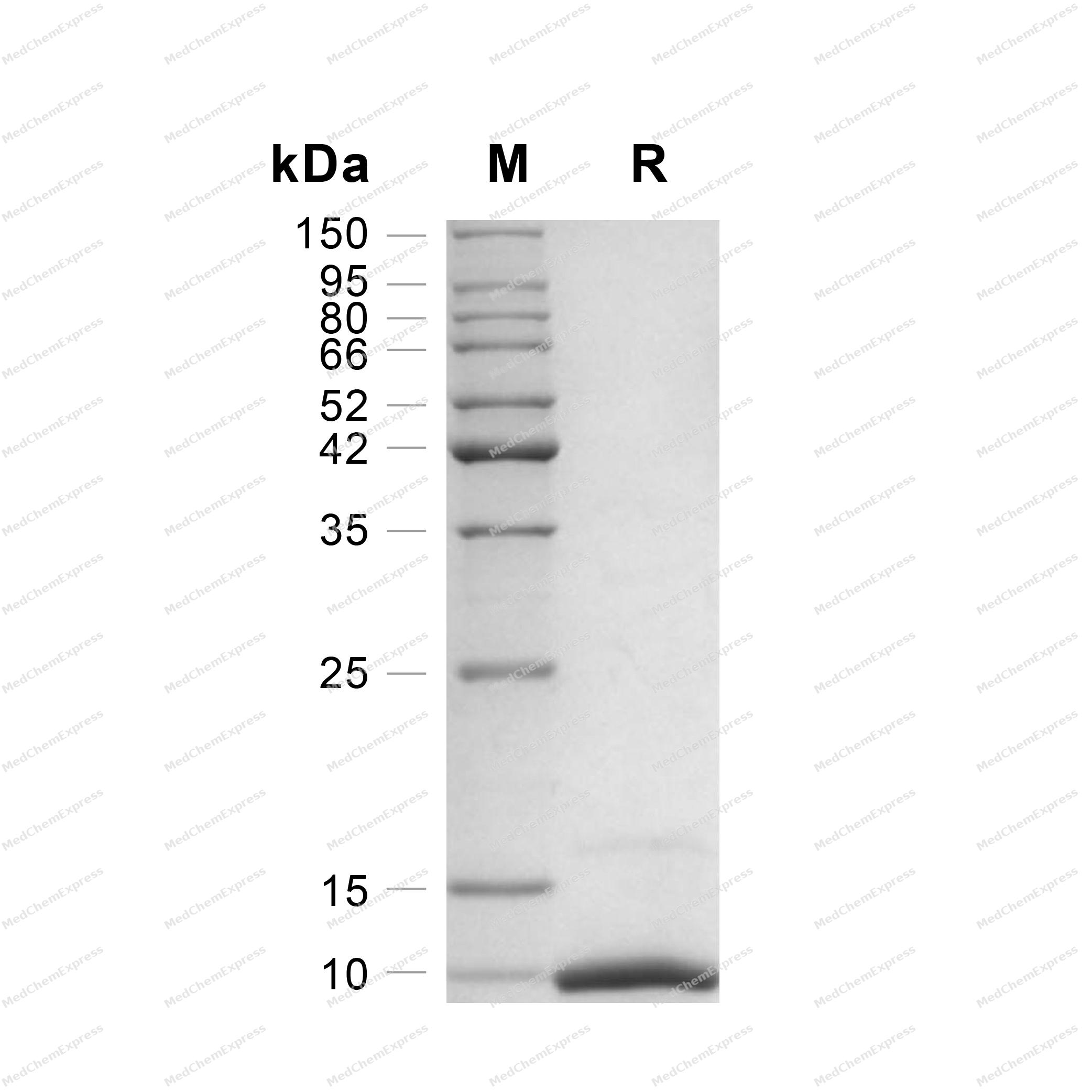
Purity - SDS-PAGE
-
Bioactivity - Cell-Based Assay
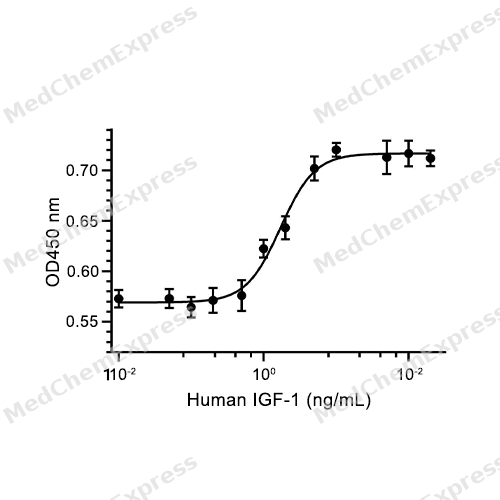
Bioactivity - Cell-Based Assay


Publications (6)
-
Journal Impact Factor
-
Most Recent
-
J Ethnopharmacol
Anti-hepatitis B virus activity of lithospermic acid, a polyphenol from Salvia miltiorrhiza, in vitro and in vivo by autophagy regulation. [Abstract]2023 Feb 10;302(Pt A):115896. PMID: 36334815 -
Eur J Pharm Sci
IGF-PLGA microspheres promote angiogenesis and accelerate skin flap repair and healing by inhibiting oxidative stress and regulating the Ang 1/Tie 2 signaling pathway. [Abstract]2024 Feb 1:193:106687. PMID: 38176662
IGF-I/IGF-1 Protein, Human (G49-A118) purchased from MedChemExpress. Usage Cited in: Eur J Pharm Sci. 2024 Feb 1:193:106687. [Abstract]
Scratch assays and cell-migration quantification were performed in T-BHP-injured 3T3 cells treated with IGF-1 (100 ng/mL; 24 h) or IGF-PLGA containing an equivalent IGF-1 concentration. IGF-1 and IGF-PLGA enhanced cell migration, with the strongest migration observed in the IGF-PLGA group.

IGF-I/IGF-1 Protein, Human (G49-A118) purchased from MedChemExpress. Usage Cited in: Eur J Pharm Sci. 2024 Feb 1:193:106687. [Abstract]
Representative tubular structures and tube numbers were assessed in T-BHP-injured HUVECs treated with IGF-1 (100 ng/mL; 8 h) or IGF-PLGA containing an equivalent IGF-1 concentration. IGF-1 and IGF-PLGA enhanced HUVEC tube formation, with the most prominent effect observed in the IGF-PLGA group.
-
J Cancer
AQP3 Promotes the Invasion and Metastasis in Cervical Cancer by Regulating NOX4-derived H2O2 Activation of Syk/PI3K/Akt Signaling Axis. [Abstract]2024 Jan 1;15(4):1124-1137. PMID: 38230207
IGF-I/IGF-1 Protein, Human (G49-A118) purchased from MedChemExpress. Usage Cited in: J Cancer. 2024 Jan 1;15(4):1124-1137. [Abstract]
The difference in cell migration distance under the action of IGF-1 (100 ng/mL; 24 h) was detected by the scratch test. IGF-1 enhanced cell invasion abilities.
-
-
Bioengineered
Inhibition of integrin subunit alpha 11 restrains gastric cancer progression through phosphatidylinositol 3-kinase/Akt pathway. [Abstract]2021 Dec;12(2):11909-11921. PMID: 34802381
IGF-I/IGF-1 Protein, Human (G49-A118) purchased from MedChemExpress. Usage Cited in: Bioengineered. 2021 Dec;12(2):11909-11921. [Abstract]
Cell proliferation was assessed by CCK-8 in si-ITGA11 MKN45 cells treated with IGF-1 (50 ng/mL; 24-96 h). IGF-1 intervention facilitated cell proliferation versus the Si-ITGA11 group.

IGF-I/IGF-1 Protein, Human (G49-A118) purchased from MedChemExpress. Usage Cited in: Bioengineered. 2021 Dec;12(2):11909-11921. [Abstract]
Transwell assays were used to evaluate migration and invasion in si-ITGA11 MKN45 cells treated with IGF-1 (50 ng/mL; 24 h). IGF-1 intervention strengthened cell migration and invasion versus the Si-ITGA11 group.
-
Oxid Med Cell Longev
Berberine Suppresses EMT in Liver and Gastric Carcinoma Cells through Combination with TGF β R Regulating TGF- β/Smad Pathway. [Abstract]2021 Oct 18;2021:2337818. PMID: 34712379


Technical Parameters
-
Species Human
-
Source E. coli
-
Tag Tag Free
-
Accession
P05019-1 (G49-A118)
-
Molecular Construction
-
N-term
-
IGF1 (G49-A118)
Accession # P05019-1 -
C-term
-
-
Protein Length
Full Length of Isoform-1
-
Synonyms
IGF1; Somatomedin-C; Insulin Like Growth Factor 1; IGF1A; IGF-I; MGF; Insulin-Like Growth Factor 1; Insulin-Like Growth Factor IB; Insulin-Like Growth Factor I; Insulin-Like Growth Factor-I; IGFI; Alternative Protein IGF1; IGF; Somatomedin C; Insulin-Like
-
AA Sequence
GPETLCGAELVDALQFVCGDRGFYFNKPTGYGSSSRRAPQTGIVDECCFRSCDLRRLEMYCAPLKPAKSA
-
Predicted Molecular Mass
7.6 kDa
-
Molecular Weight
Approximately 8-12 kDa, based on SDS-PAGE under reducing conditions.
-
Purity
≥ 95%, as determined by reducing SDS-PAGE.


Product Properties
Lyophilized powder
Lyophilized from a 0.22 μm filtered solution of 20 mM NaAc-HAC, pH 4.5.
<1 EU/μg, determined by LAL method.
It is not recommended to reconstitute to a concentration less than 100 μg/mL in 50 mM HAc. For long term storage it is recommended to add a carrier protein (0.1% BSA, 5% HSA, 10% FBS or 5% Trehalose).
Stored at -20°C for 2 years from date of receipt. After reconstitution, it is stable at 4°C for 1 week or -20°C for longer (with carrier protein). It is recommended to freeze aliquots at -20°C or -80°C for extended storage.
Room temperature in continental US; may vary elsewhere.


Documentation
-
Data Sheet (236 KB)
-
SDS (252 KB)
- English - EN (252 KB)
- Français - FR (252 KB)
- Deutsch - DE (252 KB)
- Norwegian - NO (252 KB)
- Español - ES (252 KB)
- Swedish - SV (252 KB)
- Italian - IT (252 KB)
- Korean - KR (252 KB)
- Portuguese - PT (252 KB)
-
Handling Instructions (2659 KB)

Calculators
Concentration (start) × Volume (start) = Concentration (final) × Volume (final)


 Powered by Bioz

