



IL-6R Protein, Canine (HEK293, His)

Based on 1 Customer Validation
IL-6R alpha is a subunit alpha of IL-6 receptors, also shared by other interleukin receptors. IL-6R alpha acts as IL-6 agonist and involves in JAK/STAT, MAPK, and Akt signaling pathway. IL-6R alpha, Canine consists of 462 amino acids (M1-R462) and is produced in HEK293 cells with a C-Terminal His-tag.
- Species: Canine
- Source: HEK293
-
Storage:Stored at -80°C for 1 year from date of receipt. It is stable at -20°C for 3 months after opening. It is recommended to freeze aliquots at -80°C for extended storage. Avoid repeated freeze-thaw cycles.


To place orders, for customer services and technical support, please contact: MedChemExpress USA
Tel: 609-228-6898 E-mail: [email protected] [email protected]


-
 Biological Activity
-
Technical Parameters
-
Product Properties
- Documentation
- References
- Help & FAQs




Biological Activity
Description
IL-6R alpha is a subunit alpha of IL-6 receptors, also shared by other interleukin receptors. IL-6R alpha acts as IL-6 agonist and involves in JAK/STAT, MAPK, and Akt signaling pathway[1][2]. IL-6R alpha, Canine consists of 462 amino acids (M1-R462) and is produced in HEK293 cells with a C-Terminal His-tag.
Background
IL-6 acts as both inflammatory factor and anti-inflammatory factor, fuels cancer progression through activating a series of downstream signalling cascade including gp130 (dimers), JAK/STAT, MAPK, and Akt[1][2].
IL-6R alpha (IL-6Rα) as a part of the receptor for interleukin 6, is a type I transmembrane glycoprotein, which forms a complex with the type I transmembrane signal transducer Glycoprotein 130 (CD130) and regulates the biological activity of IL-6 with a low affinity[3].
IL-6R alpha has 2 isoform including mIL6R (the longer one) or sIL6R (the shorter one):
The mIL6R is membrane-bound interleukin-6 receptor, has the potential to drive naive CD4+ T cells to the Th17 lineage, through 'cluster signaling' by dendritic cells[4].
The sIL-6R is soluble interleukin-6 receptor subunit, cleaved from IL-6R alpha (IL-6Rα) in activated CD4+ T cells by proteolysis, and serves as IL-6 agonist. sIL-6R binds membrane-bound IL6R and subunit IL6ST to activate regenerative and anti-inflammatory signal via IL-6 trans signaling and promotes pro-inflammatory properties of IL-6. The hydrolysis of IL-6R alpha is also called ectodomain shedding[1].
IL-6R alpha involves in regulating cell growth and differentiation, and plays an important role in regulation of immune response, acute-phase reactions and hematopoiesis[5].
However, IL-6R alpha shows tissue expression specificity in liver and some cells of the immune system, thus results a limitation of IL6 signaling[6].
It's worth noting that IL-6R alpha dysregulation is implicated in the pathogenesis of many diseases, such as multiple myeloma, autoimmune diseases, and prostate cancer[7][8].
Verified Bioactivity
Measured by its binding ability in a functional ELISA.Immobilized canine IL6R-His at 10 μg/mL (100 μL/well) can bind human IL6, the EC50 of human IL6 is 5-50 ng/mL.
MCE Validation Data
-
Purity - SDS-PAGE
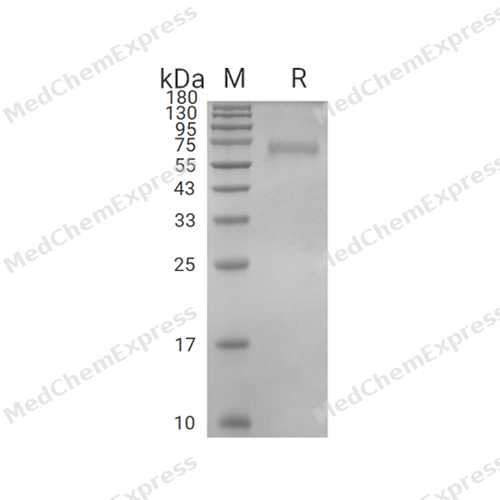
Purity - SDS-PAGE


Technical Parameters
-
Species Canine
-
Source HEK293
-
Tag C-His
-
Accession
A0A8I3NUE0/XP_855105.1 (L20-P365)
-
Molecular Construction
-
N-term
-
IL-6R (L20-P365)
Accession # A0A8I3NUE0/XP_855105.1 -
His
-
C-term
-
-
Protein Length
Partial
-
Synonyms
IL6R; IL-6R 1; Interleukin 6 Receptor; IL-6RA; Gp80; Interleukin 6 Receptor Subunit Alpha; Interleukin-6 Receptor Subunit Alpha; IL-6R Subunit Alpha; Membrane Glycoprotein 80; IL-6R-Alpha; IL-1Ra; IL-6R-1; IL6RA; IL6QTL; IL-6R; IL6RQ; CD126; HIES5; IL-6 R
-
AA Sequence
LAPWGCPAPEVMSGVVTSLPGASVTLTCPGGEPEDNGTVQWLLQNLVDDSYLGSRAAVGRTLLLRSVQLSDSGNYSCYQDGRLAGTVRLLVDAPPEEPQLACFRKSPLSMVFCEWSPRHPPSPKTRATLLVRKFRGRPVGDSQEPCPYAQGPQKFSCQLAVPEGDNSLYVVSLCVTNSAGSRSSTPQTFEGYGILQPDPPVNITVTAVDRNPRWLRVSWQDPPSWNSYFYRLQFELRYRAERSKTFTMLMIKEFQHHCIIHDAWRGMRHVVQLRAREEFGHGSWSTWSQEAVGTPWTESRSPAAETELPHSTQAPTTNEDNKNNISKDIANATSLPVQDSSSAPLP
-
Predicted Molecular Mass
39.8 kDa
-
Molecular Weight
Approximately 58-66 kDa, based on SDS-PAGE under reducing conditions.
-
Purity
≥ 95%, as determined by reducing SDS-PAGE.


Product Properties
Solution
Supplied as a 0.22 μm filtered solution of PBS, pH 7.4, 5% trehalose, 5% mannitol and 0.01% Tween 80.
<1 EU/μg, determined by LAL method.
Stored at -80°C for 1 year from date of receipt. It is stable at -20°C for 3 months after opening. It is recommended to freeze aliquots at -80°C for extended storage. Avoid repeated freeze-thaw cycles.
Shipping with dry ice.


Documentation
-
Data Sheet (266 KB)
-
SDS (252 KB)
- English - EN (252 KB)
- Français - FR (252 KB)
- Deutsch - DE (252 KB)
- Norwegian - NO (252 KB)
- Español - ES (252 KB)
- Swedish - SV (252 KB)
- Italian - IT (252 KB)
- Korean - KR (252 KB)
- Portuguese - PT (252 KB)
-
Handling Instructions (2659 KB)


References
[1]. Garbers C, et al. Inhibition of classic signaling is a novel function of soluble glycoprotein 130 (sgp130), which is controlled by the ratio of interleukin 6 and soluble interleukin 6 receptor. J Biol Chem. 2011 Dec 16;286(50):42959-70. [Content Brief]
[3]. Larsen JV, et al. SorLA in Interleukin-6 Signaling and Turnover. Mol Cell Biol. 2017 May 16;37(11):e00641-16. [Content Brief]
[4]. Kang S, et al. Targeting Interleukin-6 Signaling in Clinic. Immunity. 2019 Apr 16;50(4):1007-1023. [Content Brief]
[5]. Giannitrapani L, et al. Circulating IL-6 and sIL-6R in patients with hepatocellular carcinoma. Ann N Y Acad Sci. 2002 Jun;963:46-52. [Content Brief]
[6]. Arnold P, et al. Joint Reconstituted Signaling of the IL-6 Receptor via Extracellular Vesicles. Cells. 2020 May 24;9(5):1307. [Content Brief]
[7]. Mishra AK, et al. Metformin inhibits IL-6 signaling by decreasing IL-6R expression on multiple myeloma cells. Leukemia. 2019 Nov;33(11):2695-2709. [Content Brief]
[8]. Gruber CN, et al. Mapping Systemic Inflammation and Antibody Responses in Multisystem Inflammatory Syndrome in Children (MIS-C). Cell. 2020 Nov 12;183(4):982-995.e14. [Content Brief]

Calculators
Concentration (start) × Volume (start) = Concentration (final) × Volume (final)


 Powered by Bioz

