



JAM-A/CD321 Protein, Human (HEK293, His)

Based on 1 Customer Validation
The JAM-A/CD321 protein is critical for the formation of epithelial tight junctions, is present in early junction development, and recruits PARD3. Binding of the PARD6-PARD3 complex may hinder PARD3-JAM1 interaction, thereby impeding tight junction assembly. JAM-A/CD321 Protein, Human (HEK293, His) is the recombinant human-derived JAM-A/CD321 protein, expressed by HEK293 , with C-6*His labeled tag.
- Species: Human
- Source: HEK293
-
Storage:Stored at -20°C for 2 years from date of receipt. After reconstitution, it is stable at 4°C for 1 week or -20°C for longer (with carrier protein). It is recommended to freeze aliquots at -20°C or -80°C for extended storage.


To place orders, for customer services and technical support, please contact: MedChemExpress USA
Tel: 609-228-6898 E-mail: [email protected] [email protected]


-
 Biological Activity
-
Technical Parameters
-
Product Properties
- Documentation
- Help & FAQs




Biological Activity
Description
The JAM-A/CD321 protein is critical for the formation of epithelial tight junctions, is present in early junction development, and recruits PARD3. Binding of the PARD6-PARD3 complex may hinder PARD3-JAM1 interaction, thereby impeding tight junction assembly. JAM-A/CD321 Protein, Human (HEK293, His) is the recombinant human-derived JAM-A/CD321 protein, expressed by HEK293 , with C-6*His labeled tag.
Background
The JAM-A/CD321 protein appears to be involved in the formation of tight junctions in epithelial cells. It is present in the early stages of cell junction development and recruits PARD3. The association of the PARD6-PARD3 complex may prevent the interaction between PARD3 and JAM1, thus hindering tight junction assembly. The protein also plays a role in regulating monocyte transmigration, which is crucial for maintaining the integrity of the epithelial barrier. It acts as a ligand for integrin alpha-L/beta-2, facilitating the transmigration of memory T-cells and neutrophils. Additionally, it is involved in platelet activation. In terms of microbial infection, JAM-A/CD321 acts as a receptor for Mammalian reovirus sigma-1.
Verified Bioactivity
Immobilized Human JAM-A at 1 μg/mL (100 μL/well) can bind Anti-JAM-A antibody. The ED50 for this effect is 3.4 ng/mL.
MCE Validation Data
-
Purity - SDS-PAGE

Purity - SDS-PAGE
-
Bioactivity - ELISA
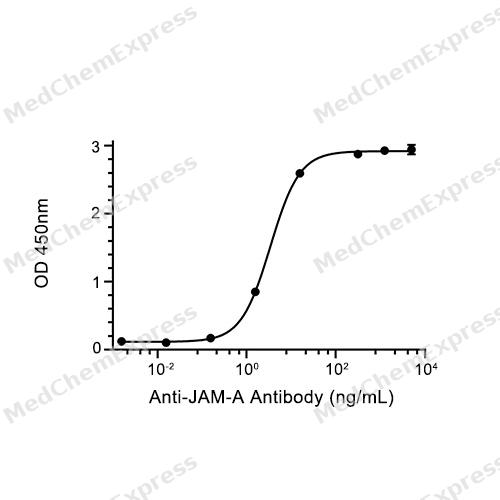
Bioactivity - ELISA


Technical Parameters
-
Species Human
-
Source HEK293
-
Tag C-6*His
-
Accession
Q9Y624-1 (S28-V238)
-
Molecular Construction
-
N-term
-
JAM-A (S28-V238)
Accession # Q9Y624-1 -
6*His
-
C-term
-
-
Protein Length
Extracellular Domain
-
Synonyms
F11R; JAM-A; Prev. JAM1; JAMA; Junctional Adhesion Molecule 1; Platelet Adhesion Molecule 1; PAM-1; Platelet F11 Receptor; JCAM; CD321 Antigen; Junctional Adhesion Molecule A; JAM; JAM-1; KAT; F11 Receptor; CD321
-
AA Sequence
SVTVHSSEPEVRIPENNPVKLSCAYSGFSSPRVEWKFDQGDTTRLVCYNNKITASYEDRVTFLPTGITFKSVTREDTGTYTCMVSEEGGNSYGEVKVKLIVLVPPSKPTVNIPSSATIGNRAVLTCSEQDGSPPSEYTWFKDGIVMPTNPKSTRAFSNSSYVLNPTTGELVFDPLSASDTGEYSCEARNGYGTPMTSNAVRMEAVERNVGV
-
Predicted Molecular Mass
23.9 kDa
-
Molecular Weight
Approximately 28-33 kDa, based on SDS-PAGE under reducing conditions.
-
Glycosylation
Yes
-
Purity
≥ 95%, as determined by reducing SDS-PAGE.


Product Properties
Lyophilized powder.
Lyophilized from a 0.22 μm filtered solution of 20 mM Tris-HCl, 150 mM NaCl, 100 mM Glycine, pH 7.5.
Note: For SPR assay, please replace the buffer. Primary amine components (e.g., Tris, imidazole) can affect protein-coupled chips.
<1 EU/μg, determined by LAL method.
It is not recommended to reconstitute to a concentration less than 100 μg/mL in ddH2O. For long term storage it is recommended to add a carrier protein (0.1% BSA, 5% HSA, 10% FBS or 5% Trehalose).
Stored at -20°C for 2 years from date of receipt. After reconstitution, it is stable at 4°C for 1 week or -20°C for longer (with carrier protein). It is recommended to freeze aliquots at -20°C or -80°C for extended storage.
Room temperature in continental US;may vary elsewhere.


Documentation
-
Data Sheet (237 KB)
-
SDS (252 KB)
- English - EN (252 KB)
- Français - FR (252 KB)
- Deutsch - DE (252 KB)
- Norwegian - NO (252 KB)
- Español - ES (252 KB)
- Swedish - SV (252 KB)
- Italian - IT (252 KB)
- Korean - KR (252 KB)
- Portuguese - PT (252 KB)
-
Handling Instructions (2659 KB)

Calculators
Concentration (start) × Volume (start) = Concentration (final) × Volume (final)


 Powered by Bioz

