



JAM-C/CD323 Protein, Human (HEK293)

Based on 1 Customer Validation
The JAM-C/CD323 protein is a junctional adhesion protein that regulates various cellular processes by interacting with JAM2 and JAM3. It is essential for the homing of hematopoietic cells in the bone marrow, promotes leukocyte migration, and participates in spermatogenesis by anchoring germ cells. JAM-C/CD323 Protein, Human (HEK293) is the recombinant human-derived JAM-C/CD323 protein, expressed by HEK293 , with tag free.
- Species: Human
- Source: HEK293
-
Storage:Stored at -20°C for 2 years from date of receipt. After reconstitution, it is stable at 4°C for 1 week or -20°C for longer (with carrier protein). It is recommended to freeze aliquots at -20°C or -80°C for extended storage.


To place orders, for customer services and technical support, please contact: MedChemExpress USA
Tel: 609-228-6898 E-mail: [email protected] [email protected]


-
 Biological Activity
-
Technical Parameters
-
Product Properties
- Documentation
- Help & FAQs




Biological Activity
Description
The JAM-C/CD323 protein is a junctional adhesion protein that regulates various cellular processes by interacting with JAM2 and JAM3. It is essential for the homing of hematopoietic cells in the bone marrow, promotes leukocyte migration, and participates in spermatogenesis by anchoring germ cells. JAM-C/CD323 Protein, Human (HEK293) is the recombinant human-derived JAM-C/CD323 protein, expressed by HEK293 , with tag free.
Background
JAM-C/CD323, a junctional adhesion protein, orchestrates heterotypic cell-cell interactions with its receptor JAM2, exerting regulatory control over diverse cellular processes. Notably, it plays a crucial role in the homing and mobilization of hematopoietic stem and progenitor cells within the bone marrow, contributing to their retention on the surface of bone marrow stromal cells. This function involves the interaction with JAM3-expressing hematopoietic cells. In the context of leukocyte extravasation, JAM-C facilitates transmigration through the endothelium, underscoring its central role in this physiological process. Furthermore, in spermatogenesis, JAM-C engages with both Sertoli and germ cells, essential for anchoring germ cells onto Sertoli cells and assembling cell polarity complexes during spermatid differentiation. Acting as a counter-receptor for ITGAM, JAM-C mediates leukocyte-platelet interactions and regulates the transepithelial migration of polymorphonuclear neutrophils. Additionally, JAM-C is implicated in angiogenesis, cell migration regulation, and myocyte fusion during myogenesis, promoting chemotaxis of vascular endothelial cells and stimulating angiogenesis.
Verified Bioactivity
Measured by its ability to chemoattract HUVEC cells. The ED50 for this effect is 0.114 μg/mL, corresponding to a specific activity is 8.772×10³ U/mg.
MCE Validation Data
-
Purity - SDS-PAGE
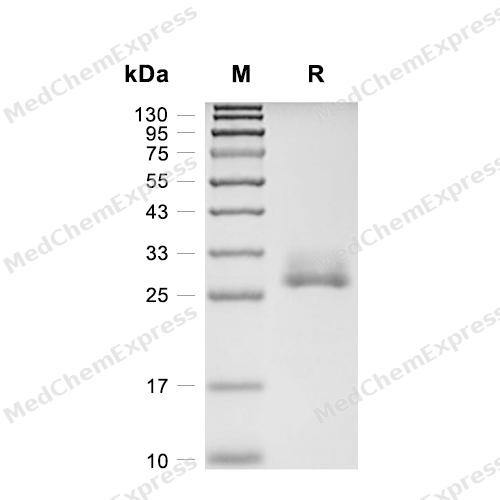
Purity - SDS-PAGE
-
Bioactivity - Cell-Based Assay
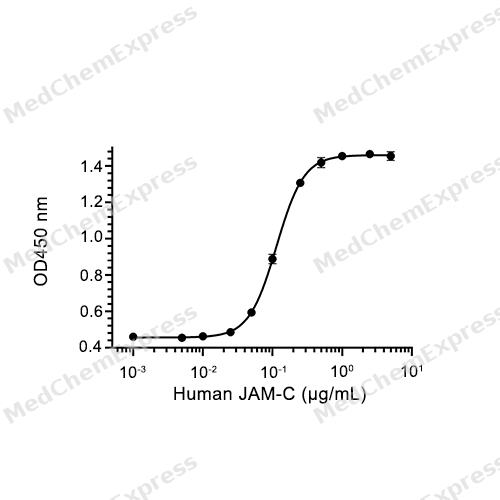
Bioactivity - Cell-Based Assay


Technical Parameters
-
Species Human
-
Source HEK293
-
Tag Tag Free
-
Accession
Q9BX67 (V32-N241)
-
Molecular Construction
-
N-term
-
JAM-A (V32-N241)
Accession # Q9BX67 -
C-term
-
-
Protein Length
Extracellular Domain
-
Synonyms
JAM3; Junctional Adhesion Molecule C; Junctional Adhesion Molecule 3; JAMC; JAM-C; JAM-2; JAM-3
-
AA Sequence
VNLKSSNRTPVVQEFESVELSCIITDSQTSDPRIEWKKIQDEQTTYVFFDNKIQGDLAGRAEILGKTSLKIWNVTRRDSALYRCEVVARNDRKEIDEIVIELTVQVKPVTPVCRVPKAVPVGKMATLHCQESEGHPRPHYSWYRNDVPLPTDSRANPRFRNSSFHLNSETGTLVFTAVHKDDSGQYYCIASNDAGSARCEEQEMEVYDLN
-
Molecular Weight
Approximately 33 kDa, based on SDS-PAGE under reducing conditions.
-
Glycosylation
Yes
-
Purity
≥ 95%, as determined by reducing SDS-PAGE.


Product Properties
Lyophilized powder.
Lyophilized from a 0.22 μm filtered solution of PBS, pH 7.4, 8% trehalose.
<1 EU/μg, determined by LAL method.
It is not recommended to reconstitute to a concentration less than 100 μg/mL in ddH2O.
Stored at -20°C for 2 years from date of receipt. After reconstitution, it is stable at 4°C for 1 week or -20°C for longer (with carrier protein). It is recommended to freeze aliquots at -20°C or -80°C for extended storage.
Room temperature in continental US; may vary elsewhere.


Documentation
-
Data Sheet (237 KB)
-
SDS (251 KB)
- English - EN (251 KB)
- Français - FR (251 KB)
- Deutsch - DE (251 KB)
- Norwegian - NO (251 KB)
- Español - ES (251 KB)
- Swedish - SV (251 KB)
- Italian - IT (251 KB)
- Korean - KR (251 KB)
- Portuguese - PT (251 KB)
-
Handling Instructions (2659 KB)

Calculators
Concentration (start) × Volume (start) = Concentration (final) × Volume (final)


 Powered by Bioz

