



L-selectin/CD62L Protein, Mouse (HEK293, His)

Based on 1 Customer Validation
L-selectin, a calcium-dependent lectin, binds to glycoproteins on adjacent cells, facilitating lymphocyte attachment to endothelial cells in peripheral lymph nodes. This interaction is essential for leukocyte rolling along the endothelium and requires L-selectin's binding to SELPLG/PSGL1 and PODXL2, dependent on glycan and sulfation modifications. Sulfation of 'Tyr-51' on SELPLG is particularly important for L-selectin binding. L-selectin/CD62L Protein, Mouse (HEK293, His) is the recombinant mouse-derived L-selectin/CD62L protein, expressed by HEK293 , with C-His labeled tag.
- Species: Mouse
- Source: HEK293
-
Storage:Stored at -80°C for 1 year from date of receipt. It is stable at -20°C for 3 months after opening. It is recommended to freeze aliquots at -80°C for extended storage. Avoid repeated freeze-thaw cycles.


To place orders, for customer services and technical support, please contact: MedChemExpress USA
Tel: 609-228-6898 E-mail: [email protected] [email protected]


-
 Biological Activity
-
Technical Parameters
-
Product Properties
- Documentation
- Help & FAQs




Biological Activity
Description
L-selectin, a calcium-dependent lectin, binds to glycoproteins on adjacent cells, facilitating lymphocyte attachment to endothelial cells in peripheral lymph nodes. This interaction is essential for leukocyte rolling along the endothelium and requires L-selectin's binding to SELPLG/PSGL1 and PODXL2, dependent on glycan and sulfation modifications. Sulfation of 'Tyr-51' on SELPLG is particularly important for L-selectin binding. L-selectin/CD62L Protein, Mouse (HEK293, His) is the recombinant mouse-derived L-selectin/CD62L protein, expressed by HEK293 , with C-His labeled tag.
Background
L-selectin, a calcium-dependent lectin, plays a crucial role in cell adhesion through its binding to glycoproteins on adjacent cells. Specifically, it facilitates the attachment of lymphocytes to endothelial cells in high endothelial venules within peripheral lymph nodes, promoting the initial tethering and rolling of leukocytes along the endothelium. This process requires the interaction of L-selectin with SELPLG/PSGL1 and PODXL2, which is dependent on the sialyl Lewis X glycan modification of SELPLG and PODXL2, as well as the tyrosine sulfation modifications of SELPLG. Notably, the sulfation of 'Tyr-51' on SELPLG is of particular importance for the binding of L-selectin.
Verified Bioactivity
Measured by the ability of the immobilized protein to support the adhesion of LS180 human colorectal adenocarcinoma cells. The ED50 for this effect is 5.230 μg/mL, corresponding to a specific activity is 191.205 units/mg.
MCE Validation Data
-
Bioactivity - Cell-Based Assay
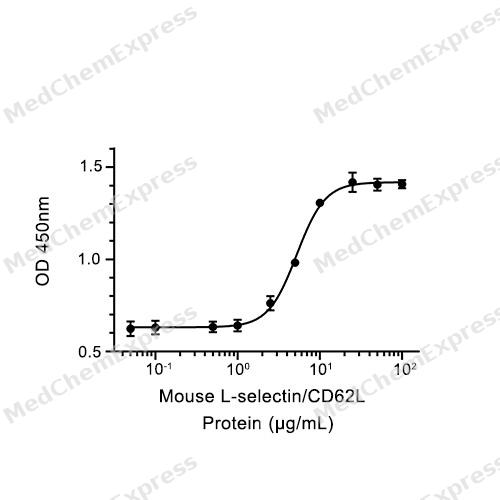
Bioactivity - Cell-Based Assay


Technical Parameters
-
Species Mouse
-
Source HEK293
-
Tag C-His
-
Accession
NP_035476.1 (W39-N332)
-
Molecular Construction
-
N-term
-
L-selectin/CD62L (D29-N332)
Accession # NP_035476.1 -
His
-
C-term
-
-
Protein Length
Extracellular Domain
-
Synonyms
SELL; Lymphocyte Adhesion Molecule 1; Prev. LYAM1; Gp90-MEL; Prev. LNHR; Lyam-1; L-Selectin; LECAM1; LAM-1; HLHRc; PLNHR; Leu-8; CD62L; TQ1; LSEL; Leukocyte Adhesion Molecule 1; LAM1; Pln Homing Receptor; Leukocyte-Endothelial Cell Adhesion Molecule 1; CD
-
AA Sequence
WTYHYSEKPMNWENARKFCKQNYTDLVAIQNKREIEYLENTLPKSPYYYWIGIRKIGKMWTWVGTNKTLTKEAENWGAGEPNNKKSKEDCVEIYIKRERDSGKWNDDACHKRKAALCYTASCQPGSCNGRGECVETINNHTCICDAGYYGPQCQYVVQCEPLEAPELGTMDCIHPLGNFSFQSKCAFNCSEGRELLGTAETQCGASGNWSSPEPICQVVQCEPLEAPELGTMDCIHPLGNFSFQSKCAFNCSEGRELLGTAETQCGASGNWSSPEPICQETNRSFSKIKEGDYN
-
Predicted Molecular Mass
34.7 kDa
-
Molecular Weight
Approximately 70-80 kDa, based on SDS-PAGE under reducing conditions, due to the glycosylation.
-
Glycosylation
Yes
-
Purity
≥ 95%, as determined by reducing SDS-PAGE.


Product Properties
Solution
Supplied as a 0.22 μm filtered solution of PBS, pH 7.4.
<1 EU/μg, determined by LAL method.
Stored at -80°C for 1 year from date of receipt. It is stable at -20°C for 3 months after opening. It is recommended to freeze aliquots at -80°C for extended storage. Avoid repeated freeze-thaw cycles.
Shipping with dry ice.


Documentation
-
Data Sheet (237 KB)
-
SDS (252 KB)
- English - EN (252 KB)
- Français - FR (252 KB)
- Deutsch - DE (252 KB)
- Norwegian - NO (252 KB)
- Español - ES (252 KB)
- Swedish - SV (252 KB)
- Italian - IT (252 KB)
- Korean - KR (252 KB)
- Portuguese - PT (252 KB)
-
Handling Instructions (2659 KB)

Calculators
Concentration (start) × Volume (start) = Concentration (final) × Volume (final)


 Powered by Bioz

