



Lipocalin-2/NGAL Protein, Human (HEK293, His)

Based on 1 Customer Validation
Lipocalin-2/NGAL is an iron transporter that plays a crucial role in various cellular processes. It interacts with the siderophore 2,3-DHBA to transport iron into or out of cells depending on cellular needs. Lipocalin-2/NGAL Protein, Human (HEK293, His) is the recombinant human-derived Lipocalin-2/NGAL protein, expressed by HEK293 , with C-6*His labeled tag.
- Species: Human
- Source: HEK293
-
Storage:Stored at -80°C for 1 year from date of receipt. It is stable at -20°C for 3 months after opening. It is recommended to freeze aliquots at -80°C for extended storage. Avoid repeated freeze-thaw cycles.


To place orders, for customer services and technical support, please contact: MedChemExpress USA
Tel: 609-228-6898 E-mail: [email protected] [email protected]


-
 Biological Activity
-
Technical Parameters
-
Product Properties
- Documentation
- Help & FAQs




Biological Activity
Description
Lipocalin-2/NGAL is an iron transporter that plays a crucial role in various cellular processes. It interacts with the siderophore 2,3-DHBA to transport iron into or out of cells depending on cellular needs. Lipocalin-2/NGAL Protein, Human (HEK293, His) is the recombinant human-derived Lipocalin-2/NGAL protein, expressed by HEK293 , with C-6*His labeled tag.
Background
Lipocalin-2/NGAL, an iron-trafficking protein, plays a pivotal role in diverse cellular processes, including apoptosis, innate immunity, and renal development. Through its interaction with the siderophore 2,3-dihydroxybenzoic acid (2,3-DHBA), bearing structural resemblance to bacterial enterobactin, Lipocalin-2/NGAL serves as a versatile mediator for the transport of iron into or out of cells, contingent on specific cellular requirements. The iron-bound form (holo-24p3) undergoes internalization upon binding to the SLC22A17 (24p3R) receptor, leading to the liberation of iron and a subsequent rise in intracellular iron concentration. Conversely, the association of the iron-free form (apo-24p3) with the SLC22A17 (24p3R) receptor initiates a cascade involving an intracellular siderophore, resulting in iron chelation and subsequent extracellular iron transfer, ultimately reducing intracellular iron levels. In the context of apoptosis induced by interleukin-3 (IL3) deprivation, the iron-loaded form augments intracellular iron concentration without triggering apoptosis, while the iron-free form diminishes intracellular iron levels, inducing the expression of the proapoptotic protein BCL2L11/BIM, thereby promoting apoptosis. Lipocalin-2/NGAL's involvement in innate immunity manifests as it restricts bacterial proliferation by sequestering iron bound to microbial siderophores, such as enterobactin. Furthermore, Lipocalin-2/NGAL exhibits the ability to bind siderophores from M.tuberculosis. Its structural arrangements include a monomeric state and a homodimer linked by disulfide bonds, as well as a heterodimeric form in association with MMP9.
Verified Bioactivity
1.Fully biologically active determined by the dose dependent decrease in SH-SY5Y cell number. The ED50 this effect is 0.1265 μg/mL, corresponding to a specific activity is 7.91×10³ units/mg.
2.Measured by its ability to bind Iron(III) dihydroxybenzoic acid [Fe(DHBA)3] in 30 min at 25°C. The binding of Fe(DHBA)3 results in the quenching of Trp fluorescence in 2μM NGAL. >1.5 µM of Fe(DHBA)3 can be bound.
MCE Validation Data
-
Purity - SDS-PAGE
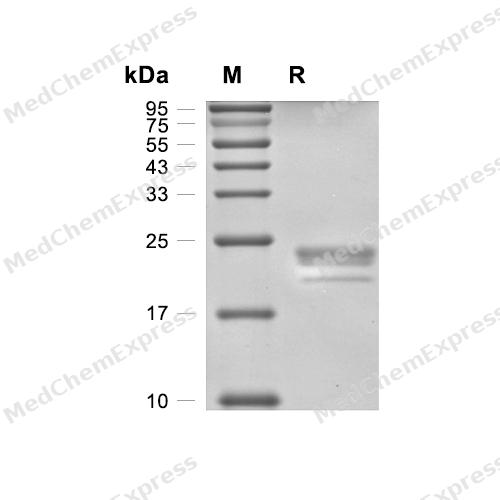
Purity - SDS-PAGE
-
Bioactivity - Cell-Based Assay
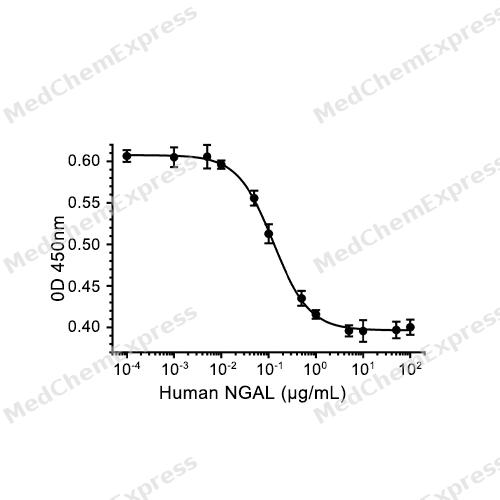
Bioactivity - Cell-Based Assay


Technical Parameters
-
Species Human
-
Source HEK293
-
Tag C-6*His
-
Accession
P80188-1 (Q21-G198)
-
Molecular Construction
-
N-term
-
NGAL (Q21-G198)
Accession # P80188-1 -
6*His
-
C-term
-
-
Protein Length
Full Length of Isoform-1
-
Synonyms
LCN2; P25; Lipocalin 2; Migration-Stimulating Factor Inhibitor; NGAL; Lipocalin 2 (Oncogene 24p3); Neutrophil Gelatinase-Associated Lipocalin; Siderocalin LCN2; Oncogene 24p3; Lipocalin-2; 24p3; MSFI; 25 KDa Alpha-2-Microglobulin-Related Subunit Of MMP-9;
-
AA Sequence
QDSTSDLIPAPPLSKVPLQQNFQDNQFQGKWYVVGLAGNAILREDKDPQKMYATIYELKEDKSYNVTSVLFRKKKCDYWIRTFVPGCQPGEFTLGNIKSYPGLTSYLVRVVSTNYNQHAMVFFKKVSQNREYFKITLYGRTKELTSELKENFIRFSKSLGLPENHIVFPVPIDQCIDG
-
Molecular Weight
Approximately 23 kDa, based on SDS-PAGE under reducing conditions.
-
Glycosylation
Yes
-
Purity
≥ 95%, as determined by reducing SDS-PAGE.


Product Properties
Solution
Supplied as a 0.2 μm filtered solution of PBS, 50% Glycerol, pH 7.4.
<1 EU/μg, determined by LAL method.
Stored at -80°C for 1 year from date of receipt. It is stable at -20°C for 3 months after opening. It is recommended to freeze aliquots at -80°C for extended storage. Avoid repeated freeze-thaw cycles.
Shipping with dry ice.


Documentation
-
Data Sheet (237 KB)
-
SDS (252 KB)
- English - EN (252 KB)
- Français - FR (252 KB)
- Deutsch - DE (252 KB)
- Norwegian - NO (252 KB)
- Español - ES (252 KB)
- Swedish - SV (252 KB)
- Italian - IT (252 KB)
- Korean - KR (252 KB)
- Portuguese - PT (252 KB)
-
Handling Instructions (2659 KB)

Calculators
Concentration (start) × Volume (start) = Concentration (final) × Volume (final)


 Powered by Bioz

